The aviation industry in India is experiencing unprecedented growth, creating exceptional opportunities for aspiring pilots. If you’ve ever dreamed of commanding an aircraft and soaring through the skies, understanding the pilot requirement is your first crucial step. This comprehensive guide explores everything you need to know about pilot requirements in India, pilot license requirements and commercial pilot requirements that will shape your aviation career.
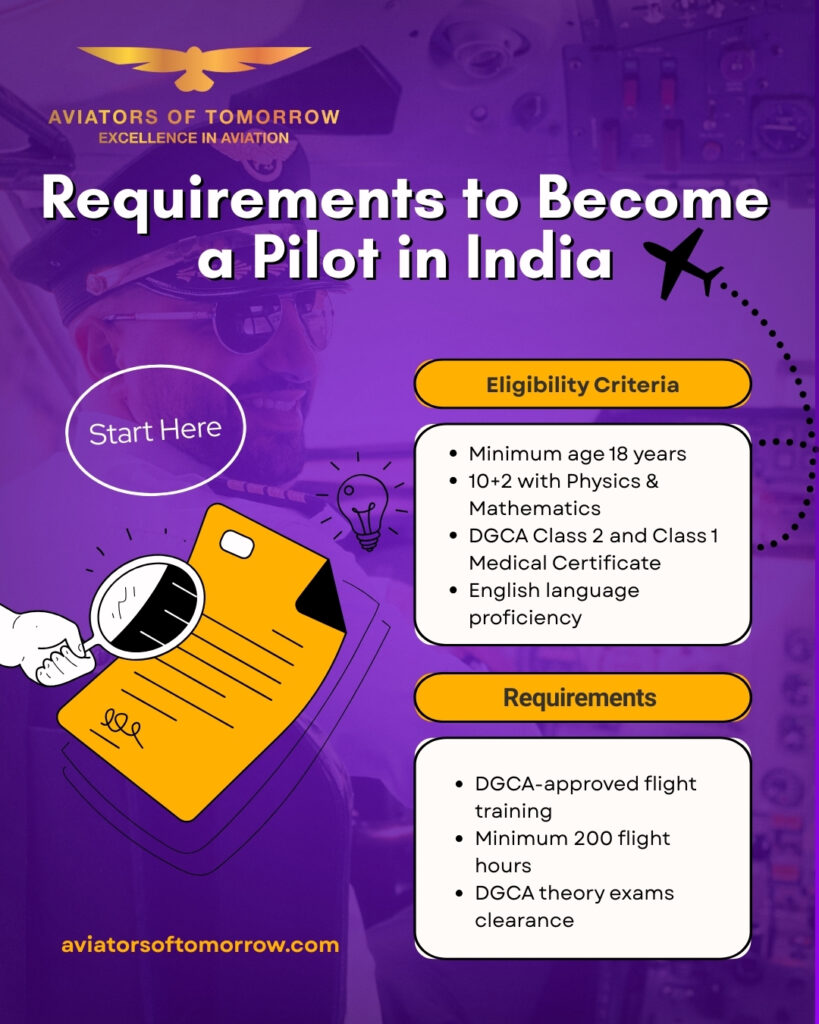
Table of Contents
Understanding Pilot Requirements: The Foundation of Your Aviation Career
The requirement to be a pilot in India is governed by the Directorate General of Civil Aviation (DGCA), which sets stringent standards to ensure safety and professionalism in Indian airspace. Whether you’re a fresh Class 12 graduate or someone considering a career switch, comprehending these pilot eligibility criteria is essential for planning your aviation journey effectively.
At Aviators of Tomorrow (AOT), we understand that navigating the complexities of becoming a pilot requirements can be overwhelming. As one of India’s premier aviation training requirements institutes, we provide comprehensive guidance through every stage of the licensing process, ensuring our students meet all DGCA pilot requirements while receiving world-class training.
Educational Requirements: Academic Foundation for Future Pilots
Minimum Educational Qualification
The fundamental pilot requirement regarding education mandates that candidates must have completed their 10+2 (Class 12) education from a recognized board. Here are the specific academic prerequisites for meeting pilot license requirements:
Subject Requirements:
- Physics (Mandatory)
- Mathematics (Mandatory)
- English (Mandatory)
The minimum passing percentage varies by training institution and cadet program, but most reputable flight training requirements demand at least 50-60% aggregate marks. Understanding these commercial pilot requirements early helps students prepare their academic foundation properly.
Options for Non-Science Students
A significant update in pilot requirements in India is the growing flexibility for students from Arts and Commerce backgrounds. If you didn’t study Physics and Mathematics in your Class 12, you can still meet pilot eligibility criteria through:
- National Institute of Open Schooling (NIOS)
- Private candidate examinations from recognised boards
- Bridge courses offered by aviation academies
This progressive change has made the requirement to be a pilot more accessible to students from diverse educational backgrounds, democratizing entry into this prestigious profession. These updated DGCA pilot requirements reflect the industry’s commitment to inclusivity.
Age Requirements: When Can You Start Your Pilot Training?
Understanding age-related pilot requirements in India is crucial for planning your timeline and meeting aviation training requirements:
Student Pilot License (SPL)
- Minimum Age: 16 years
- No flight experience required
- Foundation for all subsequent pilot license requirements
Private Pilot License (PPL)
- Minimum Age: 17 years
- Requires 40-50 hours of flight training requirements
- Allows non-commercial flying
Commercial Pilot License (CPL)
- Minimum Age: 18 years
- Mandatory for commercial operations
- Gateway to airline careers and core commercial pilot requirements
Airline Recruitment Age Limits
While DGCA doesn’t impose a maximum age for obtaining licenses as part of basic pilot requirements in India, airlines typically prefer candidates under 30-35 years for cadet programs. For experienced pilots with valid CPLs, age restrictions vary based on the specific role and aircraft type, making early career planning important for becoming a pilot.
Medical Fitness Requirements: Health Standards for Pilots
Medical fitness is a critical pilot requirement that ensures aviation safety. The DGCA mandates specific medical examinations as part of the comprehensive DGCA pilot requirements:
Class 2 Medical Certificate
Required before starting flight training, the Class 2 medical assessment is among the first pilot license requirements you’ll encounter:
Vision Requirements:
- Distant vision: 6/6 in each eye (with or without correction)
- Near vision: N5 at 30-50 cm
- Colour vision: Ability to identify aviation signal colours
- No progressive eye diseases
Hearing Standards:
- Ability to hear a conversational voice at 6 feet distance
- Tested in both ears separately
Cardiovascular Health:
- Normal blood pressure (typically below 140/90 mmHg)
- No history of significant heart conditions
- ECG may be required for older candidates
General Physical Fitness:
- BMI within an acceptable range
- No neurological disorders
- Mental and psychological stability
- No substance dependence
Do You Know?
DGCA Class 2 Medical is your entry ticket into pilot training, without it, flying can’t begin.For more information about DGCA Class 2 medical you may read our blog “DGCA Class 2 Medical 2026: Complete Guide“
Class 1 Medical Certificate
To hold a Commercial Pilot License, candidates must obtain the more stringent Class 1 medical certification, which represents higher-level commercial pilot requirements:
- Comprehensive cardiovascular evaluation
- Detailed neurological assessment
- Psychiatric evaluation
- Annual renewal requirement (every 6 months for pilots over 40)
The medical requirement to be a pilot is designed not as a barrier but as a safety measure. Most healthy individuals can meet these pilot eligibility criteria. At Aviators of Tomorrow, we provide medical guidance and connect students with DGCA-approved Aviation Medical Examiners to streamline this process and help you fulfil all aviation training requirements.
Do You Know?
Class 1 Medical is not just a formality, it can decide how fast or how delayed your pilot career becomes.For more information about DGCA Class 1 medical you may read our blog “DGCA Class 1 Medical: Complete Guide“
Once your DGCA Class 2 and 1 medical is approved, the next essential step is obtaining your DGCA Computer Number. This number is mandatory to book DGCA written exams and move ahead in the pilot licensing process. Many students miss this step or get confused about when and how to apply, so we’ve explained it in detail in our complete guide on DGCA Computer Number.
Flight Training Requirements: Building Your Flight Hours
Meeting the flight training requirements involves structured progression through various license levels, each with specific pilot requirements in India:
Student Pilot License (SPL)
- Gateway to formal flight training
- No flight hours required initially
- Validity: 5 years
- Allows solo flying under supervision
- First step in meeting pilot license requirements
Private Pilot License (PPL)
- Total Flight Hours: 40-50 hours minimum
- 20 hours dual instruction
- 20 hours solo flying
- Cross-country navigation experience
- Night flying experience
- Essential milestones in becoming a pilot requirements
Commercial Pilot License (CPL)
- Total Flight Hours: 200 hours minimum
- 100 hours as pilot-in-command
- 20 hours cross-country flight time
- 10 hours of instrument training
- Multi-engine rating (recommended)
- Culmination of core commercial pilot requirements
Do You Know?
Some pilot licences let you start flight training, while others decide when and how you’re allowed to fly, choosing the wrong one can delay your pilot career.For more information you may read our blog “Types of Pilot Licence: Your Complete Guide to Aviation Licenses“
Type Rating
After obtaining your CPL and meeting basic DGCA pilot requirements, you’ll need an aircraft-specific type rating:
- Duration: 2-3 months
- Cost: ₹12-25 lakhs
- Required for specific aircraft (A320, Boeing 737, etc.)
- Usually sponsored by airlines
- Final stage of flight training requirement.
Do You Know?
A Commercial Pilot Licence lets you fly, but without type rating, airlines won’t let you operate their aircraftFor more information about Type rating You may read our blog “Why Type Rating Is Important for Pilots“
Ground School Requirements: Theoretical Knowledge
The pilot requirement extends beyond practical flying to comprehensive theoretical knowledge, forming crucial aviation training requirements:
DGCA Theory Examinations
Students must pass six DGCA-mandated theory subjects as part of pilot license requirements:
- Air Navigation
- Charts and maps interpretation
- Navigation systems
- Flight planning
- Critical for meeting commercial pilot requirements
- Aviation Meteorology
- Weather patterns
- Meteorological phenomena
- Weather forecasting
- Safety-focused pilot eligibility criteria
- Air Regulations
- DGCA rules and regulations
- International aviation law
- Airspace classification
- Legal aspects of DGCA pilot requirements
- Aircraft Technical
- Aircraft systems
- Powerplant operations
- Instrument systems
- Technical flight training requirements
- Radio Telephony (RTR)
- Communication protocols
- Phraseology
- Emergency procedures
- Communication pilot requirements in India
At Aviators of Tomorrow, our ground school program is designed to ensure 100% success rate in DGCA examinations. We provide expert instructors, comprehensive study materials and regular mock tests to prepare students thoroughly for meeting all theoretical pilot requirements in India and aviation training requirements.
For more information about DGCA Ground Classes You may read our blog “DGCA Ground Classes: Complete Guide“
Language Proficiency Requirements
English proficiency is a mandatory requirement to be a pilot in India and forms part of the essential pilot eligibility criteria:
- ICAO Level 4 or above in English
- Ability to communicate effectively in aviation terminology
- Some cadet programs require IELTS certification for overseas training
- Comprehension of complex technical documentation
- Non-negotiable aspect of commercial pilot requirements
Strong communication skills are essential for radio communications, coordinating with air traffic control and ensuring safety in multinational flight operations, making language proficiency a critical component of pilot license requirements.
Do you know
A pilot can be grounded not for flying skills, but for failing to meet ICAO English proficiency standards.
For Knowing more information You may read our blog “How English Proficiency Impacts a Pilot’s Career“
Financial Requirements: Investment in Your Aviation Career
Understanding the financial aspect of pilot requirements in India helps in proper planning for becoming a pilot requirements:
Training Costs Breakdown
Complete CPL Training in India:
- Average Cost: ₹40-55 lakhs
- Includes ground school, flight hours, and examinations
- Varies based on aircraft type and location
- Complete fulfilment of flight training requirements
Overseas Training:
- Average Cost: ₹35-60 lakhs
- Additional DGCA conversion fees: ₹6-8 lakhs
- Better weather conditions allow faster completion
- Popular destinations: USA, Canada, South Africa
- Alternative path for meeting DGCA pilot requirements
Type Rating:
- Cost Range: ₹12-25 lakhs
- Duration: 2-3 months
- Often sponsored by airlines upon employment
- Final investment in commercial pilot requirements
Financial Planning Options
Meeting the financial requirement to be a pilot is achievable through various methods that support aviation training requirements:
- Education Loans: Many banks offer specialised aviation loans
- Airline Cadet Programs: Some airlines provide sponsored training
- Scholarships: Merit-based financial assistance from DGCA and private academies
- Instalment Plans: Flexible payment options at training institutes
Aviators of Tomorrow works with financial institutions to help students access competitive loan options, making pilot license requirements financially accessible to deserving candidates.
Start Your Pilot Journey the Right Way
Fill the form below to get a FREE one-to-one pilot eligibility assessment.
Your aviation journey starts with clarity.
Stand a chance to win 100% scholarship & start training with India’s trusted aviation institute. Apply & Check Eligibility.
Apply Now!Documentation Requirements: Essential Paperwork
Proper documentation is a crucial pilot requirement often overlooked by aspiring aviators pursuing pilot requirements:
Mandatory Documents for Pilot License Requirements
- Educational Certificates
- Class 10 marksheet and certificate
- Class 12 marksheet and certificate
- Equivalency certificate (for international qualifications)
- Proof of meeting the educational pilot eligibility criteria
- Identity Proofs
- Valid Indian passport (mandatory for DGCA pilot requirements)
- Aadhaar card
- PAN card
- Medical Certificates
- DGCA Class 1 Medical Certificate
- Regular renewal documentation
- Core health-related pilot requirements in India
- Police Verification
- Character certificate
- Background verification clearance
- Security aspect of commercial pilot requirements
- Photographs
- Passport-size photographs
- Specific format as per DGCA requirements
International Training Documents
For students planning overseas training as part of their flight training requirements, additional pilot requirements in India include:
- Student visa for the training country
- Proof of financial capability
- Insurance documentation
- Foreign license conversion paperwork
- Additional aviation training requirements for international programs
Specialised Pilot Career Requirements
Different aviation career paths have varying requirement to be pilot specifications and unique pilot eligibility criteria:
Airline Cadet Programs
Major airlines like Air India, IndiGo and Akasa Air have specific commercial pilot requirements:
Air India Cadet Pilot Programme:
- Age: 18-30 years
- 60% in Class 12 (Physics, Mathematics, English)
- DGCA Class 1 medical fitness
- Must be a citizen of India or OCI
- Shall demonstrate good command of written and spoken English
- Candidates should be in good physical and mental health.
IndiGo Cadet Program:
- Age: 18-35 years
- Strong English communication
- 51% in Class 12 (Physics, Mathematics, English)
- Valid DGCA Class 1 medical certificate
- Candidates can apply using Class 2 Medicals; however, they must have an Indian DGCA Class 1 Medical certificate at the time of signing the IndiGo cadet pilot agreement (to avoid delays in start of training or monetary loss in case of rejection by the medical board at a later stage).
- The candidate must be an Indian National or an Overseas Citizen of India (OCI) card holder
Helicopter Pilot Requirements
For those interested in rotary-wing aviation, the requirement to be a pilot includes specialised flight training requirements:
- Same basic educational qualifications
- Additional helicopter rating after PPL or CPL
- 40-50 hours helicopter-specific training
- Different medical considerations (no colour blindness tolerance)
- Unique commercial pilot requirements for rotary-wing operations
Continuous Learning Requirements: Beyond Initial Licensing
The pilot requirements in India don’t end with obtaining your CPL. Professional pilots must maintain ongoing aviation training requirements:
Airline Transport Pilot License (ATPL)
The highest level of pilot license requirements demands:
- Minimum Flight Hours: 1,500 hours
- Command experience
- Advanced theoretical examinations
- Mandatory for captains on commercial flights
- Pinnacle of commercial pilot requirements
Recurrent Training
Professional pilots must maintain currency through ongoing DGCA pilot requirements:
- Simulator training (every 6 months)
- Line checks
- Medical certificate renewals
- License revalidation
- Instrument rating renewals
- Continuous flight training requirements
Type Rating Renewals
Aircraft-specific qualifications require regular updates to maintain pilot eligibility criteria:
- Regular simulator sessions
- Proficiency checks
- Validity periods vary by aircraft type
Pilot Salary in India
- Trainee Pilot: ₹50,000 – ₹80,000 per month
- First Officer / Co-Pilot: ₹1.5 lakh – ₹3 lakh per month
- Captain: ₹3 lakh – ₹6 lakh per month (can increase for international airlines)
Factors affecting salary
- Airline (e.g., IndiGo, Air India)
- Aircraft type (A320, B737, etc.)
- Experience & flying hours
Aviators of Tomorrow: Meeting Requirements with Excellence
At Aviators of Tomorrow (AOT), we’ve designed our programs to help students not just meet but exceed pilot requirements in India, commercial pilot requirements and all aviation training requirements. Here’s how we stand apart:
Comprehensive Training Infrastructure
- Modern Fleet: Well-maintained and advanced simulators for all training requirements
- Advanced Simulators: Realistic training environments
- DGCA-Approved Curriculum: Fully compliant with all DGCA pilot requirements
- Expert Instructors: Experienced pilots and educators who understand pilot license requirements
Holistic Student Support
- Medical Guidance: Assistance with DGCA medical examinations and pilot eligibility criteria
- Documentation Support: Help with paperwork and applications for becoming a pilot requirements
- Financial Counselling: Loan facilitation and payment planning
- Career Placement: Airline preparation and recruitment support
International Opportunities
Understanding that pilot requirements in India can be complemented by global experience, AOT offers:
- Partnerships with international flight schools
- Guidance on foreign license conversions
- Global airline placement assistance
- International exposure programs
- Alternative paths for aviation training requirements
Ground School Excellence
Our ground school program ensures students master all theoretical requirements to be a pilot and the pilot license requirements:
- Experienced faculty with airline backgrounds
- Comprehensive study materials covering all commercial pilot requirements
- Regular assessment and feedback
- 100% DGCA exam success focus
- Modern teaching methodologies for DGCA pilot requirements
Step-by-Step Process: Your Journey at AOT
Meeting all pilot requirements in India and flight training requirements through Aviators of Tomorrow follows this streamlined process:
Phase 1: Enrollment and Eligibility (Month 1)
- Initial consultation and career counselling on pilot eligibility criteria
- Verification of educational qualifications for pilot license requirements
- Medical examination scheduling
- Documentation compilation for DGCA Class 2 and Class 1 medical.
- Course selection and enrollment
Phase 2: Ground School (Months 2-6)
- Theoretical subject training covering aviation training requirements
- DGCA examination preparation
- Aviation English proficiency development
- Simulator introduction
- Theory examinations meeting commercial pilot requirements
Phase 3: Flight Training (Months 7-18)
- Pre-solo flying to meet initial flight training requirements
- Solo flights
- Cross-country navigation
- Instrument training
- Multi-engine training satisfying pilot requirements in India
- Night flying experience
Phase 4: Licensing and Beyond (Months 19-24)
- DGCA skill tests validating the requirement to be a pilot completion
- License application and issuance
- Type rating training
- Airline interview preparation
- Placement assistance
Common Challenges in Meeting Pilot Requirements
Understanding potential obstacles in fulfilling pilot requirements in India and becoming a pilot helps in preparation:
Medical Concerns
Some candidates face challenges with pilot eligibility criteria. Our advice:
- Consult with aviation medical examiners early
- Address correctable issues proactively
- Understand special issuance possibilities
- Maintain overall fitness throughout training
- Stay updated on changing DGCA pilot requirements
Financial Constraints
The investment in aviation training requirements can be substantial. Solutions include:
- Early financial planning for pilot license requirements
- Exploring all loan options
- Considering airline-sponsored cadet programs
- Part-time work opportunities (where permitted)
- Scholarship applications for commercial pilot requirements
Academic Gaps
Students without Physics/Mathematics can still meet pilot requirements in India:
- Complete NIOS examinations
- Take bridge courses
- Allow extra preparation time
- Seek academic support services
- Alternative pathways to fulfil the requirement to be a pilot
Time Management
Balancing flight training requirements intensity requires:
- Commitment to full-time study
- Proper scheduling
- Realistic timeline expectations
- Family support and understanding
- Dedication to meeting DGCA pilot requirements
Future of Pilot Requirements in India
The aviation regulatory landscape is evolving. Anticipated changes in pilot requirements in India and pilot license requirements include:
Regulatory Updates
- Possible relaxation for non-science students in the pilot eligibility criteria
- Enhanced simulator training credits for flight training requirements
- Digital medical certification processes
- Streamlined licensing procedures for commercial pilot requirements
- Updated DGCA pilot requirements reflecting modern aviation needs
Industry Growth
India’s aviation sector is projected to be the third-largest globally by 2030, creating:
- Increased pilot demand (estimated 10,000+ new pilots needed)
- More training capacity for aviation training requirements
- Enhanced career opportunities
- Better starting salaries
- Expanded requirement to be pilot pathways
Technology Integration
Future requirements to be a pilot and pilot license requirements may incorporate:
- Advanced simulator training reduces traditional flight training requirements
- Virtual reality applications
- AI-assisted learning platforms
- Digital skill assessments
- Modernised commercial pilot requirements
Do You Know?
There is no single pilot entrance exam after 12th in India.
Becoming a pilot depends on DGCA eligibility, medical fitness and academy or airline selection, not one exam.For more information you may read our blog “How to Give Pilot Entrance Exam After 12th“
Conclusion: Your Aviation Journey Starts Here
Understanding and meeting pilot requirements in India, pilot license requirements, commercial pilot requirements and comprehensive aviation training requirements is the foundation of a successful aviation career. From educational qualifications and medical fitness to flight training requirements and theoretical knowledge, each requirement to be a pilot serves a crucial purpose in creating safe, competent and professional aviators.
The pathway may seem challenging, but with proper guidance, dedication and the right training partner, your dream of fulfilling the requirements to become a pilot is entirely achievable. The pilot requirement framework, including stringent DGCA pilot requirements and pilot eligibility criteria, is designed not to discourage but to ensure that only the most prepared and capable individuals take command of aircraft.
At Aviators of Tomorrow (AOT), we’re committed to transforming aviation dreams into reality. Our comprehensive programs address every aspect of pilot requirements in India, commercial pilot requirements, flight training requirements and all aviation training requirements, providing students with:
- World-class training infrastructure meeting all DGCA pilot requirements
- Expert guidance through every pilot license requirements stage
- Complete documentation and medical support for pilot eligibility criteria
- Financial assistance and career placement
- International exposure and opportunities
The sky is not the limit, it’s just the beginning. Whether you’re fresh out of Class 12, a working professional seeking a career change, or someone who’s always dreamed of flying, understanding and fulfilling pilot requirements in India and the complete requirements to be a pilot is your first step toward an extraordinary career.
Ready to Become a Professional Pilot?
You’ve understood the pilot requirements in India, now it’s time to take action.
At Aviators of Tomorrow (AOT), we guide you through every step, from eligibility and DGCA medicals to flight training, licensing and airline preparation
Stand a chance to win 100% scholarship & start training with India’s trusted aviation institute. Apply & Check Eligibility.
Apply Now!