Modern aircraft rely heavily on automation to ensure safe, efficient and predictable flight operations. One of the most important systems supporting this automation is Vertical Navigation (VNAV). Understanding how VNAV works is essential for pilots, aviation engineers and aviation students who want to operate confidently in modern glass cockpit aircraft.
At Aviators Of Tomorrow, we focus on explaining advanced aviation technologies in a practical and professional way. This VNAV System Technical Guide explores how vertical navigation functions, why it is critical to modern flight operations and how aviation professionals can use it effectively.
This VNAV System Technical Guide is essential for pilots and aviation students to understand modern flight automation.
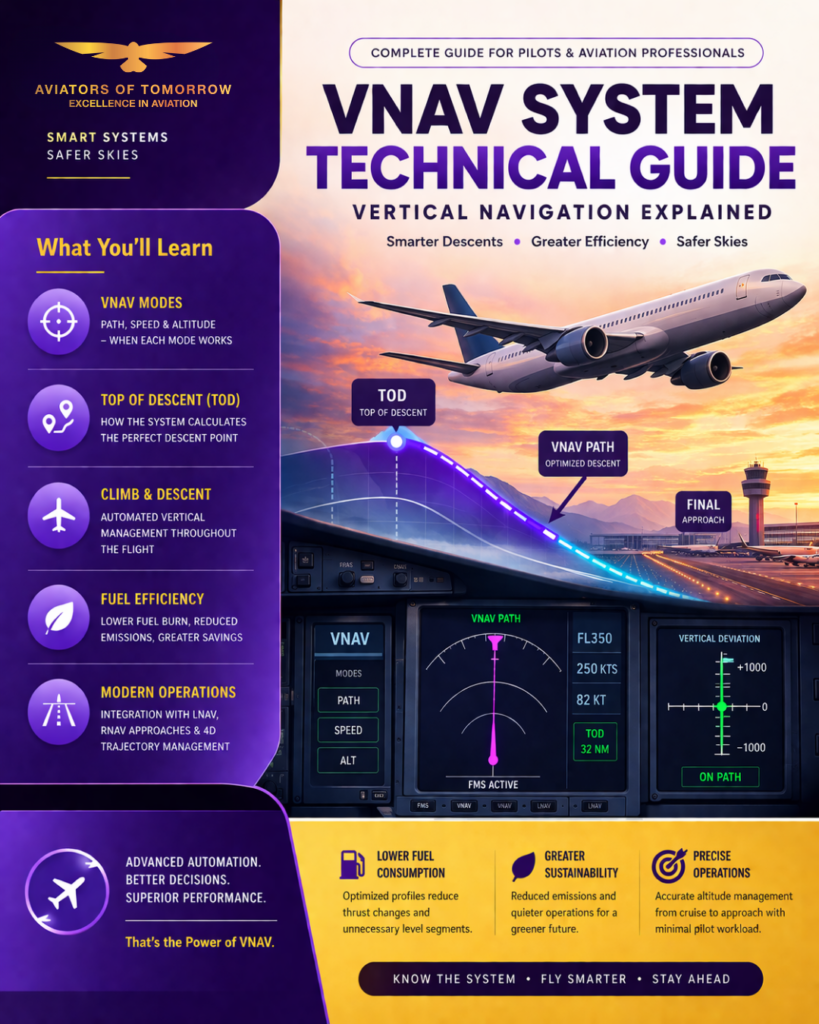
Table of Contents
VNAV System Technical Guide: What Is Vertical Navigation?
Understanding Vertical Navigation
Vertical Navigation, commonly referred to as VNAV, is a feature within the Flight Management System (FMS) that automatically manages an aircraft’s vertical flight profile.
Instead of pilots manually controlling climb and descent throughout the flight, VNAV calculates and follows the most efficient vertical path based on multiple operational factors.
These factors include:
- Aircraft performance data
- Aircraft weight and fuel load
- Wind conditions
- Flight plan altitude constraints
- Airspace restrictions
- Speed limitations
By continuously analysing these parameters, the system determines when the aircraft should climb, level off or descend, significantly reducing pilot workload while improving flight efficiency.
VNAV System Technical Guide: Core Modes Explained
In this VNAV System Technical Guide, understanding VNAV modes is critical for managing climb and descent. VNAV operates through several operational modes that allow the aircraft to maintain the programmed vertical profile throughout the flight.
VNAV PATH Mode
Precision Descent Management
VNAV PATH mode is primarily used during descent.
In this mode, the autopilot follows a pre calculated vertical path created by the Flight Management System. The aircraft automatically adjusts pitch and thrust in order to remain on the programmed descent profile.
This mode ensures:
- Smooth descent profiles
- Accurate altitude management
- Reduced fuel consumption
VNAV PATH is commonly used during continuous descent operations where the aircraft descends smoothly without unnecessary level segments.
VNAV SPEED Mode
Speed Priority Control
VNAV SPEED mode is activated when the aircraft cannot maintain the programmed vertical path due to operational limitations.
Situations that may trigger VNAV SPEED include:
- Insufficient engine thrust
- Strong headwinds
- Unexpected atmospheric conditions
In this mode, the system prioritises maintaining the target airspeed, even if the aircraft temporarily deviates from the calculated vertical profile.
VNAV ALTITUDE Mode
Level Off Protection
VNAV ALT mode is used when the aircraft reaches a temporary altitude restriction or needs to maintain a specific level before continuing the climb or descent.
This mode is common during:
- Step climbs in cruise
- Step descents in controlled airspace
- Air Traffic Control altitude restrictions
The autopilot holds the aircraft at the required altitude until the system receives clearance to continue the vertical profile.
VNAV System Technical Guide: Top of Descent (TOD)
Understanding the TOD Calculation
One of the most important calculations performed by VNAV is the Top of Descent (TOD).
The TOD is the precise point where the aircraft must begin descending in order to reach the required altitude at the correct position and speed. This VNAV System Technical Guide explains how TOD ensures precise descent planning.
The Flight Management System calculates this point using several variables:
- Current cruise altitude
- Target altitude at arrival or waypoint
- Required descent gradient
- Airspace speed restrictions
- Real time wind data
If the aircraft passes the TOD without initiating descent, it may require steeper descent angles, increased engine thrust changes or intervention from air traffic control.
Proper VNAV monitoring ensures that the aircraft remains on its optimal descent path.
Efficient flying starts with smart navigation.
Stand a chance to win 100% scholarship & start training with India’s trusted aviation institute. Apply & Check Eligibility.
Apply Now!VNAV During Different Phases of Flight
VNAV During Climb
According to this VNAV System Technical Guide, VNAV ensures efficient climb performance. During the climb phase, VNAV automatically manages the aircraft’s ascent while balancing performance limits and regulatory speed restrictions.
Below 10,000 feet, the system typically maintains the 250-knot speed restriction commonly applied in controlled airspace. Once above this altitude, the system transitions to the programmed climb speed schedule.
Benefits during climb include:
- Reduced pilot workload during departure
- Accurate compliance with speed restrictions
- Optimised climb performance
VNAV During Descent
This VNAV System Technical Guide highlights how VNAV enables smooth and fuel-efficient descent. The descent phase is where VNAV provides some of its most valuable operational benefits.
Using programmed arrival procedures, the system calculates an efficient Continuous Descent Approach (CDA).
This descent profile offers several advantages:
- Lower fuel consumption
- Reduced aircraft noise
- Lower carbon emissions
- Smooth altitude transitions
VNAV often uses a descent profile close to three degrees, which is considered the most efficient and stable descent angle for most transport aircraft.
VNAV, Cockpit Automation and Modern Navigation
Integration with LNAV
VNAV is typically used alongside Lateral Navigation (LNAV).
While LNAV controls the horizontal flight path, VNAV manages the vertical profile. When both systems operate together, the aircraft follows a fully automated trajectory through both lateral and vertical dimensions.
This capability forms the basis of four dimensional navigation, where the aircraft follows a precise route while meeting altitude and time constraints. This VNAV System Technical Guide also explains the integration of VNAV with LNAV for complete navigation control.
Baro VNAV Approaches
VNAV technology also enables Barometric VNAV approaches, often referred to as Baro VNAV.
These procedures are used on RNAV (GPS) instrument approaches where an Instrument Landing System (ILS) is not available.
Baro VNAV uses the aircraft’s barometric altitude system to provide vertical guidance during approach, allowing aircraft to fly stable descent profiles even at airports without traditional precision approach infrastructure.
Fuel Efficiency and Environmental Benefits
One of the most significant advantages of VNAV is its ability to improve fuel efficiency.
Optimised vertical profiles reduce unnecessary thrust adjustments and level segments during descent. Studies across multiple airline operations show that effective VNAV usage can reduce fuel consumption by approximately 3–8 percent compared with manually managed vertical profiles. As described in this VNAV System Technical Guide, VNAV improves fuel efficiency and reduces emissions.
Across global airline fleets, this leads to:
- Significant reductions in jet fuel consumption
- Lower airline operating costs
- Reduced carbon dioxide emissions
- Lower noise exposure around airports
Efficient VNAV operations therefore contribute both to economic efficiency and environmental sustainability.
VNAV Best Practices and Common Errors
Common Errors to Avoid
This VNAV System Technical Guide recommends proper monitoring to avoid common VNAV errors. Even with advanced automation, VNAV requires careful monitoring.
Common mistakes include:
- Incorrect cruise altitude entries in the FMS
- Missing altitude constraints in the flight plan
- Failing to update aircraft performance data after load changes
- Passing the Top of Descent without initiating descent
Such errors can result in altitude deviations or inefficient flight profiles.
VNAV Best Practices
Professional flight crews apply several best practices when operating VNAV systems:
Cross Check Vertical Deviation
Regularly monitor the Vertical Deviation Indicator (VDI) to ensure the aircraft remains on the programmed descent path.
Anticipate ATC Instructions
Air traffic control may issue altitude or speed restrictions that require temporary deviations from the VNAV profile.
Review Approach Procedures
Before instrument approaches, pilots should review VNAV behaviour for both normal and non normal scenarios.
Monitor Aircraft Energy State
Tracking airspeed trends and thrust settings helps ensure the aircraft remains within the desired energy envelope.
The Future of VNAV Technology
VNAV technology continues to evolve as flight management systems become more advanced.
One major development is 4D trajectory management, where aircraft must meet Required Time of Arrival (RTA) constraints at specific waypoints.
Advanced flight management systems can adjust speed and vertical profiles dynamically in order to reach these waypoints within narrow time windows.
Another emerging development is the integration of artificial intelligence and predictive analytics within flight management systems. These technologies analyse historical flight data and real time weather conditions to optimise vertical navigation even further.
At Aviators Of Tomorrow, these innovations represent the next stage of intelligent flight operations.
You May Read Our Blog “TCAS System: Understanding the Guardian of Aircraft Safety in Modern Aviation“
Final Thoughts: VNAV Knowledge and Aviation Standards
Vertical Navigation has become a fundamental component of modern aviation operations. From climb management and precise descent planning to advanced RNAV approaches, VNAV plays a vital role in ensuring safe and efficient flights.
For aviation professionals, understanding VNAV is not simply a technical advantage but an operational requirement in today’s highly automated cockpit environment.
As aviation continues to evolve, regulatory bodies such as the Directorate General of Civil Aviation (DGCA) emphasise strong theoretical knowledge of modern flight management systems during aviation training and licensing standards. A clear understanding of automation systems like VNAV is therefore essential for professionals working within the regulated aviation framework. At Aviators Of Tomorrow, our mission is to simplify complex aviation technologies and make them accessible for the next generation of aviation professionals. By mastering systems such as VNAV, aviation specialists can operate with greater confidence, precision and efficiency in the increasingly advanced world of modern flight operations.
Master VNAV, master the skies.
Stand a chance to win 100% scholarship & start training with India’s trusted aviation institute. Apply & Check Eligibility.
Apply Now!