Understanding the angle of attack is essential for anyone who wants to learn how aircraft fly. Whether you are preparing for flight training, studying aviation theory or exploring aerodynamics basics, this single concept explains lift generation, aircraft performance and stall behaviour more clearly than any other principle.
Many aviation incidents occur not because of engine failure or lack of airspeed, but due to improper angle of attack management. This article explains the concept in depth, using simple language while maintaining technical accuracy for students, pilots and aviation enthusiasts.
Table of Contents
What Is the Angle of Attack in Aviation?
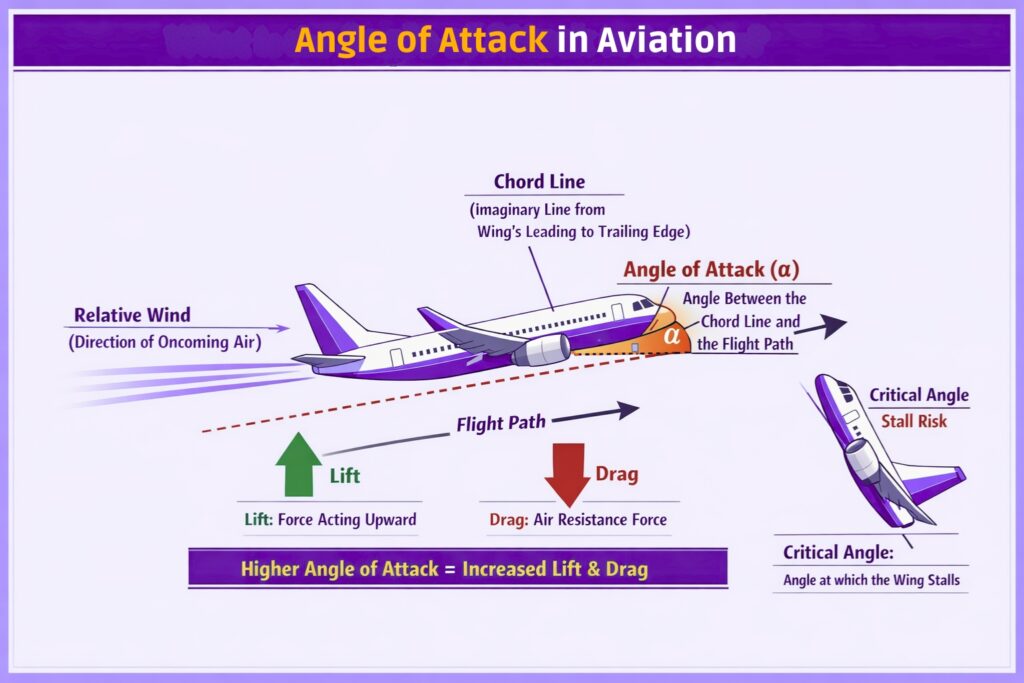
In aviation, angle of attack (AOA) refers to the angle formed between the wing’s chord line and the relative wind, which is the direction of airflow opposite the aircraft’s movement through the air.
This angle determines how efficiently the wing produces lift. It is important to understand that the angle of attack is independent of airspeed and not the same as pitch attitude, which is a common misunderstanding among beginners.
An aircraft can fly safely at low or high speed as long as the wing remains below its critical angle of attack.
Why Angle of Attack Matters More Than Speed
Aircraft lift is governed by four main factors:
- Wing area
- Air density
- Airspeed
- Lift coefficient
The lift coefficient changes directly with the angle of attack. This means pilots can increase lift without increasing speed simply by increasing the angle between the wing and the airflow.
This principle is especially important during:
- Takeoff
- Landing
- Slow flight
- Steep turns
Focusing only on airspeed can be misleading. The wing does not stall because speed is low; it stalls because the angle of attack becomes too high.
How Aircraft Wings Generate Lift
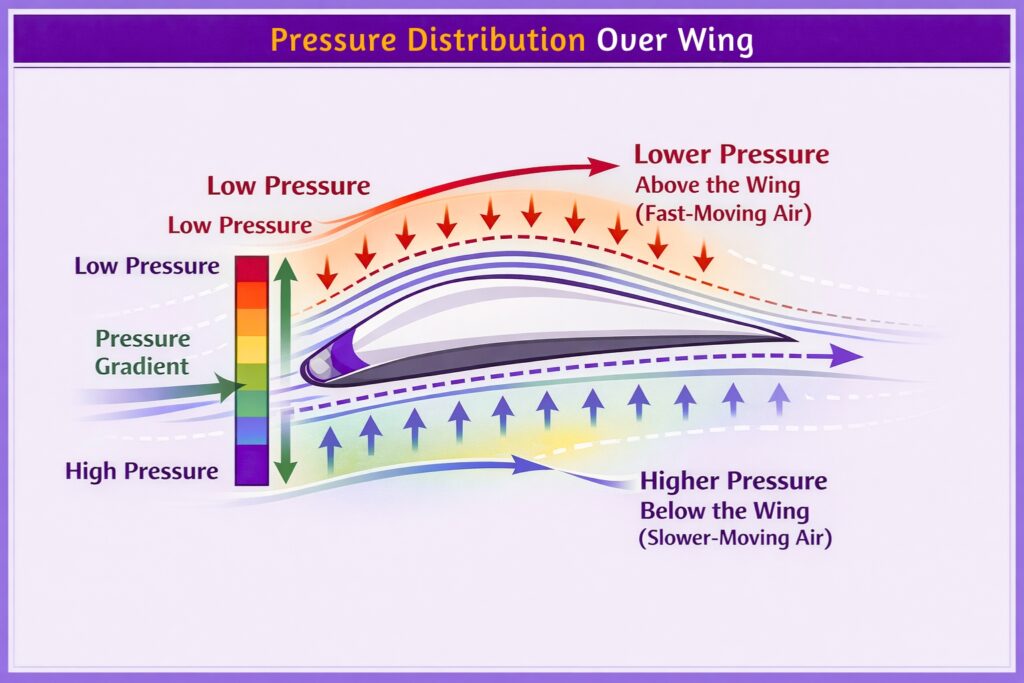
When a wing meets the airflow at a positive AOA:
- Air accelerates over the upper surface
- Pressure above the wing decreases
- Higher pressure remains below the wing
This pressure difference produces lift perpendicular to the relative wind.
As the angle of attack increases:
- Lift increases
- Drag also increases
However, there is a limit to how much lift a wing can produce. Once this limit is reached, the airflow can no longer remain smooth, leading to a stall.
Critical Angle of Attack and Aircraft Stall
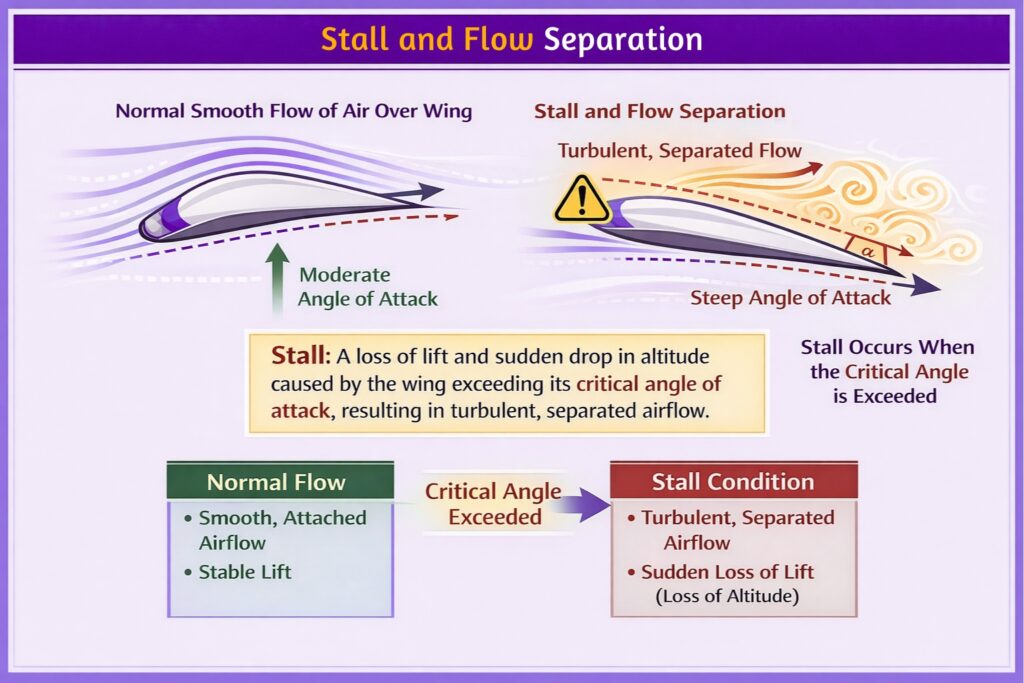
Every wing has a critical AOA, usually between 15 and 20 degrees for most conventional aircraft.
When this angle is exceeded:
- Smooth airflow separates from the wing
- Lift decreases sharply
- The aircraft enters a stall
Key Safety Principle:
A stall can occur at any airspeed, altitude or aircraft attitude. The only cause of a stall is exceeding the critical angle of attack.
This is why stall speed changes with weight, bank angle and configuration, but the critical AOA remains constant.
Recognising an Approaching Stall
Pilots are trained to identify early stall warning signs, including:
- Aircraft buffeting
- Reduced control effectiveness
- Sluggish control response
- Activation of stall warning systems
Modern aircraft are equipped with sensors that monitor the AOA and provide visual or audible warnings before a stall occurs.
Angle of Attack vs Pitch Attitude
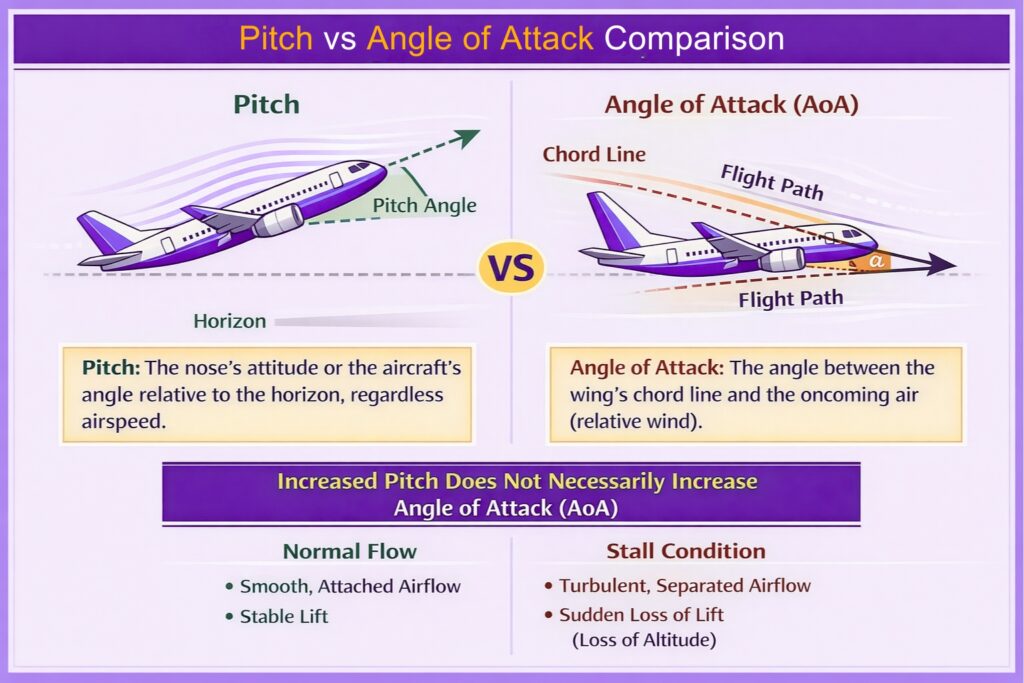
One of the most important distinctions in flight training is understanding the difference between AOA and pitch attitude.
Pitch Attitude:
- Angle between the aircraft’s longitudinal axis and the horizon
- What the pilot visually observes
Angle of Attack:
- Angle between the wing and the airflow
- Determines lift and stall behaviour
An aircraft can have:
- A high-pitch attitude with a low AOA
- A low-pitch attitude with a high AOA
This explains why aircraft can stall in turns or during climb, even when the nose does not appear excessively high.
Angle of Attack Indicators
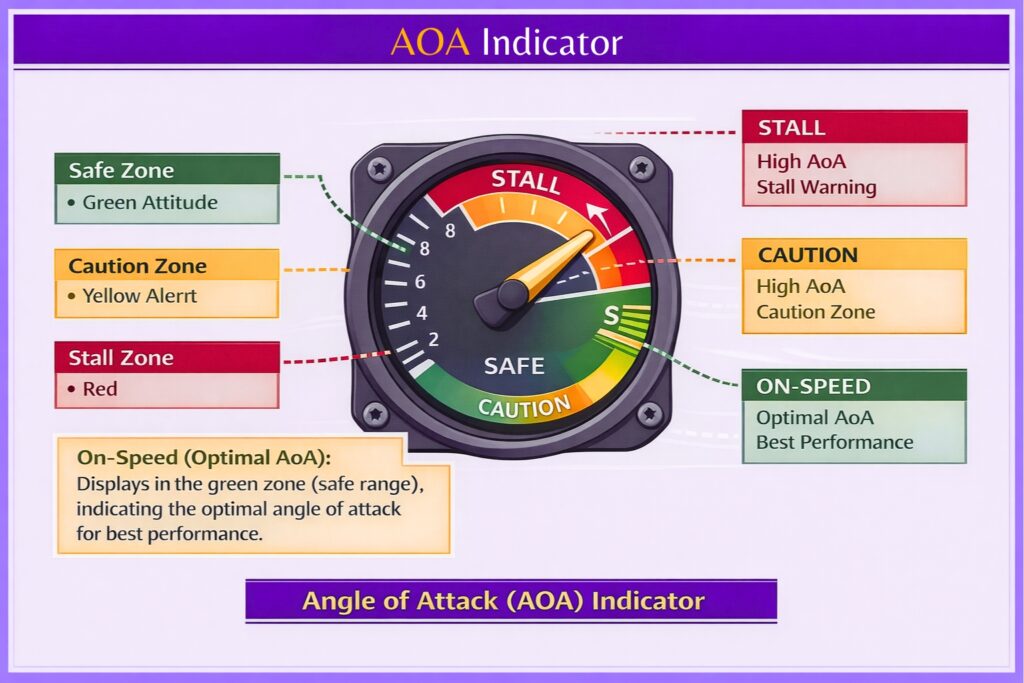
An angle of attack indicator provides real-time information about how close the wing is to its critical angle.
Unlike airspeed indicators, which vary with aircraft weight and loading, AOA indicators remain accurate under all conditions.
These systems help pilots:
- Prevent stalls
- Optimise approach speeds
- Improve landing consistency
- Enhance overall flight safety
Angle-based awareness is increasingly emphasised in modern flight training programs.
Fill out the form below and get expert consultation on DGCA exams, flight training, and aviation career planning.
Stand a chance to win 100% scholarship & start training with India’s trusted aviation institute. Apply & Check Eligibility.
Apply Now!How Angle of Attack Is Measured
Aircraft measure AOA using:
- Vane-type sensors aligned with airflow
- Pressure-based probes
- Integrated flight control sensors
Modern aircraft use multiple sensors for redundancy. Data from these sensors is used for:
- Stall warning systems
- Flight envelope protection
- Autopilot and fly-by-wire logic
Experienced pilots also learn to recognise AOA indirectly through control feel, aircraft response and visual cues.
Lift Coefficient and Its Relationship to AOA
The lift coefficient represents how efficiently a wing generates lift at a given AOA.
Key characteristics:
- Increases steadily at low angles
- Peaks near the critical angle
- Drops sharply after stall
High lift devices, such as flaps, increase the lift coefficient by changing the wing’s shape. This allows aircraft to fly safely at slower speeds during approach and landing.
Wing Design and Angle of Attack Behaviour
Different wing designs respond differently to changes in AOA.
Cambered Wings:
- Common on transport and training aircraft
- Produce lift at lower angles
- Provide gentle stall characteristics
Symmetrical Wings:
- Used on aerobatic aircraft
- Require a positive AOA to produce lift
- Perform equally well upright and inverted
Aspect ratio, airfoil thickness and wing shape all influence how a wing behaves near stall.
AOA During Different Phases of Flight
Takeoff:
- Increasing the AOA generates lift
- Rotation raises the wing’s effective angle
Climb:
- Higher AOA than cruise
- Increased drag
- Optimised for excess power
Cruise:
- Small =AOA
- Maximum fuel efficiency
- Best lift-to-drag ratio
Approach and Landing:
- Precise AOA control
- Too high an AOA increases stall risk
- Too low an AOA increases landing distance
Managing the AOA correctly during landing is one of the most important pilot skills.
Environmental Effects on AOA
Altitude and Temperature:
- Reduced air density
- Higher true airspeed required
- The same critical angle applies
Icing Conditions:
- Alters the wing shape
- Reduces the critical AOA
- Increases stall risk
Turbulence:
- Causes rapid airflow direction changes
- Momentarily increases the AOA
- Requires additional speed margin
Pilots must adjust operating techniques based on these conditions.
AOA in Flight Training
Flight training programs emphasise:
- Angle awareness over speed fixation
- Stall recognition and recovery
- Energy management
- Safe slow flight techniques
Simulator training allows pilots to practice high-angle situations safely, improving real-world stall avoidance skills.
Advanced Use of Angle of Attack in Modern Aircraft
Modern aircraft rely heavily on AOA data for:
- Flight envelope protection
- Automatic stall prevention
- Fly-by-wire flight control systems
Some advanced aircraft can safely operate beyond traditional stall angles using thrust vectoring and computerised control laws.
Future aircraft designs may further optimise AOA through adaptive wings and artificial intelligence.
Why Angle of Attack Is Fundamental to Safe Flying
Angle of attack explains:
- How aircraft generate lift
- Why stalls occur
- Why pitch can be misleading
- How pilots control performance
Pilots who understand and manage the angle of attack correctly:
- Fly more efficiently
- Reduce accident risk
- Maintain better aircraft control
You may also read our blog about “Complete Guide to Pilot Requirements in India: Your Pathway to Aviation Excellence“
Conclusion
Angle of attack is the foundation of aerodynamics and aircraft control. While airspeed, altitude and power all matter, it is the wing’s angle relative to the airflow that ultimately determines lift and safety.
A clear understanding of the AOA transforms flying from a mechanical activity into an informed, controlled process. As aviation technology evolves, this principle remains unchanged and continues to be the cornerstone of safe, efficient flight.
Fill out the form now and get a free career counselling session with our aviation experts.
Stand a chance to win 100% scholarship & start training with India’s trusted aviation institute. Apply & Check Eligibility.
Apply Now!