If you’ve dreamed of a commercial cockpit career, you’ve probably encountered a mountain of conflicting information online. Many aspiring pilots hear myths that make the journey seem confusing or even impossible. The truth is that with the right information and preparation, becoming a commercial pilot is achievable for many motivated individuals. CPL flying training in India is one of the most structured pathways for students who want to build a career in aviation.
Here, we separate the most common myths about CPL flying training and replace them with clear facts.
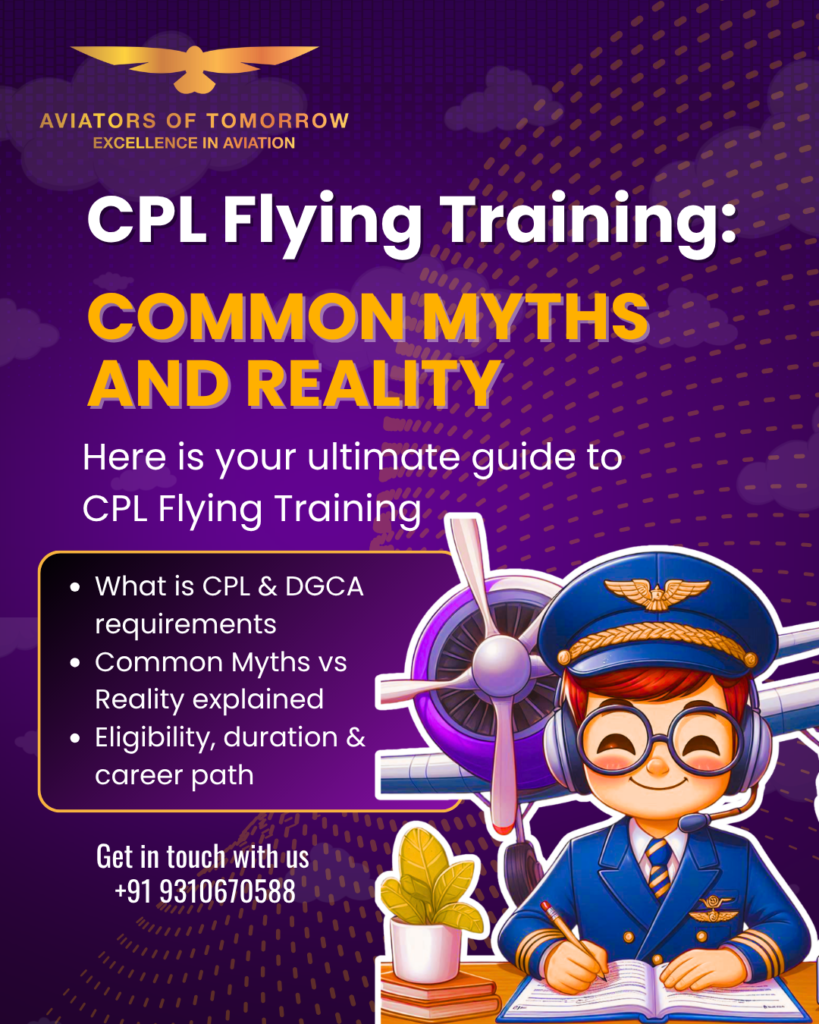
Table of Contents
What Is CPL Flying Training?
A Commercial Pilot Licence (CPL) allows a pilot to be paid for flying aircraft professionally. It sits above the Private Pilot Licence (PPL) and below the Airline Transport Pilot Licence (ATPL) and is a major step toward becoming an airline pilot.
In India, CPL training is regulated by the Directorate General of Civil Aviation (DGCA). To complete CPL flying training, candidates must meet requirements such as:
- A minimum of 200 hours of flying experience
- Passing DGCA ground school examinations
- Completing required CPL flying training exercises
- Holding a valid DGCA Class 1 Medical Certificate
Myth 1: It’s Only for the Exceptionally Gifted
Reality:
CPL training is designed for motivated and disciplined individuals, not extraordinary geniuses. Aviation skills are developed through structured training, consistent practice and dedication.
Many professional pilots succeed because of hard work and determination, rather than natural talent alone.
Myth 2: You Need Perfect Vision
Reality:
Perfect eyesight is not required. The DGCA Class 1 Medical Certificate allows pilots to have corrected vision.
This means:
- Wearing glasses or contact lenses is acceptable
- Vision must meet the required limits when corrected
Many professional pilots fly safely while using corrective lenses.
Myth 3: Training Takes a Decade
Reality:
Full-time CPL flying training in India can typically be completed within 18 to 24 months, depending on factors such as:
- Weather conditions
- Aircraft availability
- Training schedules
- Student progress
Some students may take longer if they choose a modular training approach, which allows greater flexibility.
Myth 4: You Need a Science or Engineering Degree
Reality:
A college degree is not required to become a commercial pilot in India.
The basic academic requirement is:
- 10+2 (Class 12) with Physics and Mathematics
Students from many academic backgrounds successfully become pilots. Even students from commerce or humanities streams can qualify after completing Physics and Mathematics through approved boards such as NIOS.
Myth 5: It’s Only Affordable for the Wealthy
Reality:
While CPL flying training can be expensive, several financial options are available today, including:
- Education loans from banks
- Airline cadet pilot programmes
- Aviation scholarships
- Modular training that allows payment in stages
With proper financial planning, many students successfully manage the cost of training.
Start your CPL flying training journey today and take the first step toward becoming a professional pilot under DGCA guidelines.
Stand a chance to win 100% scholarship & start training with India’s trusted aviation institute. Apply & Check Eligibility.
Apply Now!Myth 6: Age Is a Barrier
Reality:
The minimum age to obtain a CPL in India is 18 years, but there is no strict upper age limit to begin training.
Since commercial airline pilots can typically fly until around age 65, even individuals who begin training in their 30s or later can still build long and successful aviation careers.
Myth 7: Simulators Are No Substitute for Real Flying
Reality:
Modern flight simulators are highly advanced training tools used worldwide.
They allow student pilots to practise:
- Emergency procedures
- Instrument flying
- Complex flight scenarios
Simulators help improve safety, confidence and decision-making skills before performing these manoeuvres in real aircraft.
Myth 8: A CPL Means You’re Immediately Airline-Ready
Reality:
After earning a CPL, most pilots still need additional qualifications before joining airlines. These often include:
- Multi-Engine Rating (ME)
- Instrument Rating (IR)
- Type Rating for specific aircraft, such as the Airbus A320 or Boeing 737
Many pilots begin their careers with charter operators, flight schools or regional airlines to build experience before moving to larger carriers.
Myth 9: Online Ground School Isn’t Taken Seriously
Reality:
What matters most is exam performance and knowledge, not the format of study.
Many aviation institutions now offer online or blended ground school programs that combine digital learning with instructor guidance and structured exam preparation.
This approach provides flexibility while maintaining strong academic standards.
Myth 10: All Flying Schools Deliver the Same Outcome
Reality:
Training quality can vary significantly between flying schools.
Important factors to consider include:
- Instructor experience
- Aircraft maintenance and availability
- Training structure
- DGCA exam success rates
- Student support and mentoring
Choosing the right flying school is one of the most important decisions for any aspiring pilot.
You may read our blog “Simulator and Real Flying Hours: Complete Pilot Training Guide“
Final Thoughts
CPL flying training is open to people from many different backgrounds, ages and educational paths. With the right preparation, discipline and reliable information, and by meeting the guidelines set by the Directorate General of Civil Aviation (DGCA), the path to becoming a professional pilot is achievable. Understanding the facts behind common myths can help aspiring aviators make better decisions and start their CPL flying training journey with confidence.
Don’t let myths hold you back join a CPL flying training program and turn your dream of flying into reality.
Stand a chance to win 100% scholarship & start training with India’s trusted aviation institute. Apply & Check Eligibility.
Apply Now!