A pre-flight inspection is the cornerstone of aviation safety and following a structured pre-flight inspection checklist is essential for every pilot. Whether you are a seasoned commercial pilot or a student pilot preparing for your first solo flight, following a structured pre-flight inspection before every departure is not merely a procedural step; it is a critical safety discipline. Every pre-flight inspection helps pilots identify potential risks before takeoff.
In India, aviation safety is regulated by the Directorate General of Civil Aviation (DGCA), which requires every pre-flight inspection to ensure aircraft airworthiness before departure, which requires pilots to verify aircraft airworthiness before every flight. Conducting a proper pre-flight inspection helps build a culture of safety awareness, systematic verification and professional responsibility that protects both those on board and people on the ground.
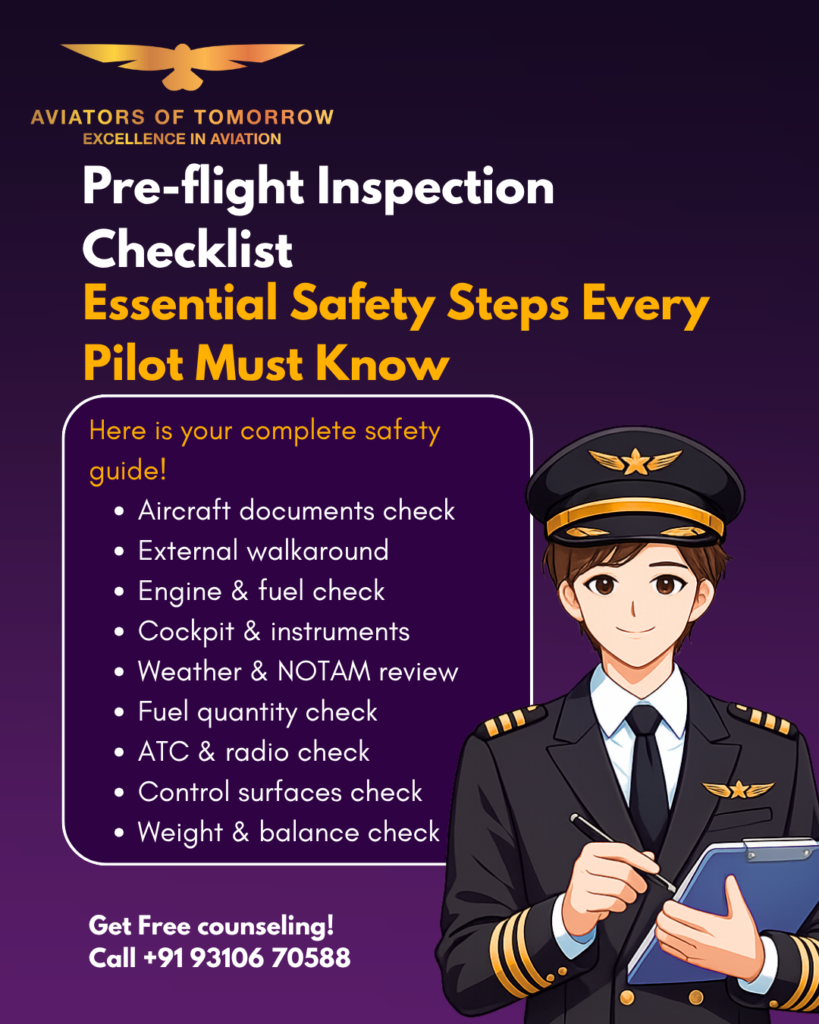
Table of Contents
Why the Pre-flight Inspection Checklist Is Absolutely Non-Negotiable
Aviation accidents are rarely caused by a single catastrophic failure. Most incidents occur when multiple small oversights combine into a serious problem.
A thorough pre-flight inspection helps break this chain of events before a flight even begins.
Common issues discovered during pre-flight checks include:
- Fuel contamination due to water or impurities
- Damage to control surfaces caused by weather or wildlife
- Low or incorrect tyre pressure
- Loose panels, cowlings or fasteners
- Missing or outdated aircraft documentation
Even when an aircraft has been cleared by licensed aircraft maintenance engineers, the pilot in command remains responsible for confirming the aircraft is safe to fly on that particular day.
Pre-flight Inspection Checklist: Stage One – Aircraft Documentation and Airworthiness Verification
The first step in a pre-flight inspection is verifying that all aircraft documentation is valid and available on board.
Key documents that must be checked include:
- Certificate of Airworthiness – confirms the aircraft meets regulatory safety standards
- Certificate of Registration – identifies the aircraft legally
- Radio Telephony Licence – required for aircraft communication systems
- Pilot Operating Handbook (POH) – the aircraft manufacturer’s official operating manual
- Insurance Documentation – confirms legal coverage
- Maintenance Release / Technical Logbook – confirms the aircraft is serviceable
Pilots commonly remember these documents using the ARROW mnemonic:
- A – Airworthiness
- R – Registration
- R – Radio Licence
- O – Operating Handbook
- W – Weight and Balance documentation
No physical inspection should begin until these documents have been verified.
Stage Two: The External Walkaround Inspection
The aircraft pre-flight inspection walkaround is one of the most important parts of the pre-flight inspection. The aircraft walkaround inspection is a critical part of every pre-flight inspection. Pilots typically follow a consistent path around the aircraft to ensure no area is missed.
Fuselage and Airframe
During the inspection, pilots must check for:
- Visible dents, cracks or corrosion
- Secure panel fasteners
- Clear static ports
- Pitot tube cover removed
- Drain holes free of debris
- Aircraft registration markings clearly visible
Any structural damage discovered during inspection requires evaluation by a licensed aircraft maintenance engineer before flight.
Wings and Control Surfaces
The wings and control surfaces are essential for flight stability and control.
Pilots must verify:
- Fuel caps secured
- Fuel quantity visually checked
- Fuel samples were taken from each sump and checked for contamination
- Ailerons, flaps and other control surfaces are moving freely
- Wing leading edges free from damage or contamination
- Navigation lights intact
- Tie-down ropes removed
Fuel contamination remains one of the most common causes of engine failure in light aircraft.
Undercarriage and Tyres
The landing gear absorbs significant stress during take-offs and landings.
Pilots must check:
- Tyres for cuts, wear or bulges
- Correct tyre pressure
- Brake discs and hydraulic systems for leaks
- Wheel fairings secure
- Nose wheel steering linkages intact
Engine and Propeller
The engine and propeller inspection requires careful attention as these components operate under extreme stress. because they operate under extreme mechanical stress.
Pilots must confirm:
- Engine cowlings secure
- Oil level within the acceptable range
- No visible fuel or oil leaks
- Exhaust stacks secure
- Propeller blades free from cracks or damage
- Spinner secure and undamaged
- No foreign objects near the propeller area
Even small defects in a propeller can lead to serious failures at high rotational speeds.
Stage Three: Cockpit Pre-flight Checks and Instrument Verification
After the external inspection, pilots move into the cockpit to verify that all instruments and avionics are functioning correctly. These flight instrument checks ensure accurate readings before takeoff. A proper pilot pre-flight checklist ensures that no critical step is missed during inspection.
Flight Instruments
Pilots should confirm:
- Altimeter set to local pressure
- The attitude indicator is functioning correctly
- Direction indicator aligned with the compass
- Airspeed indicator reading near zero on the ground
- Vertical speed indicator at zero
- Engine instruments within normal range
Navigation and Communication Equipment
Pilots should verify:
- GPS or navigation systems operational
- Radios functioning correctly
- Transponder set to standby with the correct code
Flight Controls
Pilots must ensure:
- Ailerons move freely and correctly
- The elevator moves without restriction
- Rudder moves properly
- Flaps extend and retract correctly
- Trim tabs set for take-off
Control surfaces must move freely and in the correct direction.
Emergency Equipment
Pilots must verify the availability and condition of:
- Fire extinguisher
- First aid kit
- Emergency Locator Transmitter (ELT)
- Life jackets for overwater flights
- Oxygen system (if required)
Preparation is the pilot’s first responsibility.
Stand a chance to win 100% scholarship & start training with India’s trusted aviation institute. Apply & Check Eligibility.
Apply Now!Stage Four: Fuel Planning and Weight & Balance
Before departure, pilots must ensure the aircraft operates within its certified weight and centre of gravity limits.
Fuel planning should include:
- Fuel required for the planned flight
- Alternate airport fuel
- Mandatory reserve fuel
- Taxi and engine run-up fuel
Incorrect weight distribution can make an aircraft difficult or impossible to control.
Stage Five: Weather Assessment and NOTAM Review
Pre-flight preparation also includes evaluating the operating environment. These aviation pre-flight procedures are essential to maintain operational safety.
Pilots must check:
- METAR and TAF weather reports
- SIGMET and AIRMET warnings
- ATIS information from airports
- NOTAMs for airspace restrictions or runway closures
- Sunrise and sunset times
Weather remains one of the most unpredictable elements of aviation safety. A careful go / no-go decision must always be made before departure.
Stage Six: Engine Start and Pre-Departure Checks
Once all inspections are complete, pilots proceed with engine start and pre-departure checks according to the aircraft’s Pilot Operating Handbook (POH).
Typical checks include:
- Parking brake set
- Fuel selector positioned correctly
- Mixture set appropriately
- Throttle slightly open
- Oil pressure rising within seconds of engine start
- Magneto checks during engine run-up
- Avionics turned on after engine start
- Taxi clearance obtained from ATC, where applicable
Only after every checklist item is complete should the pilot prepare for take-off.
Common Pre-flight Mistakes Every Pilot Must Avoid
Even experienced pilots sometimes develop habits that weaken their pre-flight discipline.
Common mistakes include:
Complacency
Assuming the aircraft is safe because it flew the previous day.
Rushing the walkaround
Time pressure should never shorten a safety inspection.
Ignoring minor issues
Small abnormalities may indicate larger problems.
Skipping documentation checks
Missing or expired documents can create legal and safety issues.
Leaving covers or locks in place
Pitot covers, control locks or wheel chocks must always be removed.
You May Read Our Blog “CPL Flying Training: Common Myths and Reality“
Final Thoughts: Safe Flights Begin on the Ground
A pre-flight inspection checklist represents professional discipline, responsibility and commitment to safety, aligned with the standards set by the Directorate General of Civil Aviation (DGCA).
No advanced avionics system or automation can replace the importance of a pilot personally verifying the aircraft’s condition before flight.
The aviation industry, guided by DGCA regulations, depends on pilots who never rush, never assume and always verify.
Safe flying always begins with a thorough pre-flight inspection, ensuring safety, compliance and confidence before every flight.
A smart pilot never skips the checklist.
Stand a chance to win 100% scholarship & start training with India’s trusted aviation institute. Apply & Check Eligibility.
Apply Now!