The journey to becoming a commercial airline pilot or aviation professional is one of the most rigorous and rewarding career paths in the world. At the very heart of this journey lies a critical stage that determines whether a candidate progresses further or returns to the drawing board, the aptitude and psychometric tests for airline entrance exams. These assessments are not merely a formality; they are scientifically designed instruments that evaluate a candidate’s cognitive abilities, personality traits, decision making skills and mental aptitude for the demanding environment of commercial aviation.
At Aviators of Tomorrow , we understand that many aspiring aviation professionals feel anxious or underprepared when they first encounter these assessments. The terminology alone, psychometric battery, cognitive ability test and pilot aptitude battery can feel overwhelming. However, once you understand how these tests work and what airlines are truly looking for, you gain a tremendous advantage in the airline selection process.
This comprehensive guide will walk you through everything you need to know about how aptitude and psychometric tests shape the airline entrance exam process, what types of assessments you are likely to face, how to prepare effectively and why these evaluations are considered the gold standard in airline recruitment processes worldwide. Whether you are a fresh school leaver pursuing a cadet programme or an experienced professional transitioning into aviation, this blog is your complete roadmap.
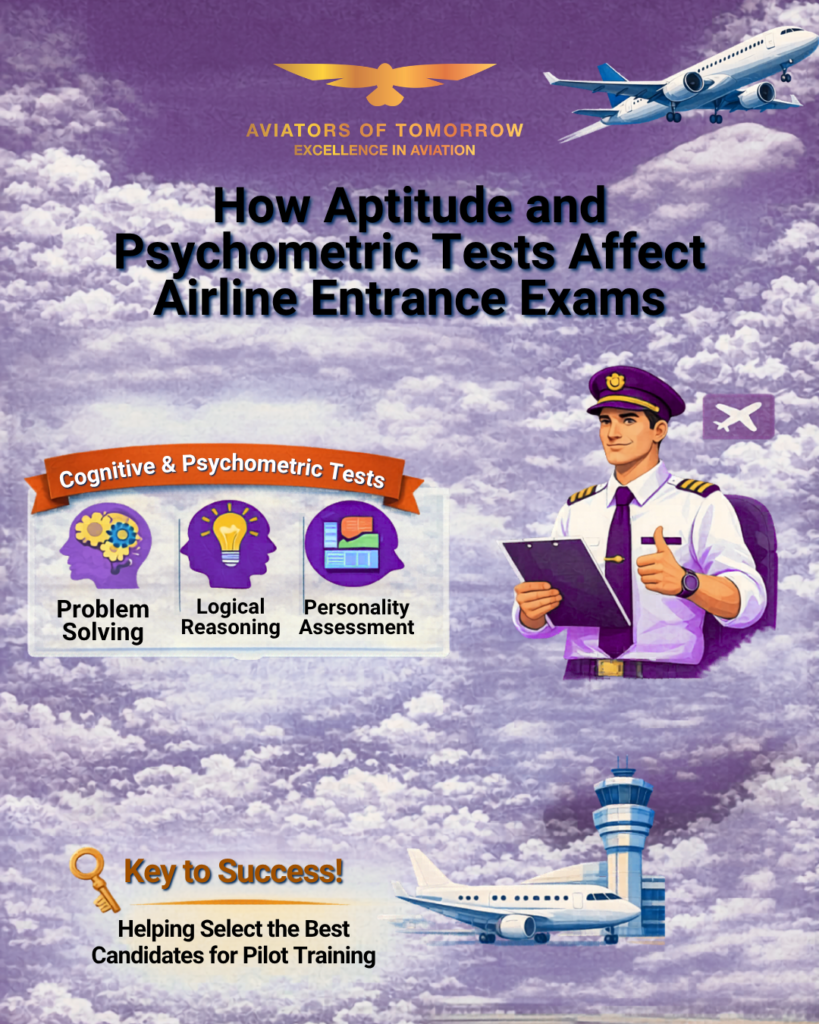
Table of Contents
What Are Aptitude and Psychometric Tests in the Context of Airline Entrance Exams?
Before diving into strategy and preparation, it is essential to understand what these tests actually are and why airlines rely on them so heavily during the airline entrance exam preparation phase.
Psychometric assessments are standardised tests designed to measure a range of psychological attributes from intellectual ability and reasoning skills to personality characteristics and behavioural tendencies. The term “psychometric” simply means the measurement of the mind and in aviation, this measurement is taken extremely seriously.
Aptitude tests, on the other hand, evaluate a candidate’s natural ability and potential to learn specific skills. Unlike academic examinations, aptitude tests are not necessarily about what you already know; they assess how well your mind processes information, identifies patterns and solves problems under pressure. These qualities are essential for anyone aspiring to sit in the cockpit of a commercial aircraft or take on a critical operational role in the aviation industry.
Airlines use these tools because aviation is an environment where human error can have catastrophic consequences. The aviation aptitude test serves as a predictive tool helping airlines identify candidates who are most likely to perform safely, reliably and effectively throughout their careers. This is why the airline selection process places such enormous weight on psychometric and aptitude results, often ranking them above academic qualifications.
Why Airlines Place So Much Importance on Psychometric Assessments for Pilots
Understanding the “why” behind psychometric assessments for pilots helps candidates approach these tests with the right mindset rather than treating them as arbitrary obstacles.
Airlines are responsible for the lives of hundreds of passengers on every single flight. The environment inside a commercial aircraft cockpit is one of the most mentally demanding workplaces on the planet. Pilots must process vast amounts of information simultaneously, make split second decisions, manage stress, communicate clearly with crew and air traffic control and maintain situational awareness across multiple systems all at once. These are not skills that can be taught overnight and they cannot be assessed through a simple interview or academic transcript.
The pilot aptitude battery, which forms a core component of most airline entrance exams, was developed precisely to identify whether a candidate possesses the cognitive architecture required to handle this complexity. Research in aviation psychology consistently shows that performance on these assessments correlates strongly with training success and long term performance in the cockpit.
Furthermore, the personality assessment airline component helps airlines understand how a candidate is likely to behave under pressure, how they interact within a crew environment and whether they have the temperament and emotional resilience required for a long and successful aviation career. A brilliant mind that cannot function as part of a team or that crumbles under pressure is not the right fit for the flight deck.
Types of Aptitude and Psychometric Tests Used in Airline Entrance Exams
The aviation psychometric battery used by most major airlines comprises several distinct categories of assessment. Here is a detailed breakdown of each type you are likely to encounter during your airline entrance exam journey.
1. Numerical Reasoning Tests in Aviation Entrance Exams
Numerical reasoning aviation tests assess your ability to interpret, analyse and draw accurate conclusions from numerical data. In an airline entrance exam context, you might be presented with tables, graphs or datasets and asked to answer questions within a tight time limit.
Aviation professionals routinely work with numbers, fuel calculations, speed and distance computations, altitude readings, weather data and weight and balance calculations. Strong numerical reasoning is therefore a core requirement. These tests are not simply about mental arithmetic; they evaluate your logical approach to numerical problems and your ability to remain accurate under time pressure.
Preparation tip from Aviators of Tomorrow : Practise numerical reasoning tests daily in the weeks leading up to your exam. Focus on accuracy first, then build your speed progressively. Avoid the common mistake of rushing at the expense of precision.
2. Verbal Reasoning Tests
The verbal reasoning test component evaluates your ability to understand written information, identify logical conclusions and distinguish between what is stated, implied and unsupported by the text. Strong verbal reasoning is critical in aviation, where clear communication, whether in written briefings, operational manuals or verbal exchanges with crew, can mean the difference between safety and disaster.
Airline entrance exams typically present candidates with short passages of text followed by statements that must be identified as “True,” “False,” or “Cannot Say” based solely on the information provided. This requires disciplined, objective thinking rather than reliance on prior knowledge.
3. Abstract Reasoning Tests
The abstract reasoning test is often considered one of the purest measures of raw intellectual potential. It presents candidates with sequences of shapes, patterns or symbols and requires them to identify the underlying rule or relationship and apply it to find the next element in the series.
Abstract reasoning is closely linked to fluid intelligence, the ability to solve novel problems without relying on prior learning. In aviation, this translates to the capacity to adapt to unfamiliar situations, identify patterns in complex data and think creatively when standard procedures do not provide a ready answer.
4. Spatial Awareness Tests
Perhaps the most directly aviation relevant component of the aptitude test battery, the spatial awareness test evaluates a candidate’s ability to mentally manipulate two and three dimensional shapes, understand the relationship between objects in space and visualise how structures appear from different angles and perspectives.
Pilots rely on spatial awareness constantly, whether interpreting instrument displays, maintaining orientation during turns or mentally visualising their position relative to terrain and other aircraft. Poor spatial awareness is one of the most common reasons candidates fail the cockpit aptitude test stage, making this an area that deserves dedicated preparation.
5. Psychomotor and Multi Tasking Tests
Many airline cadet selection programmes include tests of psychomotor coordination, the ability to track moving objects, maintain precise control inputs and manage multiple tasks simultaneously. These assessments often involve computer based simulations where candidates must respond to changing stimuli across several screens or input devices at the same time.
The cognitive ability to divide attention, prioritise tasks and switch smoothly between activities is fundamental to modern aviation. These tests assess whether a candidate has the neurological foundation required to develop these skills to a professional level.
6. Personality Assessments and Situational Judgement Tests
The personality assessment airline companies use is not designed to identify a “right” or “wrong” personality type; rather, it seeks to understand whether a candidate’s natural tendencies align with the demands of the aviation environment. Airlines look for traits such as conscientiousness, openness to learning, emotional stability, assertiveness, balanced with teamwork and a disciplined approach to safety.
Situational Judgement Tests (SJTs) present candidates with realistic aviation related scenarios and ask them to choose the most appropriate course of action from a list of options. These tests evaluate practical wisdom, ethical judgement and an understanding of Crew Resource Management (CRM) principles.
Build the mindset, master the tests, and unlock your aviation future.
Stand a chance to win 100% scholarship & start training with India’s trusted aviation institute. Apply & Check Eligibility.
Apply Now!Stand a chance to win 100% scholarship & start training with India’s trusted aviation institute. Apply & Check Eligibility.
Apply Now!How the COMPASS Test and Aviation Specific Assessments Work
One of the most widely referenced assessments in the airline entrance exam world is the COMPASS test aviation, a computer based selection tool used by several major airlines and training organisations to evaluate pilot candidates across multiple cognitive dimensions simultaneously.
The COMPASS test typically combines elements of numerical reasoning, spatial reasoning, memory, attention and multi-tasking within a single integrated assessment environment. What makes it particularly demanding is that it mirrors the real world complexity of flight operations, where a pilot must manage several tasks concurrently rather than focusing on one problem in isolation.
At Aviators of Tomorrow , our preparation programmes are specifically designed to familiarise candidates with the format and demands of assessments like COMPASS, ensuring that the test environment itself does not come as a shock on exam day. Familiarity with the format reduces anxiety and allows your genuine abilities to shine through.
The Role of Aptitude and Psychometric Tests in Airline Cadet Selection Programmes
For those pursuing the cadet route into commercial aviation, the airline cadet selection process represents one of the most competitive and high stakes stages of their early careers. Sponsored cadet programmes at major carriers receive thousands of applications for just a handful of training places and aptitude and psychometric assessments play a decisive role in narrowing the field.
The aviation career test battery used in cadet selection is typically administered over one or two full days and may include multiple rounds of psychometric testing, group exercises, individual interviews, simulator assessments and medical evaluations. Candidates who underestimate the psychometric component often find themselves eliminated at an early stage despite having strong academic results and relevant experience.
The key insight here is that airlines are investing hundreds of thousands of pounds in training each successful cadet. They cannot afford to select candidates who will struggle through training or, worse, fail to complete it. The pilot screening test battery is therefore designed to be as predictive as possible and the data consistently show that it does an excellent job of identifying candidates most likely to succeed.
How to Prepare Effectively for Aptitude and Psychometric Tests
Preparation is the single most important factor that differentiates successful candidates from those who fall short during the airline entrance exam preparation phase. While it is true that some aspects of psychometric ability reflect natural talent, research consistently shows that structured, targeted practice can lead to significant improvements in test performance.
Here is how Aviators of Tomorrow recommends approaching your preparation:
Start Early and Practice Consistently. Begin your preparation at least three to four months before your scheduled aviation entrance exam. Sporadic, last minute cramming is far less effective than consistent daily practice. Even thirty to forty-five minutes of focused practice each day will yield remarkable improvements over time.
Identify Your Weak Areas. Take a diagnostic assessment early in your preparation to identify which areas of numerical reasoning, spatial awareness, and abstract reasoning require the most attention. Focus your energy where improvement will have the greatest impact on your overall performance.
Simulate Exam Conditions Practise under timed conditions that mirror the actual test environment as closely as possible. This means no interruptions, no reference materials and strict adherence to time limits. The goal is to make the actual exam feel familiar and manageable rather than stressful and overwhelming.
Understand the Logic, Not Just the Answers Do not simply memorise answers to practice questions. Instead, invest time in understanding the underlying logical principles that each question type tests. This deeper understanding allows you to tackle novel questions you have never seen before which is exactly what you will encounter on exam day.
Work on Your Mental Fitness Cognitive performance is directly affected by physical and mental wellbeing. Ensure you are getting adequate sleep, maintaining a balanced diet, exercising regularly and managing stress effectively in the lead up to your aviation aptitude test. A sharp, well rested mind outperforms an exhausted one, regardless of raw ability.
Seek Expert Guidance Consider working with an aviation specific preparation programme like those offered by Aviators of Tomorrow , where our expert mentors have direct experience of the airline selection process and can provide personalised guidance, mock assessments and detailed feedback.
Common Mistakes Candidates Make During Airline Psychometric Assessments
Understanding what not to do is just as valuable as knowing what to do. Here are the most common errors that cost candidates during the airline recruitment process:
Underestimating the Difficulty Many candidates assume that aptitude tests are straightforward and arrive without adequate preparation. The reality is that these assessments are designed by occupational psychologists specifically to challenge candidates and create meaningful differentiation between high and low performers.
Spending Too Long on Individual Questions In most aviation psychometric battery assessments, time management is a critical skill in itself. Spending too long on a single difficult question can cost you several easier marks later in the section. Develop the discipline to move on when you are stuck and return if time allows.
Being Inconsistent in Personality Assessments Some candidates try to “game” personality assessments by answering what they believe the airline wants to hear rather than responding authentically. Most modern personality assessments include validity scales specifically designed to detect inconsistent or socially desirable responses. Authenticity is always the wisest approach.
Neglecting the Situational Judgement Component SJTs are sometimes treated as an afterthought, yet they can be highly differentiating in a competitive airline candidate evaluation process. Invest time in understanding CRM principles, aviation safety culture and professional standards so that your responses reflect genuine understanding rather than guesswork.
How Aviators of Tomorrow Supports Candidates Through the Process
At Aviators of Tomorrow , our mission is to bridge the gap between aspiration and achievement in the aviation industry. We recognise that the aptitude and psychometric testing stage represents one of the most significant hurdles in the pilot aptitude battery and broader airline selection journey and we have developed a comprehensive suite of resources designed to give our students a genuine competitive edge.
Our preparation programmes include full length mock psychometric assessments modelled on real airline tests, expert led workshops on each test category, personalised feedback reports identifying individual strengths and areas for development, one to one coaching sessions with industry professionals who have personally navigated the airline selection process and ongoing support throughout every stage of your aviation career journey.
We believe that every motivated, capable candidate deserves the opportunity to demonstrate their true potential and that the right preparation makes all the difference in whether that potential is recognised during the airline selection process.
The Future of Aptitude Testing in Aviation Recruitment
The landscape of airline recruitment processes is continually evolving. As artificial intelligence, adaptive testing technology and big data analytics become increasingly integrated into aviation selection, psychometric assessments are becoming more sophisticated, more personalised and more predictive than ever before.
Future aviation career test systems are likely to incorporate real time biometric data, immersive virtual reality scenarios and AI-driven adaptive questioning that adjusts in real time based on candidate responses. These innovations will make it even more important for candidates to develop genuine underlying cognitive abilities rather than relying on surface level test familiarity alone.
At Aviators of Tomorrow , we stay at the forefront of these developments, continuously updating our preparation resources to reflect the latest trends in airline entrance exams and ensuring that our students are always one step ahead.
You May Read Our Blog “Why Airlines Prefer Candidates from a Cadet Pilot Programme“
Conclusion: Your Path Forward in Airline Entrance Exams
Aptitude and psychometric tests for airline entrance exams play a vital role in identifying candidates with the right cognitive skills, personality traits and mental resilience required for aviation careers. With the right preparation, consistent practice and a focused mindset, these tests are completely achievable. Candidates should also stay aligned with standards set by the Directorate General of Civil Aviation (DGCA), which governs pilot training and aviation regulations in India.
At Aviators of Tomorrow, we support aspiring aviation professionals at every stage of their journey, helping them prepare confidently and succeed in airline selection processes.
Right guidance turns ambition into achievement—start your journey today.
Stand a chance to win 100% scholarship & start training with India’s trusted aviation institute. Apply & Check Eligibility.
Apply Now!Stand a chance to win 100% scholarship & start training with India’s trusted aviation institute. Apply & Check Eligibility.
Apply Now!