When airlines shortlist candidates for their next batch of First Officers, one pattern emerges consistently across carriers both in India and around the world; they almost always prefer graduates from a cadet pilot programme. Airlines prefer candidates from a cadet pilot programme because these individuals arrive thoroughly prepared, professionally groomed and operationally aligned with the demands of modern commercial aviation. At Aviators of Tomorrow, we have built our entire training philosophy around this reality, ensuring that every cadet who walks through our doors walks out as the pilot every airline is actively looking to hire.
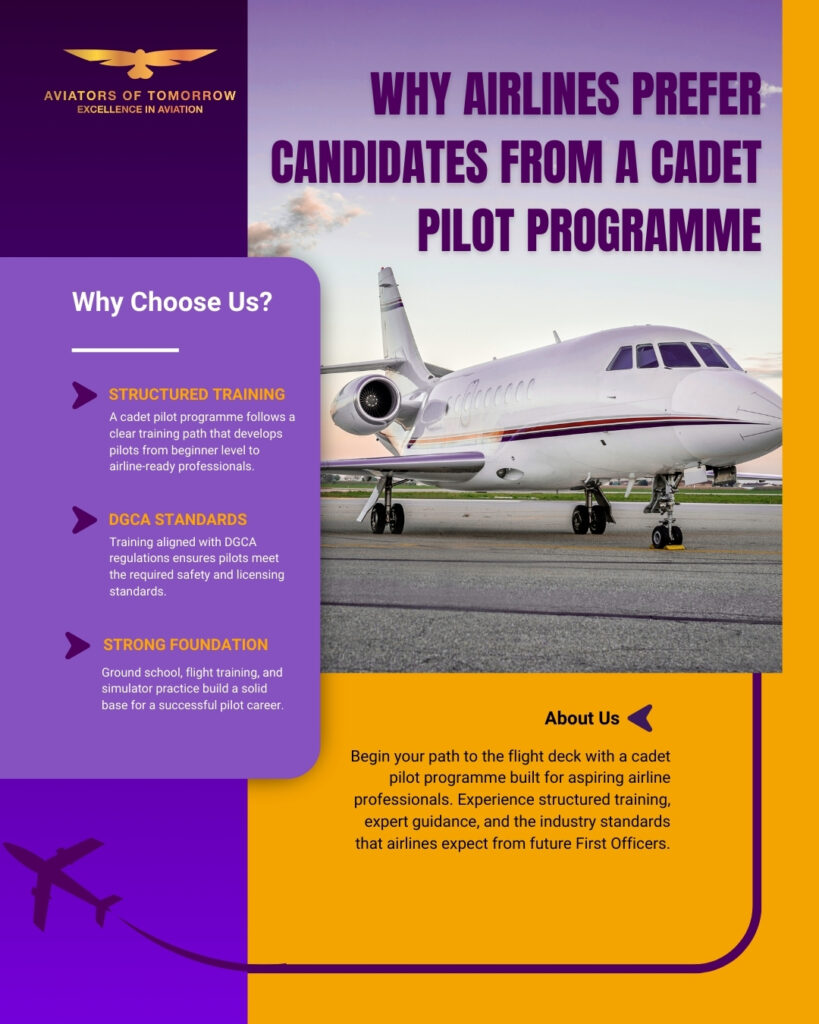
Table of Contents
What Is a Cadet Pilot Programme and Why Does It Matter?
A cadet pilot programme is a structured, end to end training pathway designed to take an individual from zero flying experience to a fully qualified, airline ready commercial pilot. Unlike fragmented or self arranged flight training, a cadet pilot programme is built with airline requirements at its very core. Every module, every assessment and every flight exercise is designed to produce a pilot who is not just licensed, but genuinely prepared for life on a commercial flight deck.
The aviation industry does not offer second chances at 35,000 feet. Airlines understand this better than anyone, which is why they have become increasingly deliberate about sourcing their pilots from cadet pilot programmes that have a proven track record of producing safe, competent and professional aviators.
Key Components of a Strong Cadet Pilot Programme
A comprehensive cadet pilot programme typically includes the following training phases. The ground school phase covers aviation meteorology, air navigation, air law, principles of flight, aircraft general knowledge, human performance and flight planning all studied to the DGCA examination standard. The flight training phase builds practical flying skills on single engine and multi-engine aircraft under the supervision of experienced flight instructors. The instrument rating phase qualifies cadets to fly in low visibility and adverse weather conditions. The multi crew cooperation phase prepares cadets for operating as part of a two pilot airline crew. Finally, the jet orientation and simulator phase familiarises cadets with the technology and procedures found on modern commercial airline flight decks.
At Aviators of Tomorrow, our cadet pilot programme covers every one of these phases with rigour, care and a relentless focus on producing airline ready pilots.
How a Cadet Pilot Programme Produces Airline-Ready Pilots
Standardised Airline Pilot Training That Carriers Can Rely On
The single most important word in aviation operations is consistency. Airlines run on standard operating procedures. Every checklist, every communication, every manoeuvre follows a defined protocol. Any deviation, however minor, introduces risk into an already complex environment.
When an airline hires from a cadet pilot programme, it receives candidates who have been trained to consistent standards from day one. They have been assessed against the same benchmarks, developed within the same operational philosophy and exposed to the same safety culture throughout their training. There is no ambiguity about what the pilot knows, how they communicate or how they perform under pressure.
This is what makes structured airline pilot training through a cadet pilot programme so valuable to carriers. The standardisation that airlines depend on in the cockpit begins in the training environment and a well run cadet pilot programme is where that standardisation is built.
Crew Resource Management The Heart of Airline Pilot Training
If there is one quality that separates an airline pilot from a private flyer, it is the ability to operate effectively within a crew. Commercial aviation is not a solo endeavour. Every flight involves a captain, a first officer, cabin crew, air traffic controllers, ground handlers and a chain of operational support staff. Functioning effectively within this environment requires a specific set of skills that must be deliberately developed.
Crew resource management or CRM, is the framework through which these skills are built. It covers communication, leadership, situational awareness, decision making, threat and error management and workload distribution in a multi crew cockpit. A reputable cadet pilot programme does not treat CRM as an afterthought it weaves it into every stage of training, from the earliest ground school sessions to the final simulator assessments.
Cadet graduates who have trained with CRM embedded throughout their programme arrive at airline interviews and assessments demonstrating exactly the kind of cockpit behaviour that carriers are looking for. At Aviators of Tomorrow, CRM is treated as a foundational competency, developed continuously across the entire cadet pilot programme.
DGCA Pilot Training Standards and Why They Matter
The Role of DGCA Pilot Training in Airline Hiring Decisions
In India, all commercial pilot training is regulated by the Directorate General of Civil Aviation, commonly known as the DGCA. The DGCA sets the standards for flight training organisations, examination syllabi, medical requirements and licence issuance. Any cadet pilot programme operating in India must be fully compliant with DGCA regulations to produce graduates who are eligible for commercial airline employment.
DGCA pilot training standards are rigorous by design. The ATPL theoretical knowledge examinations conducted under DGCA oversight cover fourteen subjects and demand a thorough, comprehensive understanding of every dimension of aviation science. Passing these examinations requires months of dedicated study and is a genuine indicator of a candidate’s knowledge, depth and commitment.
Airlines hiring in India are well aware of what the DGCA pilot training demands. When a candidate presents a licence issued under DGCA oversight, having passed all required examinations and completed all required flight hours, the airline knows that the candidate has been held to a high, nationally regulated standard. This regulatory credibility is a powerful reason why structured cadet pilot programmes aligned with DGCA requirements are so highly valued by Indian carriers.
How AOT Aligns Its Cadet Pilot Programme with DGCA Standards
At Aviators of Tomorrow, our cadet pilot programme is built to be fully aligned with DGCA pilot training requirements from the very first day of ground school. Our curriculum reflects the DGCA examination syllabus in depth, our instructors are DGCA approved and our flight training operations comply with all applicable DGCA regulations.
This alignment means that our cadets are not just prepared for the examinations; they are prepared for the regulatory environment they will operate within throughout their entire career. They understand the rules, respect the framework and carry the professional credibility that comes with DGCA compliant training.
For airlines recruiting in India, a graduate of Aviators of Tomorrow cadet pilot programme is a candidate they can trust from the very first conversation.
Ab Initio Pilot Training Building Pilots from the Ground Up
Why Ab Initio Pilot Training Produces the Best Airline Candidates
The term ab initio comes from Latin, meaning “from the beginning.” Ab initio pilot training refers to the process of developing a pilot from zero experience to full commercial licence eligibility. This approach, which lies at the heart of every genuine cadet pilot programme, is widely recognised by the global aviation industry as the most effective method of producing airline ready pilots.
The reason ab initio pilot training is so effective is that it allows the entire training journey to be designed coherently. Rather than patching together training from different schools, different instructors and different methodologies, ab initio training builds each new skill on the foundation of the last. The result is a pilot whose knowledge, skills and professional behaviours are all integrated and mutually reinforcing.
Airlines value ab initio trained pilots because they arrive without the bad habits, inconsistent procedures or knowledge gaps that can sometimes develop when training is arranged piecemeal. The holistic nature of ab initio pilot training through a cadet pilot programme produces a more complete, more consistent and more capable pilot candidate.
The Ab Initio Journey at Aviators of Tomorrow
At Aviators of Tomorrow , our ab initio pilot training pathway begins with careful candidate selection. We assess applicants not just on their academic results, but on their aptitude for aviation, their communication skills, their psychological resilience and their physical fitness, including Class 1 Medical eligibility. This thorough selection process ensures that every cadet who joins our programme has the genuine potential to complete it successfully and go on to a rewarding airline career.
From selection through to graduation, our ab initio pilot training is delivered by a team of experienced commercial aviation professionals who bring a real airline perspective into every aspect of the programme. Our cadets do not just learn to fly, they learn to think, act and carry themselves as airline pilots from their very first day.
Your future in aviation begins here apply now and take the first step.
Stand a chance to win 100% scholarship & start training with India’s trusted aviation institute. Apply & Check Eligibility.
Apply Now!Flight Training in India: Opportunities and the AOT Advantage
The Growth of Flight Training in India
India’s aviation sector is one of the fastest growing in the world. With a rapidly expanding middle class, aggressive fleet growth by carriers such as IndiGo, Air India, Akasa Air and SpiceJet and the continued roll out of the UDAN regional connectivity scheme, the demand for qualified commercial pilots in India is at an historic high.
This demand has made flight training in India more relevant and more valuable than ever before. Young Indians who invest in a quality cadet pilot programme today are positioning themselves for careers in an industry that will offer extraordinary opportunities over the coming decades. Boeing’s global forecasts consistently project a need for hundreds of thousands of new pilots worldwide, with South Asia representing one of the fastest growing recruitment markets.
The expansion of flight training in India has also raised standards across the sector. Airlines are now able to be highly selective and they choose graduates from structured cadet pilot programmes over candidates with less organised training backgrounds. This selectivity makes the quality of the cadet pilot programme you choose more important than ever.
Why AOT Stands Apart in Flight Training in India
Aviators of Tomorrow is not simply another flight training organisation. We are an institution built specifically to serve the needs of India’s growing aviation industry and the young people who aspire to be part of it. Our cadet pilot programme combines DGCA compliant technical training with holistic professional development, creating graduates who are equipped not just to pass their exams and flight tests, but to thrive in airline careers.
Our approach to flight training in India is characterised by small cohort sizes that ensure individual attention, experienced instructors who combine technical expertise with genuine mentorship, a curriculum that stays current with industry developments and a career support framework that helps cadets navigate the transition from training to airline employment.
When you choose Aviators of Tomorrow for your flight training in India, you are not just choosing a school, you are choosing a partner in your aviation career.
Pilot Cadet Selection What Airlines Look for and How to Prepare
Understanding the Pilot Cadet Selection Process
The pilot cadet selection process used by airlines is designed to identify candidates who have the right combination of technical knowledge, flying aptitude, interpersonal skills and professional attitude to succeed as First Officers. Airlines invest significantly in this process because a poor hiring decision is costly in both financial and safety terms.
Typical pilot cadet selection assessments include cognitive and psychomotor aptitude testing, group exercises designed to assess CRM and leadership behaviours, technical knowledge interviews covering aviation theory and aircraft systems, simulator assessments evaluating basic flying ability and procedural awareness and panel interviews assessing communication skills, motivation and professional attitude.
Candidates who have completed a structured cadet pilot programme are significantly better prepared for every one of these assessment components. Their aptitude has been continuously developed through training, their CRM behaviours have been shaped and assessed, their technical knowledge has been rigorously examined and their professional attitude has been cultivated throughout the programme.
How AOT Prepares Cadets for Airline Selection
At Aviators of Tomorrow, we take pilot cadet selection preparation seriously as a dedicated element of our cadet pilot programme. We run mock assessment days, technical interview preparation sessions, aptitude test practice and simulator assessment briefings to ensure our cadets walk into airline selection events with confidence and competence.
Our cadets do not face airline selection unprepared. They face it having already experienced similar rigour throughout their training at Aviators of Tomorrow and the results speak for themselves in the outcomes our graduates achieve.
Commercial Pilot Licence The Gateway to an Airline Career
What the Commercial Pilot Licence Represents
The Commercial Pilot Licence or CPL, is the foundational qualification required for paid flying employment in India and across the world. Issued by the DGCA in India, the CPL represents the completion of a demanding training and examination process that verifies a pilot’s theoretical knowledge, practical flying skills and medical fitness to the standards required for commercial operations.
Obtaining a commercial pilot licence through a structured cadet pilot programme is the most thorough and most credible way to achieve this qualification. The comprehensive nature of cadet training means that CPL graduates from reputable programmes do not just meet the minimum requirements; they surpass them.
For airlines evaluating candidates, a commercial pilot licence obtained through a well-regarded cadet pilot programme carries additional weight. It signals not just that the candidate has passed the required tests, but that they have been developed comprehensively and consistently to an airline standard.
CPL Training India Choosing the Right Path
CPL training in India is offered by a range of institutions and the quality varies considerably. Aspiring pilots must choose carefully, because the programme they complete will follow them throughout their career. Airlines are aware of which institutions produce the best graduates and this awareness influences hiring decisions in ways that may not always be immediately visible to candidates.
Choosing Aviators of Tomorrow for your CPL training in India means choosing a programme designed from the ground up to produce airline preferred graduates. Our commitment to DGCA compliance, instructional quality and holistic cadet development ensures that our CPL graduates carry genuine credibility in the airline recruitment market.
You may Read Our blog “Top Benefits of Choosing Professional Flight Training in India“
Final Thoughts The Cadet Pilot Programme, DGCA and Your Airline Future
The aviation industry’s preference for candidates from a cadet pilot programme is well founded and well established. Structured training, standardised assessments, embedded CRM, safety culture, medical screening, ab initio development and airline partnerships these are the qualities that cadet programmes deliver and that airlines most value when building their flight deck teams.
In India, where the aviation sector is growing at a pace that is creating extraordinary career opportunities, the importance of DGCA compliant cadet training has never been greater. The Directorate General of Civil Aviation sets the regulatory framework within which every commercial pilot in India must operate and a cadet pilot programme that is fully aligned with DGCA standards does not merely prepare cadets for their examinations, it prepares them for the entirety of their professional lives as regulated, responsible and respected commercial aviation professionals.
At Aviators of Tomorrow, our cadet pilot programme is built on this foundation. DGCA compliance is not a box we tick, it is a standard we uphold in every classroom, every briefing and every flight. Our graduates carry their DGCA licences with genuine confidence because they know the depth of preparation that stands behind them.
The skies above India are expanding. The airlines are hiring. And the cadet pilot programme remains the clearest, most credible and most effective path to the flight deck. The only question is whether you are ready to take the first step.
Talent deserves wings apply now and unlock your scholarship for a brighter aviation career.
Stand a chance to win 100% scholarship & start training with India’s trusted aviation institute. Apply & Check Eligibility.
Apply Now!