If you’ve always dreamt of sitting inside a cockpit and flying an aircraft high above the clouds, a Private Pilot Licence is one of the best ways to start that journey. Many aviation enthusiasts begin with a PPL to understand what flying truly feels like, while others use it as their first step towards becoming a commercial pilot in the future.
Unlike a Commercial Pilot Licence (CPL), which is meant for professional airline flying, a Private Pilot Licence is perfect for those who want to fly for fun, explore aviation as a hobby, gain confidence, or simply enjoy the thrill of piloting an aircraft. And the best part? You don’t need extremely high qualifications or advanced subjects to start your PPL journey.
In this detailed and student-friendly guide, we’ll explain what a Private Pilot Licence is, who is eligible for it, the flying requirements, DGCA rules, training duration, overall cost, career possibilities, and how to know if it’s the right path for you, all in simple, easy-to-understand language.
What Is a Private Pilot Licence (PPL)?
A Private Pilot Licence is an aviation licence that allows you to fly small aircraft for personal, non-commercial purposes. This means you cannot earn money as a pilot with a PPL, but you can:
- Fly solo
- Take friends and family as passengers
- Rent an aircraft from a flying club
- Build flying experience
- Train for advanced flying ratings
- Prepare yourself for CPL in the future
A PPL gives you a very strong foundation in flying skills because you learn the basics of aircraft handling, navigation, radio communication, emergency procedures and flight operations.
For many students, it becomes the first real experience of being in command of an aircraft and that moment often decides their entire aviation career.
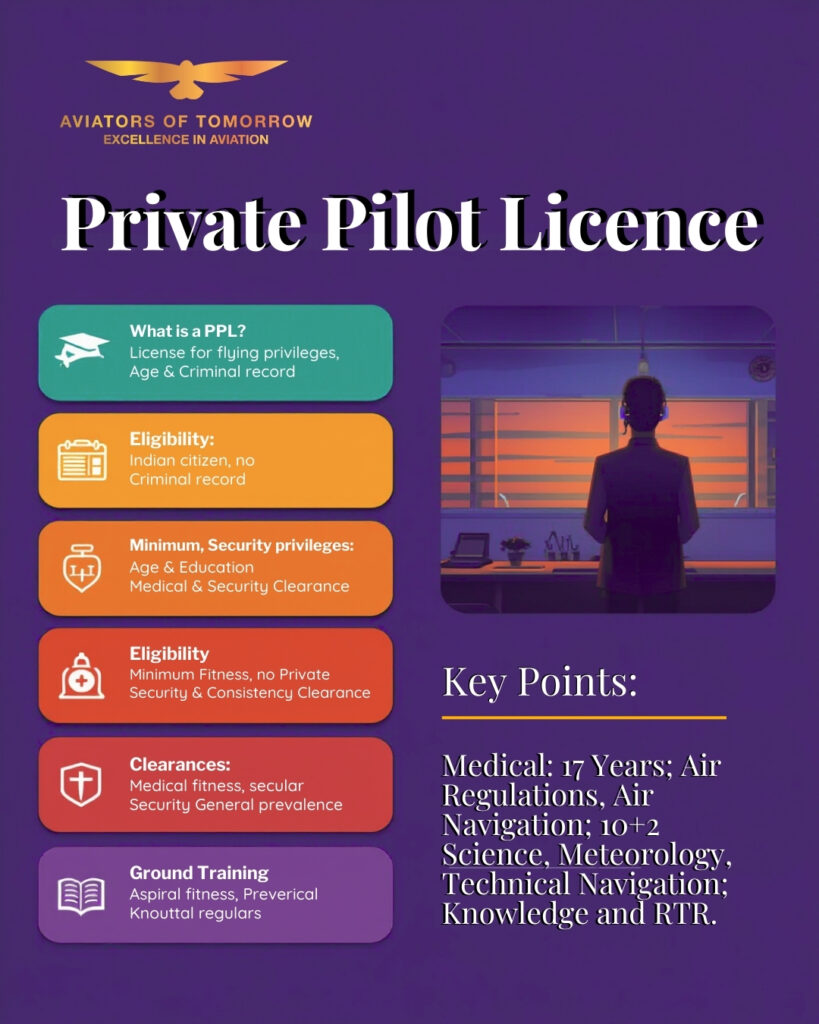
The eligibility requirements for Private Pilot Licence in India are much simpler compared to CPL or cadet programs. Here’s what you need:
1. Age Requirement
You must be minimum 17 years old to apply for a Private Pilot Licence.
You can start your ground classes earlier, even at 16 and many students begin their aviation journey right after 10th or 12th.
2. Educational Qualification
A minimum qualification of 10th standard is required to apply for a Private Pilot Licence .
There is no mandatory Physics or Math requirement, unlike CPL where PCM is compulsory. This makes PPL open to students from any stream — Arts, Commerce, or Science.
3. Medical Requirement
You must hold a valid DGCA Class 2 Medical Certificate, issued by a DGCA-approved medical examiner.
Class 2 Medical ensures:
- Your eyesight is stable (can be corrected with glasses)
- You have no major medical conditions
- You are physically fit to fly safely
Once you complete your Class 2 Medical, DGCA may upgrade it to Class 1 if needed in the future for CPL.
4. Security Clearance
To ensure safety and identity verification, DGCA requires police verification or security clearance before issuing the final licence.
This is a simple formality and flying schools usually guide students in completing it.
📚 Private Pilot Licence Ground Training – Subjects You Must Study
Before you earn your Private Pilot Licence, you need to learn and clear basic DGCA examinations. These subjects are part of your foundation in aviation:
1. Air Regulations
Understanding aviation laws, rules, airspace, aircraft documents and safety procedures.
2. Air Navigation
How to navigate the aircraft using maps, instruments and planning routes.
3. Aviation Meteorology
Understanding weather conditions, clouds, wind, storms and how weather affects your flight.
4. Technical General
Learning about the aircraft’s systems — engines, instruments, parts, fuel and basic mechanics.
Do you want to become a pilot?
Fill the form now and take your first step into the cockpit.
Stand a chance to win 100% scholarship & start training with India’s trusted aviation institute. Apply & Check Eligibility.
Apply Now!5. RTR(A) – Radio Telephony (Optional for some flying clubs)
If you plan to communicate with ATC (Air Traffic Control), RTR(A) becomes very useful.
It teaches you:
- How pilots talk on the radio
- Standard phrases
- Emergency communication
These subjects are taught during your ground classes and are explained in simple terms for beginners.
Flying Requirements for PPL in India
DGCA requires you to complete a minimum of 40 hours of flying. This includes:
1. 20 Hours of Dual Flying
You fly with an instructor who teaches you:
- Aircraft controls
- Takeoff and landing
- Basic manoeuvres
- Communication
- Emergency handling
- Circuit patterns
2. 10 Hours of Solo Flying
Solo flying is the moment every student remembers forever.
Here, you fly alone, without an instructor, demonstrating that you can:
- Control the aircraft
- Take off and land safely
- Follow communication instructions
- Fly confidently under supervision
3. Cross-Country Flying
You fly to different airports and learn:
- Route navigation
- Weather checks
- Fuel planning
- Map reading
4. Basic Manoeuvres
Including:
- Climbs
- Descents
- Turns
- Stalls (for safety understanding)
- Circuits
5. Emergency Procedures
You are trained in:
- Engine failure recovery
- Forced landing techniques
- System failures
- Radio failure procedures
Total Flying Hours Required: Minimum 40
Most students complete: 45–55 hours
The extra hours depend on weather, confidence level and aircraft availability.
How Long Does It Take to Complete PPL in India?
The duration mostly depends on flying school efficiency, weather conditions and how regularly you fly.
Average Duration
4 to 8 Months
Breakdown:
Ground School + DGCA Exams
1–2 months
If you attend classes regularly, you can finish this part quickly.
Flying Training
3–6 months
Duration depends on:
- Weather conditions
- Instructor availability
- Aircraft availability
- Your own progress
If the flying school has good aircraft availability and weather is stable, some students finish their PPL in 4 months.
PPL Cost in India (2026)
The cost of Private Pilot Licence training in India depends on the flying school, aircraft type, fuel cost and location.
Total cost for PPL in India (2026): ₹7 lakh – ₹12 lakh
Here’s a simple breakdown:
| Component | Estimated Cost |
| Ground classes | ₹20,000 – ₹50,000 |
| DGCA exam fees | ₹3,000 – ₹6,000 |
| Flying hours (40–50 hours) | ₹6–10 lakh |
| Class 2 Medical | ₹2,000 – ₹5,000 |
| Documentation & misc. fees | ₹5,000 – ₹10,000 |
Why the cost varies:
- Schools in metro cities are more expensive
- Cessna 172 flying is costlier than Cessna 152
- Fuel price fluctuations
- Instructor charges
- Extra simulator sessions
Some flying schools also charge:
- Landing fee
- Logbook fee
- Headset rental
- Membership fee
Always ask for the complete fee structure before joining.
Where Can You Do Private Pilot Licence Training in India?
PPL training is available at DGCA-approved flying schools, including:
1. Government Flying Clubs
Usually cheaper but may have slower progress due to:
- Fewer aircraft
- Maintenance delays
- Weather restrictions
2. Private Flying Academies
Faster training but costlier.
These have:
- More aircraft
- Better maintenance
- Experienced instructors
- Faster scheduling
3. Aviation Colleges with Flying Schools
Offer integrated programs, suitable for students planning a long-term aviation career.
Is Private Pilot Licence (PPL) Useful for Future CPL Training?
Yes, absolutely!
A PPL is extremely beneficial for students planning to become commercial pilots because:
- It gives you real flying experience
- You learn radio communication early
- You become comfortable in the cockpit
- Your confidence increases
- You already know basic navigation and meteorology
- Some hours may be counted towards CPL (varies by school)
Most importantly, PPL helps you know whether aviation is truly your passion before investing in full CPL training.
Career Options After Private Pilot Licence
A Private Pilot Licence does not allow you to earn money as a pilot, but it does open up many aviation opportunities, such as:
1. Recreational Flying
Fly for fun, rent aircraft and explore flying clubs.
2. Cross-Country Experience
Build skills by flying to different airports.
3. Advanced Training
You can pursue:
- Night rating
- Instrument rating
- Multi-engine training
4. Stepping Stone to CPL
Many students begin with a PPL before moving on to full commercial pilot training.
5. Flying Club Membership
Join aviation communities, participate in events and learn from experienced pilots.
Who Should Choose PPL?
PPL is perfect for you if:
✔ You want to fly for fun or as a hobby
✔ You are exploring aviation before doing CPL
✔ You want to slowly enter the pilot career path
✔ You love aircraft and want real cockpit experience
✔ You’re unsure about investing in the full CPL cost yet
PPL gives you a safe, affordable and exciting start to your flying journey.
You may also read our blog “Types of Pilot Licence: Your Complete Guide to Aviation Licenses“
Final Thoughts
A Private Pilot Licence (PPL) is one of the most rewarding and exciting ways to enter the world of aviation. Whether you eventually plan to become a commercial airline pilot or you simply want to enjoy the freedom of flying, PPL gives you the skills, confidence and real hands-on experience that are needed to grow.
It is also a great way to test your passion for flying before committing to the full CPL cost and training.
Your aviation journey can start today, all you need is the right guidance and the passion to fly.
Do you want to become a pilot?
Submit the form to speak with aviation experts and get personalized guidance for your pilot journey.
Stand a chance to win 100% scholarship & start training with India’s trusted aviation institute. Apply & Check Eligibility.
Apply Now!