When you enter an aircraft cockpit for the first time, the number of screens, gauges, dials and indicators can feel overwhelming. But each one of these tools, collectively called major aircraft instruments, plays a critical role in helping the pilots understand what an aircraft is doing, even when visibility outside is poor or nonexistent.
For aviation students pursuing PPL or CPL, mastering aircraft instruments is not just useful; it is a core requirement. It forms the foundation of flight training, DGCA theoretical exams, emergency procedures and eventual airline-level flying. This detailed guide will help you understand how each instrument works internally, when it is used, why it is needed and what happens if it fails.
Let’s begin by understanding the systems that power many flight instruments.
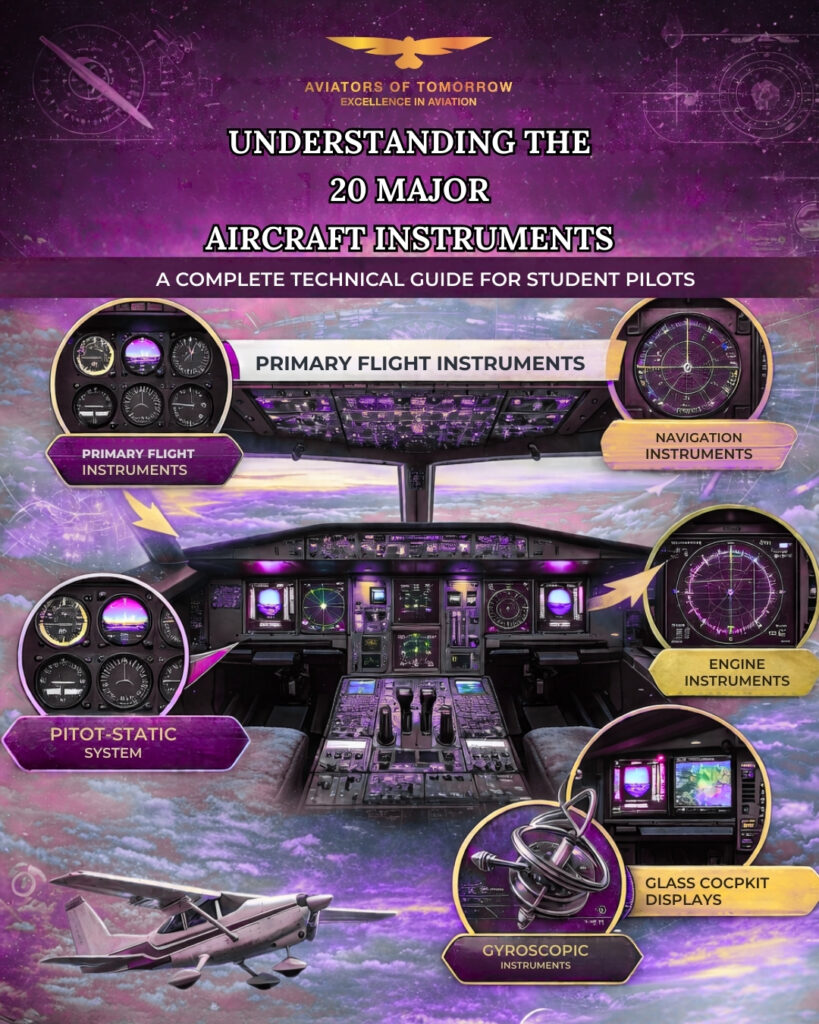
THE FOUNDATION OF FLIGHT INSTRUMENTS
Before learning individual aircraft instruments, you must understand the two core systems powering most of them:
1️. Pitot-Static System
2️. Gyroscopic Instruments
These systems make many critical flight instruments function correctly.
1. PITOT-STATIC SYSTEM, THE SOURCE OF FLIGHT PRESSURE DATA
The pitot-static system provides pressure information that is essential for instruments such as:
- Airspeed Indicator
- Altimeter
- Vertical Speed Indicator
How It Works
It has two major pressure sources:
• Pitot Pressure (Total pressure)
This tube faces forward into the airflow and captures air pressure caused by aircraft movement.
• Static Pressure (Ambient pressure)
Small vents on the aircraft measure surrounding atmospheric pressure.
These pressures feed instruments through small tubes.
If these ports get blocked by dust, insects, or ice, readings become dangerously inaccurate.
Pitot-static system failures include:
- Airspeed freezing
- Altimeter reading stuck
- VSI becoming unreliable
Proper preflight checks and periodic maintenance prevent such failures.
2. GYROSCOPIC INSTRUMENTS, STABILITY THROUGH SPINNING MOTION
Many aircraft instruments operate using spinning gyros, which maintain orientation due to the principle of rigidity in space.
Gyro-powered instruments include:
- Attitude Indicator
- Heading Indicator
- Turn Coordinator
Gyros operate on two principles:
• Rigidity in Space
A spinning gyro resists change in orientation.
• Precession
Force applied to a rotating body causes movement 90° later in the direction of rotation.
Understanding these principles makes troubleshooting gyro instrument failures, easier.
THE 20 MAJOR AIRCRAFT INSTRUMENTS FULL TECHNICAL EXPLANATION
Below is a complete breakdown of all 20 aircraft instruments, with technical depth, simplified concepts, examples and failure indications.
PRIMARY FLIGHT INSTRUMENTS (THE SIX-PACK)
1. Airspeed Indicator (ASI)
Category: static
Measures: The speed of aircraft through the air
Internal Working:
The ASI compares pitot pressure (dynamic) with static pressure, converting the difference into indicated airspeed.
Colored arcs:
- White arc – Safe flap operating range
- Green arc – Normal operating range
- Yellow arc – Caution range
- Red line – Never exceed speed (Vne)
Common Uses:
- Takeoff (rotational speed)
- Climb speed
- Cruising
- Landing approach
Failure Indications:
- Frozen pitot tube → ASI behaves like an altimeter
- Blocked static port → ASI gives unreliable readings
IFR vs VFR:
- IFR relies heavily on ASI for stall avoidance in clouds
- VFR allows visual reference but ASI is still mandatory
2. Attitude Indicator (AI)
Category: Gyroscopic
Shows: Aircraft’s pitch (nose up/down) and bank (left/right)
Internal Working:
A spinning gyro housed inside maintains rigid orientation. The horizon bar stays fixed, while the aircraft symbol moves around it.
Uses:
- Level flight
- Night flying
- Cloud flying (IFR)
Failure Indications:
- Horizon slowly tilts → vacuum failure
- “Tumbling” during aggressive manoeuvres
IFR Importance:
This is the primary attitude reference when outside visibility is zero.
3. Altimeter
Category: Pitot-static (static only)L
Measures: Aircraft altitude using atmospheric pressure
Internal Working:
Inside the altimeter are aneroid capsules that expand or contract with pressure changes.
Lower pressure = Higher altitude
Higher pressure = Lower altitude
Key Setting: QNH
Pilots adjust the altimeter to local pressure before flight.
Failures:
- Incorrect QNH → altimeter shows wrong altitude
- Blocked static port → altimeter freezes
Example:
If flying without an accurate altitude, you risk terrain collision or airspace violation.
4. Turn Coordinator
Category: Gyroscopic
Shows: Rate of turn + whether the turn is coordinated
Internal Working:
Uses a canted gyro to sense roll and yaw.
Also includes a slip/skid indicator (“the ball”).
Uses:
- Ensures coordinated turn
- Helps in instrument flying
Failure Indications:
- Needle does not move
- Ball becomes stuck
5. Heading Indicator (Directional Gyro)
Category: Gyroscopic
Shows: Aircraft heading in degrees
Problem With Magnetic Compass:
It is affected by turbulence and acceleration errors.
Internal Working:
A gyro maintains a stable reference direction.
Requires Manual Reset:
Magnetic compass and heading indicator must be aligned periodically.
Failure:
Heading slowly drifts (gyroscopic precession)
6. Vertical Speed Indicator (VSI)
Category: Pitot-static (static only)
Measures: Climb or descent rate
Internal Working:
Uses differential static pressure between immediate and delayed chambers.
Failure Indications:
- Reading stuck at zero
- Incorrect climb/descent rate
NAVIGATION & POSITION AWARENESS INSTRUMENTS
7. Magnetic Compass
Category: Magnetic navigation
Shows: Direction based on Earth’s magnetic field
Internal Working:
A lightweight magnetized card floats in fluid to reduce vibration.
Errors:
- Acceleration → causes north/south turning errors
- Dip error → varies by latitude
IFR Use:
Backup only, since it’s unstable in turbulence.
8. VOR Indicator (CDI/OBS)
Shows: Lateral position relative to a VOR station
Working:
VOR stations emit radial signals.
Pilots twist OBS to choose a radial and CDI centers when on-course.
Uses:
- Cross-country flights
- IFR navigation
- Holding patterns
Failures:
- Full deflection
- No TO/FROM flag
9. Horizontal Situation Indicator (HSI)
Advanced Navigation Instrument
Combines:
- Compass
- VOR
- Heading indicator
Why It’s Better:
Eliminates reverse sensing and reduces pilot workload.
10. GPS Navigation Display
Modern Navigation Tool
Uses satellites to calculate precise position.
Benefits:
- Terrain awareness
- Airspace alerts
- Direct-to navigation
IFR Use:
Essential for RNAV and GPS approaches.
Take the next step in your aviation journey with expert-led DGCA ground classes, CPL guidance and one-on-one instrument training.
Stand a chance to win 100% scholarship & start training with India’s trusted aviation institute. Apply & Check Eligibility.
Apply Now!ENGINE & PERFORMANCE INSTRUMENTS
These aircraft instruments keep track of engine health and performance. Engine failure is one of the biggest risks for single-engine training aircraft.
11. Tachometer (RPM Gauge)
Shows: Engine speed
Internal Working:
Mechanical cable or electronic signal measures RPM.
Failure:
- Inaccurate RPM due to cable issues
- Dangerous during takeoff
12. Manifold Pressure Gauge
Used in constant-speed propeller aircraft.
Shows: Pressure inside the intake manifold.
Related directly to engine power.
Failure:
- Incorrect power settings
- Rough engine performance
13. Fuel Quantity Gauges
Internal Working:
Float-type or capacitance-type sensors measure fuel level.
Failure Risk:
One of the most unreliable aircraft instruments.
Pilots must visually check fuel before flight.
14. Oil Pressure Gauge
Shows lubrication system pressure.
If Oil Pressure Drops:
- Engine can seize
- Immediate landing required
15. Oil Temperature Gauge
Indicates engine overheating.
Causes of High Temp:
- Low oil
- Overpowering
- Blocked airflow
16. Exhaust Gas Temperature (EGT)
Helps pilots lean fuel mixture efficiently.
Internal Working:
Thermocouple sensor in the exhaust.
IFR Use:
Used to avoid engine roughness at high altitudes.
17. Cylinder Head Temperature (CHT)
Shows temperature of engine cylinders.
Important Because:
Prevents detonation, a major engine risk.
GLASS COCKPIT & ADVANCED INSTRUMENTS
18. Primary Flight Display (PFD)
Digital replacement for six-pack.
Shows:
- Speed
- Altitude
- Attitude
- Vertical speed
- Flight path vector
- Autopilot modes
Failure:
Backup instruments must be used.
19. Multi-Function Display (MFD)
Shows:
- Maps
- Weather
- Engine data
- Traffic (ADS-B)
- Terrain
20. Autopilot/Flight Director Panel
Automates flight control.
Modes:
- Heading hold
- Altitude hold
- Navigation mode
- Approach mode
Failures:
- Autopilot disconnects
- Flight director bars unreliable
🛩️ IFR vs VFR: How Aircraft Instruments Change Flying
VFR Flying:
The pilot looks outside primarily, uses instruments as backup.
IFR Flying:
Pilot relies 100% on aircraft instruments due to zero visibility.
This is why instrument mastery is essential for professional pilots.
You may read our blog “Types of Flight Classes: A Simple Guide for Aspiring Aviators“
FINAL THOUGHTS
Understanding aircraft instruments is the most important foundation of becoming a safe, confident and professional pilot. Whether you are flying a Cessna 152, a Cessna 172 G1000, or preparing for airline-level training, these 20 instruments guide covers every phase of flight, from takeoff to landing.
If you’re confused about any part of your aviation journey, Aviators of Tomorrow (AOT) is here to help with:
- DGCA ground classes
- CPL support
- Technical instrument training
- One-on-one counselling
- Study guidance
Your cockpit learning starts here and now you are already ahead of most beginners.
Stand a chance to win 100% scholarship & start training with India’s trusted aviation institute. Apply & Check Eligibility.
Apply Now!