Every student pilot hears it during training, “Stop chasing the aircraft.” Yet understanding why pilots don’t chase the aircraft takes more than a single debrief session. It takes deliberate practice, proper mental framing and a deep respect for what the aircraft is already trying to do.
This blog breaks down the concept of control vs overcontrol, why it matters at every stage of flight and how young aviators can train their instincts to fly with precision rather than panic.
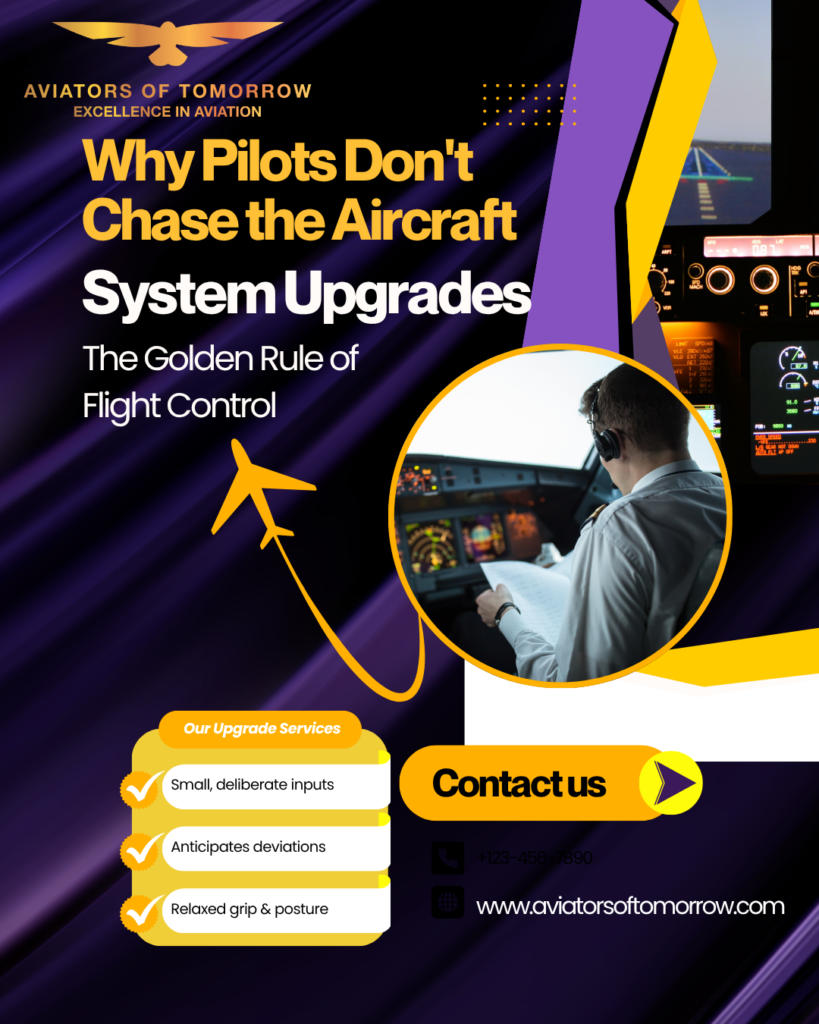
Table of Contents
What Does “Chasing the Aircraft” Actually Mean?
“Chasing the aircraft” happens when a pilot constantly reacts to what the aeroplane has already done instead of anticipating what it needs. Imagine you’re flying straight and level. The nose dips slightly and you pull back. It climbs a little too high when you push forward. You over-correct and now you’re creating a cycle of constant, unnecessary inputs.
This reactive flying style is one of the most common errors in student pilot control technique. Instead of staying ahead of the aircraft, the pilot is always one step behind, chasing a stable state that never quite arrives.
Good aircraft handling skills mean thinking ahead, anticipating the next moment rather than correcting the last one.
Understanding Overcontrol in Aviation
Overcontrol in aviation is exactly what it sounds like: doing too much with the controls. It is a natural response for nervous or inexperienced pilots. The brain senses deviation and signals the hands to fix it immediately and aggressively.
But here is the problem: many flight deviations require only small, measured control inputs rather than aggressive corrections. When a pilot over responds, the correction itself often becomes a new problem, leading to unnecessary oscillations and increased workload.
Common signs of overcontrol include:
- Constant altitude fluctuation during cruise
- Bank angle oscillations when attempting straight flight
- Tense, rigid grip on the control column or yoke
- Overcorrecting during the landing flare
Smooth flight control is the hallmark of an experienced aviator. That smoothness isn’t natural talent; it is a trained discipline.
Why Pilots Don’t Chase the Aircraft: The Psychology Behind It
To truly understand why pilots don’t chase the aircraft, you must understand the human instinct at work. When something feels wrong, the body reacts instantly. For pilots, that reaction without proper training almost always involves too much input.
Experienced aviators learn to pause between perception and action. That tiny mental gap is where good pilot decision-making in flight lives.
It is also worth understanding that an aircraft in stable flight has aerodynamic forces working in its favour. It wants to return to equilibrium. A pilot who constantly intervenes disrupts this natural tendency and actually makes the aircraft less stable.
This is often taught through the concept of hands-off flying, letting the aircraft fly itself for short moments to build trust in its inherent stability.
Control vs Overcontrol: The Core Difference
Let us break down control vs overcontrol clearly:
| Control | Overcontrol |
| Small, deliberate inputs | Large, reactive corrections |
| Anticipates deviations | Reacts to deviations |
| Relaxed grip and posture | Tense, white-knuckle flying |
| Smooth altitude and heading | Constant oscillation |
| Trusts aircraft stability | Fights aircraft stability |
The goal of every aviator of tomorrow is to move firmly into the left column through training, awareness and repetition.
The smoothest flights come from the smallest, most deliberate inputs.
Stand a chance to win 100% scholarship & start training with India’s trusted aviation institute. Apply & Check Eligibility.
Apply Now!The Role of Trim in Preventing Overcontrol
One of the most underused tools in the cockpit, especially by students, is the trim system. Trim is designed to relieve the pilot of the need to hold constant pressure on the controls. When used correctly, it dramatically reduces the tendency to overcontrol.
Many student pilots avoid trim because it feels like an extra step. But professional aviators consider proper use of aircraft trim to be one of the most essential aspects of basic flight technique. A well-trimmed aircraft practically flies itself, leaving the pilot free to think, navigate and monitor systems rather than fight the controls.
How Instructors Teach Pilots to Stop Overcontrolling
Flight instructors use several proven methods to help students develop smooth pilot inputs:
Fingertip Pressure Exercises
Students are taught to hold the controls with fingertip pressure only, no gripping. This instantly reduces the magnitude of inputs and forces the student to be gentler.
The “Press and Release” Method
Rather than holding a correction, pilots are taught to apply brief pressure, release and observe. This builds trust in the aircraft’s response and prevents over-correction cycles.
Partial Panel and Instrument Drills
Flying with limited visual reference forces the pilot to rely on the instrument scan technique and make measured, calculated inputs rather than instinctive ones.
Delayed Response Training
Instructors sometimes ask students to count to two before making any correction. This pause breaks the reactive cycle and encourages anticipatory thinking, the core of good cockpit discipline.
Why This Matters More at Critical Phases of Flight
Overcontrol in aviation becomes especially dangerous during:
Landing: The flare and touchdown demand the lightest possible touch. Chasing the runway with aggressive inputs can lead to bounced landings, porpoising, go-arounds and, in the worst cases, accidents.
Turbulence: In turbulent air, the instinct is to fight every bump. Experienced pilots relax the controls in turbulence and allow the aircraft to absorb the energy naturally. Fighting turbulence with aggressive inputs stresses the airframe unnecessarily.
Initial Climb and Go-Around: High power, changing pitch attitudes and asymmetric forces all demand precise but gentle rudder and aileron coordination. Overcontrol here can lead to dangerous yaw or roll deviations.
Building Anticipation: The Secret to Smooth Flying
The opposite of chasing the aircraft is anticipating the aircraft. This is built through:
- Understanding aircraft performance – knowing how the aeroplane behaves at various speeds, configurations and power settings
- Building flight hours – repetition trains the subconscious to recognise patterns before they become deviations
- Pre-empting power changes – applying small back pressure before adding power, for example, rather than correcting the pitch change after it happens
- Developing a visual scan – scanning instruments and outside references rhythmically rather than fixating on a single gauge
This anticipatory mindset is what separates a competent pilot from a great one and it is at the heart of aviator skill development.
Why Pilots Don’t Chase the Aircraft in Advanced Flying
As pilots progress to complex aircraft, multi-engine types or jet operations, the principle of why pilots don’t chase the aircraft becomes even more critical. Higher speeds mean that deviations develop faster. Larger aircraft have more inertia, meaning overcontrol creates massive energy management problems.
In commercial aviation, Standard Operating Procedures (SOPs) and automation management are built around this very principle to keep inputs small, intentional and ahead of the aircraft’s energy state at all times.
The phrase “aviate, navigate, communicate” exists precisely because experienced aviators know that controlled, prioritised action always outperforms frantic reaction.
Tips for Aspiring Pilots
If you are at the beginning of your flying journey, here are practical habits to build from day one:
- Relax your grip – tension in the hands creates tension in the controls
- Trim early and often – let the aircraft do the work
- Look ahead – both visually outside and mentally in your planning
- Trust small inputs – less is almost always more in the cockpit
- Debrief every flight – identify moments where you chased rather than led the aircraft
- Ask your instructor to demonstrate fingertip-only flying on your next lesson
Developing good pilot habits from the start is far easier than unlearning bad ones later.
You may read our blog “What Is a Multi-Engine Rating and Why Does It Matter for Pilots?“
Conclusion: Fly the Aircraft, Don’t Follow It
Understanding why pilots don’t chase the aircraft is one of the most transformative lessons in a pilot’s development. It shifts your mindset from reactive to proactive, from tense to relaxed and from following the aircraft to leading it.
Control vs overcontrol is not just a training topic; it is a philosophy of flying. These habits are also essential for success during DGCA flight training and throughout a pilot’s career.
Fly with intention. Fly with anticipation. And always remember the aircraft is not your enemy. Trust it, understand it and lead it.
Great pilots don’t control the aircraft more they control themselves better.
Stand a chance to win 100% scholarship & start training with India’s trusted aviation institute. Apply & Check Eligibility.
Apply Now!