Flutter in aircraft is one of the most dangerous and misunderstood phenomena in aviation. For the aviators of tomorrow, understanding how flutter develops, why it is deadly and how engineers and pilots work to prevent it is absolutely essential knowledge before stepping into a cockpit.
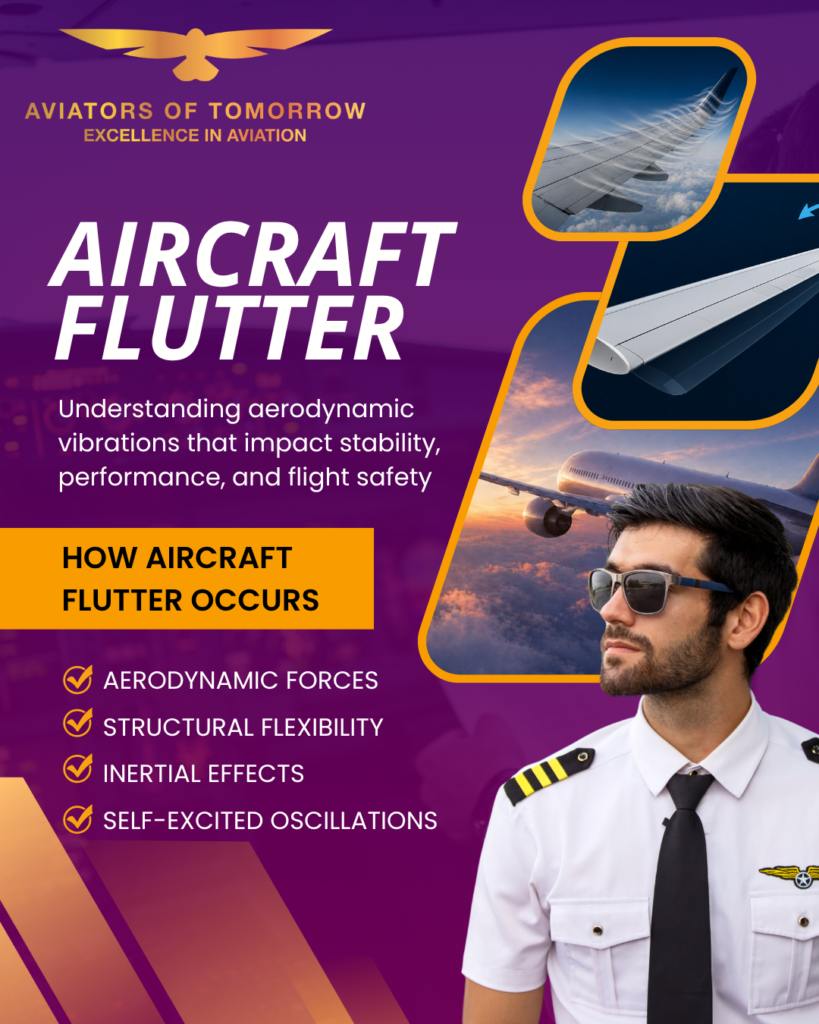
Table of Contents
What Is Flutter in Aircraft?
Flutter in aircraft is a self-excited, dynamic instability that occurs when aerodynamic forces interact with the natural structural flexibility of an airframe. In simple terms, it is a violent and rhythmic vibration that, if left unchecked, can destroy an aircraft within seconds.
Unlike ordinary turbulence or buffeting, flutter feeds on itself. The more the structure vibrates, the more energy the airstream pumps into it. This creates a deadly cycle of increasing oscillation that pilots cannot manually correct once it begins.
The Science Behind Aeroelastic Flutter
To truly understand flutter in aircraft, one must grasp the concept of aeroelastic flutter, the coupling between aerodynamic forces, elastic structural deformation and inertial forces.
Every aircraft structure is flexible to some degree. When air flows over a wing or control surface, it creates lift and drag forces. If the wing bends slightly, the angle of attack changes, which alters those forces, which causes further bending. This feedback loop is the foundation of aeroelastic flutter.
There are three key forces at play:
- Aerodynamic forces generated by airflow
- Elastic restoring forces from the aircraft’s structure
- Inertial forces from the mass distribution of the airframe
When these three forces fall into a certain relationship at a critical speed, the structure can no longer damp out the vibrations and flutter begins.
Master the science of flight understand flutter in aircraft and become a safer, smarter aviator.
Stand a chance to win 100% scholarship & start training with India’s trusted aviation institute. Apply & Check Eligibility.
Apply Now!Types of Flutter in Aircraft
Bending Flutter
Bending flutter involves oscillations in the vertical plane of a wing or tail surface. As the wing bends upward and downward repeatedly, the aerodynamic loading amplifies each cycle until the structure fails. This is most common in long, slender wings.
Torsional Flutter
Torsional flutter involves a twisting motion of the wing along its span axis. Because the centre of pressure and the elastic axis of a wing rarely coincide, aerodynamic forces can cause the wing to twist, changing the angle of attack and creating an unstable feedback loop.
Control Surface Flutter
Control surface flutter is particularly dangerous because it can occur at lower speeds than wing flutter. Ailerons, elevators and rudders are relatively lightweight and connected by cables or rods. If the mass balance of a control surface is incorrect, even a small aerodynamic disturbance can set off violent oscillations in the control surface, which then spread to the entire airframe.
What Is Flutter Speed?
The flutter speed is the critical airspeed at which flutter begins on a given aircraft. Below this speed, any vibrations introduced into the airframe are naturally damped out. Above it, vibrations grow exponentially.
Aircraft designers must ensure that the flutter speed is well above the maximum operating speed of the aircraft, typically by a margin defined by airworthiness regulations. In most certified aircraft, the flutter boundary must be at least 15–20% above the never exceed speed (Vne).
Exceeding Vne even briefly in a steep dive risks entering the flutter boundary, with potentially catastrophic consequences.
Historical Incidents Caused by Aircraft Vibration Flutter
The history of aviation is marked by tragedies directly linked to aircraft vibration and structural resonance. Some of the earliest experimental aircraft in the 1900s were lost because engineers did not yet understand flutter. In the 1940s and 1950s, as aircraft broke into higher speed regimes near the sound barrier, flutter related accidents increased significantly.
One of the most studied cases involves early jet aircraft that entered high speed dives and encountered violent oscillations that prevented recovery. These incidents drove the development of modern flutter analysis and flight testing procedures.
How Flutter Is Detected and Tested
Ground Vibration Testing
Before any new aircraft flies, engineers conduct extensive ground vibration testing (GVT). The airframe is mounted on soft supports and vibrated at a range of frequencies using mechanical shakers. This reveals the natural vibration modes of the structure and allows engineers to predict where flutter might occur.
Flutter Testing in Flight
Flutter testing in flight is one of the most hazardous phases of aircraft certification. Test pilots incrementally expand the aircraft’s speed envelope while engineers monitor structural vibrations using accelerometers fitted throughout the airframe.
At each test point, the pilot introduces a small disturbance such as a sharp stick input and engineers observe how quickly the vibrations die away. If damping decreases rapidly as speed increases, the aircraft is approaching its flutter boundary and testing is halted.
Flutter Suppression Systems
Modern commercial and military aircraft use sophisticated flutter suppression systems to actively counteract aeroelastic instability. These include:
- Active control surfaces that automatically deflect to damp out oscillations
- Structural stiffening through composite materials and clever design
- Mass balancing of control surfaces to move the centre of mass forward, preventing feedback loops
- Fly-by-wire systems that include flutter suppression algorithms in their software
These technologies have made modern aircraft significantly more resistant to dynamic instability, but they do not eliminate the need for pilots to respect operating limits.
The Role of Airframe Flutter in Aircraft Accidents
Airframe flutter remains a genuine threat in several categories of aviation:
Homebuilt and light aircraft are particularly vulnerable because amateur builders may not follow correct mass balance procedures on control surfaces or may deviate from approved designs in ways that reduce the flutter margin.
Ageing aircraft can develop flutter susceptibility as structural fatigue reduces stiffness and worn control linkages introduce free play, a key trigger for control surface flutter.
High-performance gliders operating in mountain wave conditions sometimes encounter speeds far above their normal range during uncontrolled spiral dives, placing them dangerously close to their flutter boundary.
How Pilots Can Avoid Flutter in Aircraft
Understanding aerodynamic forces and operating limits is the pilot’s primary defence against flutter. Here are the essential practices:
Respect the Vne. The never-exceed speed exists for a reason. Entering a steep dive, particularly in turbulent conditions, can cause airspeed to build rapidly. Pilots must monitor airspeed vigilantly and use airbrakes or spoilers as required.
Never modify control surfaces without proper engineering sign-off. Unapproved modifications to ailerons, elevators or rudders can alter mass balance and dramatically reduce the flutter margin.
Inspect for control surface free play. Before every flight, check that control surfaces move smoothly without excessive looseness. Free play in hinges or linkages is a known precursor to flutter.
Avoid overspeed during descent. Particularly in high-performance aircraft and gliders, pilots must manage energy carefully during descents to avoid unintentionally approaching the flutter boundary.
Report unusual vibrations immediately. Any unexplained vibration during flight should be treated as a potential flutter precursor. Reduce speed immediately and land as soon as practicable.
You May Read Our Blog “FADEC: The Brain Behind Modern Aircraft Engines“
Why Aviators Must Understand Flutter
Aviation is evolving rapidly. Electric aircraft, urban air mobility vehicles, high-altitude long endurance drones and supersonic business jets are all on the horizon. Each of these platforms will push into new flight regimes where structural resonance and flutter present fresh engineering challenges.
The next generation of pilots, engineers and aviation professionals, including those preparing for Directorate General of Civil Aviation (DGCA) examinations, must carry a deep understanding of flutter not just as an abstract engineering concept, but as a real operational hazard. Whether you are designing the next generation of composite airliners or flying a high performance glider in the mountains, flutter in aircraft is a threat that demands your full attention and respect.
Understanding aeroelastic flutter, aircraft flutter speed, the flutter boundary, and abnormal aircraft vibration is essential for every pilot. These concepts explain why flutter in aircraft remains one of the most critical structural hazards in aviation.
Every great pilot respects the limits of flight understanding flutter in aircraft is essential to flying safely and confidently.
Stand a chance to win 100% scholarship & start training with India’s trusted aviation institute. Apply & Check Eligibility.
Apply Now!