If you have ever glanced out of an aeroplane window and noticed the wingtip curving gently upwards, you have spotted one of aviation’s most elegant engineering solutions: aircraft winglets. For aviators of tomorrow, understanding aircraft winglets is essential, as these small structures play a surprisingly large role in flight efficiency, fuel economy and overall aircraft performance. This blog explores what aircraft winglets are, why they exist and how they continue to shape the future of commercial and general aviation.
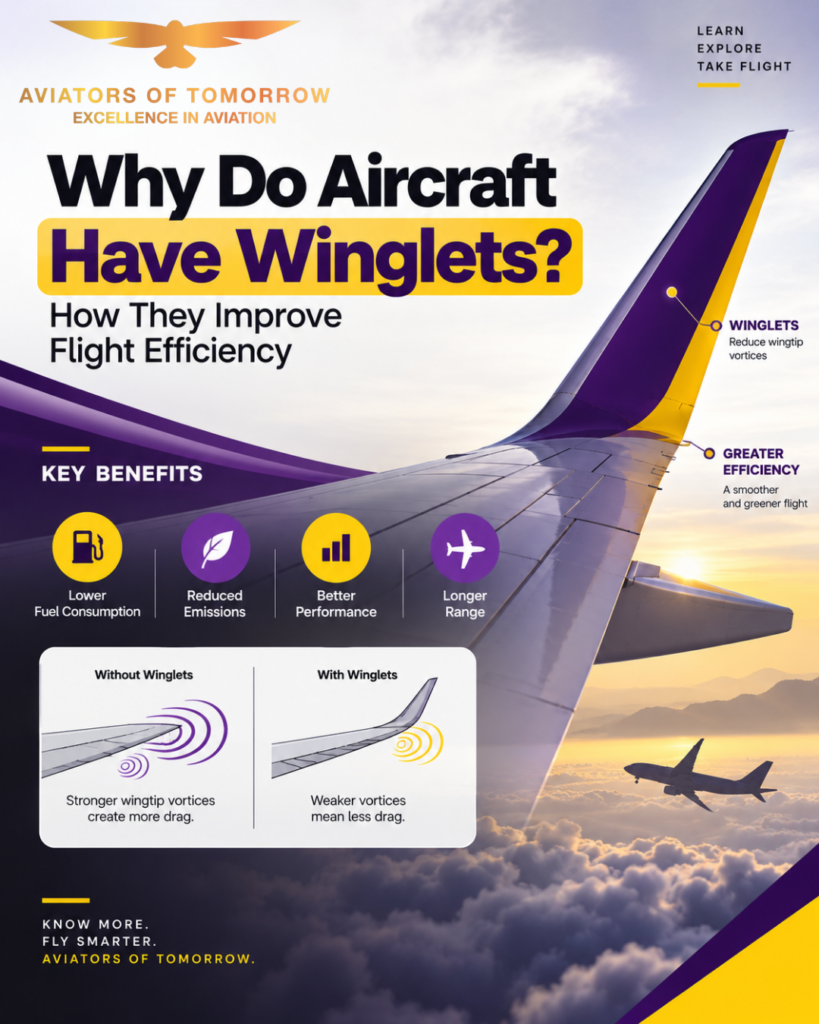
Table of Contents
What Are Aircraft Winglets?
Aircraft winglets are the near-vertical extensions found at the tips of an aeroplane’s wings. Unlike a flat wingtip, a winglet curves upward (and sometimes both upward and downward) to alter the way air flows around the wing’s edge. Aircraft winglets are not a decorative afterthought; they are carefully engineered wingtip devices designed using advanced aerodynamics to solve a very specific problem in flight.
To understand why aircraft winglets matter, we first need to understand what happens at the tip of a normal wing without one.
The Problem: Wing Tip Vortices and Induced Drag
Every wing generates lift by creating a pressure difference: higher pressure beneath the wing and lower pressure above it. At the wingtip, however, high-pressure air from below “leaks” around the edge to the low-pressure region above. This leakage creates swirling air masses known as wing tip vortices.
These vortices are not just a visual curiosity (sometimes visible as condensation trails behind aircraft in humid conditions) they are a major source of what aerodynamicists call induced drag. Induced drag increases fuel burn, reduces range and forces engines to work harder than necessary. This is precisely the inefficiency that aircraft winglets were designed to combat.
Understand the technology behind every flight and take your aviation knowledge to the next level.
Stand a chance to win 100% scholarship & start training with India’s trusted aviation institute. Apply & Check Eligibility.
Apply Now!How Wing Tip Vortices Affect Flight Efficiency
- They reduce effective lift near the wingtip
- They increase aerodynamic drag across the aircraft
- They lead to higher fuel consumption
- They can affect following aircraft through wake turbulence
For an aspiring aviator, grasping this concept is fundamental, because it explains the entire purpose behind wingtip devices such as aircraft winglets.
How Aircraft Winglets Improve Flight Efficiency
Aircraft winglets work by disrupting the formation of strong wing tip vortices. By angling the wingtip upward, the winglet reduces the pressure differential that causes air to spill over the edge of the wing. This clever redesign delivers several measurable benefits.
1. Reduced Induced Drag
The primary function of aircraft winglets is drag reduction. By smoothing the airflow at the wingtip, winglets reduce induced drag, allowing the aircraft to move through the air with less resistance.
2. Improved Fuel Efficiency
Less drag means engines require less thrust to maintain cruising speed. Airlines have reported fuel efficiency improvements of up to 5% on aircraft fitted with modern winglets, translating into significant savings over an aircraft’s operational lifetime.
3. Extended Range
Because aircraft winglets improve fuel economy, aeroplanes can often fly further on the same amount of fuel. This is particularly valuable for long-haul commercial aviation routes.
4. Lower Emissions
Reduced fuel burn naturally leads to lower carbon emissions, making aircraft winglets an important contributor to sustainable aviation goals as the industry works towards greener air travel.
5. Enhanced Climb Performance
Some pilots and engineers note that aircraft winglets can slightly improve climb performance and stability, particularly during take-off, by optimising lift distribution along the wingspan.
Types of Wingtip Devices Used in Modern Aviation
Not all wingtip devices look the same. Over the decades, aircraft manufacturers have developed several winglet designs, each suited to different aircraft types and performance goals.
Blended Winglets
Blended winglets feature a smooth, curved transition from the wing to the upward extension, reducing structural stress while still cutting drag effectively.
Split Scimitar Winglets
An evolution of the blended design, split scimitar winglets add a downward-facing component beneath the wingtip, further improving aerodynamic efficiency and fuel savings.
Sharklets
Popularised by Airbus, sharklets are a distinctive winglet design fitted to aircraft such as the A320 family, offering both drag reduction and improved wing aesthetics.
Raked Wingtips
Rather than curving upward sharply, raked wingtips extend the wing at a sweeping angle, achieving similar aerodynamic benefits without a pronounced vertical structure.
Why Understanding Aircraft Winglets Matters
For anyone training to become a pilot, aeronautical engineer or aviation enthusiast, aircraft winglets represent a perfect case study in applied aerodynamics. They demonstrate how a relatively small design change can produce outsized benefits in flight efficiency, fuel economy and aircraft performance.
Aviators of tomorrow should appreciate that aircraft winglets are the product of decades of aerodynamic research, wind tunnel testing and computational fluid dynamics modelling. Engineers such as Richard Whitcomb at NASA pioneered early winglet research in the 1970s and the technology has since become standard across commercial aviation fleets worldwide, from Boeing 737s to Airbus A350s.
Do All Aircraft Need Winglets?
Not necessarily. The benefits of aircraft winglets depend on factors such as:
- Aircraft size and wingspan
- Typical cruising altitude and speed
- Mission profile (short-haul versus long-haul)
- Airport gate space restrictions, since a longer wingspan without winglets may not fit certain gates
Smaller general aviation aircraft may see less dramatic benefits from winglets compared to large commercial jets, though many manufacturers still fit them for improved handling and marketing appeal.
The Future of Winglet Technology
As sustainable aviation becomes a greater priority, engineers continue refining wingtip devices. Future aircraft winglets may incorporate:
- Adaptive or folding winglet designs (already seen on the Boeing 777X)
- Lighter composite materials to reduce structural weight
- Advanced computational modelling for even greater drag reduction
- Integration with other aerodynamic improvements for hybrid and electric aircraft
For aviators of tomorrow, staying informed about these developments in wingtip technology will be essential to understanding the next generation of efficient, environmentally responsible aircraft.
You May Read Our Blog “Spatial Disorientation in Aviation: Why Pilots Can Lose Their Sense of Direction in Flight“
Conclusion
Aircraft winglets may appear to be a small design detail, but their impact on flight efficiency is anything but minor. By reducing wing tip vortices and induced drag, aircraft winglets improve fuel efficiency, extend range, lower emissions and enhance overall aircraft performance. As the aviation industry continues its pursuit of sustainability and efficiency, aircraft winglets will remain a key feature of wing design for years to come.
For every aspiring aviator, learning why aircraft have winglets is a small but meaningful step towards understanding the bigger picture of modern aviation. Developing a strong understanding of aerodynamics and aircraft performance is also important for students preparing for DGCA examinations and pursuing a career in aviation.
Your journey to becoming an aviator starts with understanding how modern aircraft achieve greater flight efficiency.
Stand a chance to win 100% scholarship & start training with India’s trusted aviation institute. Apply & Check Eligibility.
Apply Now!