If you are stepping into the world of aviation, one of the very first technical terms you will come across is V-Speeds. Understanding V-Speeds is not just an exam requirement, it is a matter of safety, precision and confidence in the cockpit. Every aviator, whether a student pilot or a seasoned captain, relies on V-Speeds to make split second decisions during takeoff, climb, cruise and landing. In this blog, we will break down what V-Speeds are, why they matter, how they are calculated and how you can remember them without confusion.
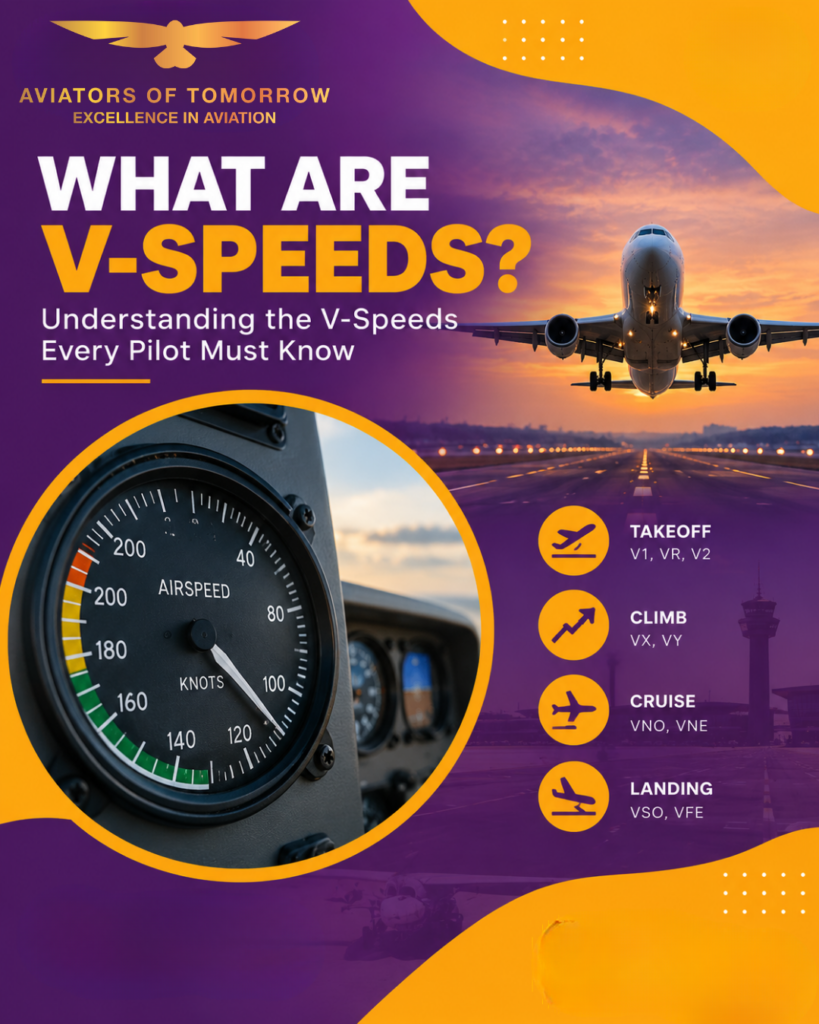
What Are V-Speeds in Simple Terms?
V-Speeds are standardised, codified aircraft speeds that indicate the safe operating limits of an aeroplane during different phases of flight. The “V” stands for “velocity,” and each V-Speed is denoted by a specific letter or number combination, such as V1, VR, V2 and VNE. These speeds are not arbitrary; they are calculated by aircraft manufacturers based on aerodynamic testing, aircraft weight, air density and runway conditions.
For a beginner pilot, learning V-Speeds might feel overwhelming at first, but once you understand the logic behind them, they become second nature. Every checklist, every briefing and every takeoff or landing procedure revolves around these numbers. In fact, most pre-flight briefings begin with a verbal confirmation of the day’s V-Speeds, tailored to that specific flight’s weight and weather.
Where Do V-Speeds Come From?
V-Speeds are not invented on the spot by pilots. They originate from rigorous flight-testing carried out by aircraft manufacturers during certification. Regulatory bodies such as the FAA and EASA require these speeds to be documented in the aircraft’s flight manual. Pilots then use this published data, combined with real-time conditions such as temperature, wind and runway length, to calculate the exact V-Speeds for that day’s flight.
Why Are V-Speeds Important ?
The future generation of pilots must treat V-Speeds as more than textbook knowledge. They are the backbone of flight safety. A wrongly calculated or misunderstood V-Speed can lead to a runway overrun, a stall or worse. That is why flying schools dedicate significant training hours purely to aircraft speed management and V-Speed recognition.
Knowing your V-Speeds means knowing exactly:
- When to commit to takeoff
- When to rotate the aircraft
- When to abort a takeoff safely
- What speed keeps you clear of a stall
- What structural speed limits should never be exceeded
- How to adjust your approach speed during landing
Types of V-Speeds Every Pilot Should Know
Let us now go through the most crucial V-Speeds used in modern aviation training and commercial operations.
V1 – Takeoff Decision Speed
V1 is arguably the most critical of all V-Speeds. It represents the maximum speed at which a pilot can safely abort a takeoff. Beyond V1, the aircraft must continue the takeoff roll, even in the event of an engine failure, because there may not be enough runway remaining to stop safely. Pilots calculate V1 before every departure, factoring in runway length, aircraft weight and surface conditions.
VR – Rotation Speed
VR is the speed at which the pilot begins to pull back on the controls to lift the nose wheel off the ground. This V-Speed ensures the aircraft has enough lift to leave the runway safely and transition smoothly into the climb phase. VR is always calculated to occur after V1 and before V2 is reached.
V2 – Takeoff Safety Speed
V2 is the minimum speed that must be maintained after takeoff, particularly if one engine fails. It guarantees a safe climb gradient even under reduced power conditions, allowing the aircraft to clear obstacles and continue climbing safely.
Know Your V-Speeds. Fly Smarter. Fly Safer.
Stand a chance to win 100% scholarship & start training with India’s trusted aviation institute. Apply & Check Eligibility.
Apply Now!VSO – Stalling Speed in Landing Configuration
VSO indicates the speed at which the aircraft will stall when flaps and landing gear are fully extended. Staying above this speed during approach is essential to avoid a dangerous stall close to the ground, where recovery altitude is limited.
VS1 – Stalling Speed in a Specified Configuration
Closely related to VSO, VS1 refers to the stalling speed in a particular configuration, often with flaps retracted. Pilots use this figure to understand the aircraft’s stall margin during cruise and maneuvering flight.
VFE – Maximum Flap Extended Speed
VFE tells the pilot the highest speed at which flaps can be safely extended without causing structural damage. Exceeding VFE while flaps are deployed can place excessive stress on the flap mechanism.
VNE – Never Exceed Speed
As the name suggests, VNE is the absolute speed limit of the aircraft. Exceeding this speed can result in structural failure, flutter or loss of control, making it one of the most important V-Speeds to respect at all times.
VNO – Maximum Structural Cruising Speed
VNO represents the speed above which the aircraft should only be flown in smooth air conditions. Flying beyond VNO in turbulence increases the risk of structural stress and damage.
VX – Best Angle of Climb Speed
VX allows the aircraft to gain the most altitude over the shortest horizontal distance extremely useful when clearing obstacles such as trees or terrain shortly after takeoff.
VY – Best Rate of Climb Speed
VY provides the greatest altitude gain over time, which is ideal for a normal climb out after departure when obstacle clearance is not an immediate concern.
VA – Manoeuvring Speed
VA is the maximum speed at which full or abrupt control inputs can be applied without overstressing the airframe. Flying below VA reduces the risk of structural damage during turbulence or sudden manoeuvres.
VMC – Minimum Control Speed
VMC is the lowest speed at which the pilot can maintain directional control of a multi-engine aircraft if one engine fails. Below VMC, the pilot risks losing directional authority, which can lead to a dangerous loss of control.
VREF – Reference Landing Speed
VREF is the target speed used during the final approach to landing, typically calculated as a safe margin above the stalling speed in landing configuration.
How V-Speeds Change With Aircraft Weight and Conditions
One key thing every aviator of tomorrow must understand is that V-Speeds are not fixed numbers. They vary depending on several factors, including:
- Aircraft weight
- Runway length and surface condition
- Wind direction and speed
- Air density and temperature
- Flap and slat configuration
- Runway slope and elevation
This is why pilots calculate V-Speeds before every single flight using performance charts, electronic flight bags or onboard flight computers. A V1 calculated for a heavy aircraft on a short runway will be very different from the same aircraft flying light on a long runway on a cool day. Understanding this variability is central to safe flight planning.
How Pilots Memorise V-Speeds
Many student pilots ask, “How do I remember all these V-Speeds?” The answer lies in repetition, structured learning and real-world application. Flight instructors often use mnemonic techniques, coloured charts and simulator training to reinforce V-Speed recognition. Over time, calling out “V1… Rotate… V2” during every takeoff briefing becomes an instinctive part of flying, embedded through muscle memory rather than rote memorisation alone.
Some instructors also recommend grouping V-Speeds by phase of flight takeoff speeds, climb speeds, cruise speeds and landing speeds rather than trying to memorise them all at once. This structured approach makes the entire concept far less intimidating for new aviators.
Why V-Speeds Matter Beyond the Classroom
Understanding V-Speeds is not just about passing a theory exam. In real-world flying, these numbers directly influence:
- Runway selection and length requirements
- Load and weight planning
- Emergency decision-making during engine failures
- Fuel efficiency during climb-out
- Overall flight safety culture within an airline or flying school
Airlines and flight schools place heavy emphasis on V-Speed accuracy because even a small miscalculation can compromise the safety of the entire flight. Simulator sessions frequently test a pilot’s response to V1 cuts, where an engine failure is simulated right at the decision speed, forcing the pilot to react correctly within seconds.
Common Mistakes Beginners Make With V-Speeds
New pilots sometimes confuse similar-sounding V-Speeds or forget that these values change with aircraft configuration. Some common errors include:
- Mixing up VR and V2 during takeoff briefings
- Forgetting to recalculate V-Speeds for a different runway or airport
- Ignoring the impact of temperature and altitude on V-Speed values
- Not briefing V-Speeds verbally before departure
- Assuming V-Speeds from one aircraft type apply to another
Avoiding these mistakes comes down to consistent practice, disciplined pre-flight preparation and a genuine understanding of why each V-Speed exists rather than simply memorising numbers.
The Role of V-Speeds in Modern Flight Training
Modern flight training programmes increasingly use simulators to expose student pilots to real-world scenarios involving V-Speeds. From rejected takeoffs at V1 to engine failures just after VR, these exercises build the confidence and muscle memory needed to react correctly under pressure. As aviation technology advances, some aircraft now calculate V-Speeds automatically using onboard computers, though pilots are still required to understand the underlying principles manually.
You May Read Our Blog “Why Do Aircraft Have Winglets? How They Improve Flight Efficiency“
Final Thoughts on V-Speeds
For the aviators of tomorrow, mastering V-Speeds is a non-negotiable milestone in flight training. These speeds form the foundation of safe takeoffs, climbs, cruising and landings. Whether you’re flying a small trainer aircraft or a commercial jet, understanding and respecting V-Speeds is an essential part of becoming a safe and competent pilot. For aspiring pilots training in India, developing a strong understanding of these concepts also supports the standards and knowledge expected under Directorate General of Civil Aviation guidelines and pilot training requirements.
As you continue your journey in aviation, take time to understand not just what each V-Speed means, but why it exists. This deeper understanding, combined with proper training and adherence to DGCA requirements, will help you become a safer, more confident and more capable pilot in the skies of tomorrow.
Master the Numbers Behind Every Safe Flight.
Stand a chance to win 100% scholarship & start training with India’s trusted aviation institute. Apply & Check Eligibility.
Apply Now!