When the Boeing 747 first took to the skies in 1969, it didn’t just represent another aircraft it symbolised humanity’s bold vision to make the world smaller, more connected and accessible to millions. The Boeing 747, affectionately known as the “Queen of the Skies,” transformed commercial aviation by introducing the wide-body jet era and setting standards that would define long-haul travel for over five decades. This iconic jumbo jet became more than an engineering marvel; it became a cultural phenomenon that brought families together across continents, enabled global commerce and turned international travel from a luxury into an attainable dream for the average traveller.
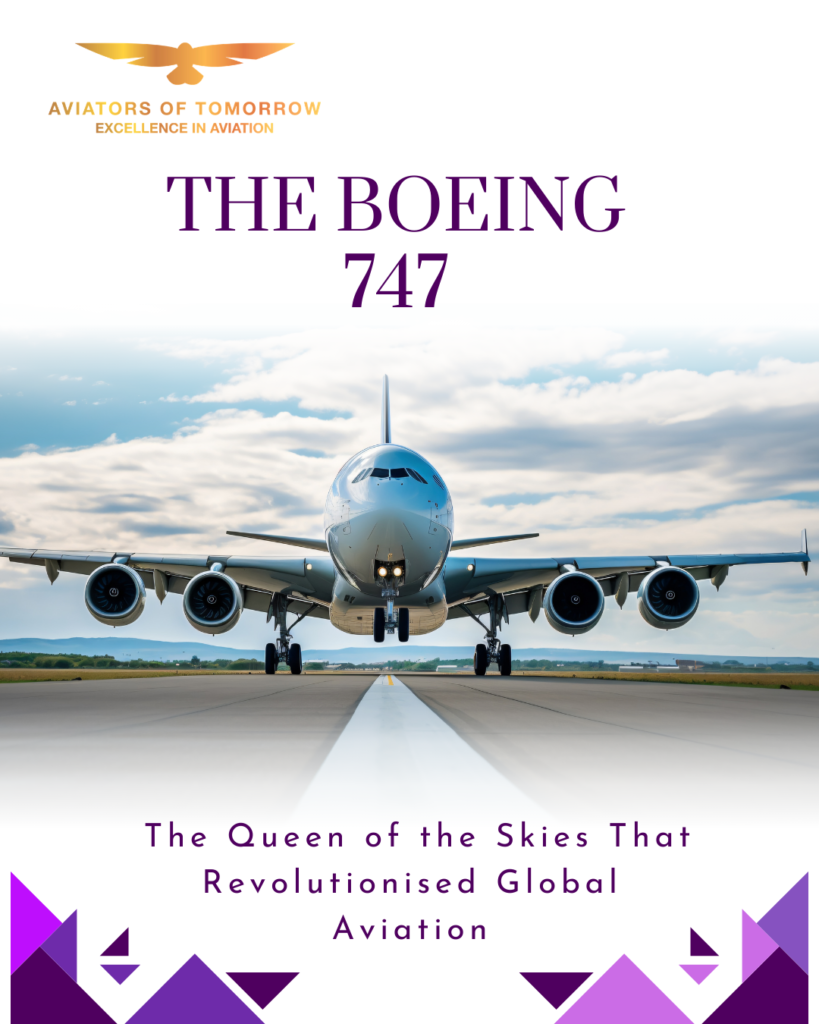
Table of Contents
The Boeing 747: The Birth of an Aviation Legend
The story of the Boeing 747 begins in the mid 1960s when Pan American World Airways approached Boeing with an ambitious request: build an aircraft twice the size of anything currently flying. The airline industry was experiencing unprecedented growth and existing aircraft couldn’t keep pace with passenger demand. Boeing accepted this monumental challenge, betting the company’s future on creating the world’s first wide-body commercial jetliner.
The development program required Boeing to construct the world’s largest building, the Everett factory in Washington State just to accommodate the massive aircraft. The engineering team, led by Joe Sutter, faced countless technical challenges in designing an aircraft that could carry up to 400 passengers efficiently and safely. They created a distinctive hump-backed design with the cockpit positioned above the main passenger deck, originally envisioning that the upper deck would facilitate cargo loading when passenger jets eventually transitioned to supersonic travel.
The 747 jumbo jet made its maiden flight on February 9, 1969, with test pilot Jack Waddell at the controls. Despite initial concerns about its size and commercial viability, the aircraft entered service with Pan Am on January 22, 1970, on the New York to London route. The Boeing 747 immediately captured public imagination, reducing travel times and costs while offering unprecedented comfort and capacity.
Revolutionary Design and Engineering Excellence
What made the Boeing 747 truly revolutionary was its innovative design philosophy. The aircraft featured four powerful engines, initially Pratt & Whitney JT9D turbofans that provided the thrust necessary to lift its massive weight. The wide-body fuselage measured 20 feet across, allowing for spacious twin-aisle cabins that eliminated the cramped conditions of earlier aircraft.
The jumbo jet’s distinctive upper deck became one of its most recognisable features. Initially designed as a short bubble to house the cockpit, airlines quickly realised the commercial potential of this space. It evolved into premium seating areas, luxurious lounges and in some configurations, even bedrooms for first-class passengers. This versatility demonstrated Boeing’s commitment to creating an aircraft that could adapt to various airline business models.
The 747 aircraft incorporated advanced avionics for its era, including one of the first commercial applications of high-bypass turbofan engines, which significantly improved fuel efficiency compared to earlier turbojet engines. The wing design, with its distinctive sweep and massive surface area, provided excellent lift characteristics while maintaining stability during all phases of flight.
Variants That Shaped Different Markets
Throughout its production life, Boeing developed numerous variants of the Boeing 747 to serve different market segments. The 747-100 was the original model, followed by the 747-200 with increased range and payload capacity. The 747-300 featured an extended upper deck, providing significantly more passenger capacity and creating the classic profile most people associate with the jumbo jet today.
The 747-400, introduced in 1988, represented a quantum leap in technology and efficiency. With winglets, updated engines, a glass cockpit and extended range, the 747-400 became the best-selling variant, with over 690 units delivered. Airlines could fly nonstop between virtually any two points on Earth, opening new routes and connecting previously underserved markets.
The final passenger variant, the 747-8 Intercontinental, launched in 2011 with even greater fuel efficiency, reduced noise levels and modern amenities. However, by this time, twin-engine aircraft like the Boeing 777 and Airbus A350 had evolved to offer similar capacity with better economics, gradually eroding the jumbo jet’s market dominance.
The freighter versions of the Boeing 747 deserve special mention. The 747-8F remains in production and continues to dominate the long-haul cargo market. Its nose loading capability, massive cargo volume and proven reliability make it indispensable for transporting oversized cargo, perishable goods and high-value shipments worldwide.
Cultural Impact and Iconic Status
Beyond its technical achievements, the Boeing 747 became deeply embedded in popular culture. It appeared in countless movies, from disaster films to action thrillers, always representing power, luxury and adventure. The aircraft served as Air Force One, carrying U.S. presidents around the world and becoming a symbol of American technological prowess and diplomatic reach.
The jumbo jet made international travel accessible to the middle class. By doubling or tripling capacity compared to earlier aircraft, the 747 aircraft helped drive down ticket prices, enabling families to visit distant relatives, students to study abroad and businesses to expand globally. It facilitated cultural exchange on an unprecedented scale, contributing to globalisation in ways that extended far beyond aviation.
Airlines competed to outfit their 747s with the most luxurious amenities. Upper deck lounges became legendary, with some carriers installing piano bars, showers and sleeping compartments. The spacious cabins allowed for innovations in flight entertainment, meal service and passenger comfort that set new industry standards.
Your journey to the cockpit starts early.
Dreaming of flying Boeing aircraft one day? Don’t let financial barriers ground your ambition.
👉 Apply for our Aviation Scholarship today and take one confident step closer to becoming a professional pilot.
Stand a chance to win 100% scholarship & start training with India’s trusted aviation institute. Apply & Check Eligibility.
Apply Now!Economic Impact on Global Aviation
The Boeing 747 fundamentally altered aviation economics. Its high capacity made hub and spoke networks more viable, leading to the development of major international hubs like Dubai, Singapore and Hong Kong. Airlines could consolidate passengers onto fewer flights between these hubs, then distribute them to final destinations on smaller aircraft.
This efficiency enabled the explosive growth of international tourism and business travel. Destinations that seemed impossibly remote became accessible weekend getaway options. The jumbo jet made it economically feasible to transport perishable goods like flowers from Kenya or seafood from Alaska to markets worldwide, transforming local economies.
However, the 747’s four-engine configuration eventually became its economic Achilles’ heel. As twin-engine aircraft became more reliable and regulations changed to allow extended over-water operations, airlines gravitated toward more fuel-efficient alternatives. The 777 and A350 could serve the same routes with 20-30% lower operating costs, making them more attractive investments.
Technical Innovations That Advanced Aviation
The development of the Boeing 747 pushed boundaries across multiple engineering disciplines. The high-bypass turbofan engines created for the jumbo jet revolutionised propulsion technology, establishing principles that underpin all modern jet engines. These engines delivered thrust more efficiently by moving larger volumes of air at lower velocities, reducing fuel consumption and noise.
The advanced materials and manufacturing techniques developed for the 747 aircraft influenced subsequent aircraft design across the industry. Boeing pioneered new aluminium alloys, advanced composites and joining methods that improved strength while reducing weight. The quality control processes established for the program became industry benchmarks.
The flight control systems represented significant advances in commercial aviation automation. Later variants incorporated fly-by-wire technology, computerised systems management and sophisticated autopilot capabilities that reduced pilot workload while improving safety and efficiency.
Environmental Considerations and Evolution
As environmental awareness grew, the Boeing 747 faced increasing scrutiny regarding its fuel consumption and emissions. Boeing responded with continuous improvements, with each new variant delivering measurably better environmental performance than its predecessors.
The 747-8 achieved a 16% improvement in fuel efficiency compared to the 747-400, while also meeting strict noise regulations that earlier variants struggled to satisfy. Modern engine technology, aerodynamic refinements and weight reduction contributed to these gains, demonstrating that even mature aircraft designs could evolve to meet changing environmental standards.
However, the fundamental economics of four engines versus two ultimately proved insurmountable. Twin-engine aircraft not only burned less fuel but also required less maintenance, generated lower emissions and faced fewer regulatory restrictions. This reality, combined with evolving market demands for smaller, more frequent flights, gradually diminished the jumbo jet’s role in passenger service.
The Freighter Legacy Continues
While passenger 747s have largely disappeared from airline fleets, the cargo variant of the Boeing 747 remains vital to global commerce. The 747-8F continues in production, serving cargo carriers who value its unmatched payload capacity and versatility. Major operators like UPS, Cargolux and Atlas Air rely on these aircraft to move everything from automotive parts to electronics across continents.
The nose-loading capability of the 747 freighter allows it to accommodate outsized cargo that won’t fit in other aircraft. Wind turbine blades, satellite components, emergency relief supplies and even other aircraft parts move regularly aboard these workhorses. During the COVID-19 pandemic, when passenger flights plummeted, cargo 747s became lifelines, transporting medical supplies, vaccines and essential goods worldwide.
This cargo specialisation ensures the Boeing 747 will remain active for decades to come. Freighter aircraft typically enjoy longer service lives than passenger jets and many passenger 747s have been converted to cargo configuration, extending their operational usefulness well beyond their original missions.
Memorable Moments in 747 History
The Boeing 747 has been central to numerous historic moments. In 1977, two 747s collided on the runway in Tenerife, resulting in aviation’s deadliest accident and leading to fundamental changes in cockpit communication protocols and air traffic control procedures. The tragedy demonstrated that even the most advanced aircraft require constant vigilance and improved safety systems.
On a more positive note, a 747 carried Pope John Paul II on his historic papal visits, becoming a symbol of faith connecting with believers worldwide. The aircraft transported Olympic teams, royal families and heads of state, often serving as a platform for historic meetings and diplomatic breakthroughs.
NASA utilised a modified 747 as the Shuttle Carrier Aircraft, transporting the Space Shuttle orbiter between landing sites and launch facilities. These flights captured public imagination, showing the jumbo jet carrying humanity’s spacecraft on its back, a powerful image of one engineering marvel supporting another.
Pilot Perspectives and Flight Characteristics
Pilots who flew the Boeing 747 consistently describe it as a magnificent aircraft with distinctive handling characteristics. Despite its enormous size, the jumbo jet proved responsive and forgiving, with well-harmonised controls that provided excellent feedback. The flight deck offered superb visibility and the aircraft’s stability made it comfortable to fly in various conditions.
Training to fly the 747 aircraft represented a career pinnacle for many pilots. The transition from smaller aircraft required mastering new techniques for managing the jumbo jet’s momentum, planning longer approaches and understanding its unique aerodynamic properties. Captains appreciated the redundancy built into every system, providing multiple backups that enhanced safety margins.
The upper deck cockpit position gave pilots a commanding view, though it also meant that judging the aircraft’s position during landing required practice and precision. Experienced 747 pilots developed an instinctive feel for the aircraft, knowing exactly how it would respond in every situation from takeoff to landing.
Engineering Challenges and Solutions
Creating the Boeing 747 required solving unprecedented engineering challenges. The sheer size demanded new approaches to structural design, ensuring the airframe could withstand enormous stresses while remaining light enough for efficient flight. Boeing engineers developed innovative stress distribution methods and employed computer modelling that was cutting-edge for the 1960s.
The landing gear system exemplified the creative problem-solving required. The jumbo jet needed gear robust enough to support maximum takeoff weights exceeding 400 tons while fitting within wing and fuselage structures. The solution involved 18 wheels arranged in a complex configuration that distributed loads effectively while retracting into a limited space.
Engine integration posed another significant challenge. The four massive engines needed careful positioning to balance thrust, minimise asymmetric handling if an engine failed and provide adequate ground clearance. Boeing’s solution created the characteristic engine placement that became the 747’s visual signature.
The End of an Era
In 2023, Boeing delivered its final Boeing 747, a freighter destined for Atlas Air, closing a production run spanning 54 years. The delivery ceremony was emotional, with thousands of current and former Boeing employees gathering to bid farewell to an aircraft that defined their company and careers. It marked the end of the four-engine commercial jet era, as no manufacturer plans to develop a similar aircraft.
The last passenger 747 flights generated enormous public interest, with aviation enthusiasts worldwide tracking final services and bidding farewell to the Queen of the Skies. Airlines organised special commemorative flights and airports hosted celebrations honouring the jumbo jet’s contributions to global connectivity.
While new 747s will no longer roll off production lines, existing aircraft will continue flying for years, particularly freighters. Museums worldwide have preserved examples of various 747 variants, ensuring future generations can appreciate this engineering masterpiece that changed aviation history.
Looking Forward: The 747’s Lasting Influence
Though production has ended, the Boeing 747‘s influence on aviation remains profound. The wide-body concept it pioneered became the industry standard for long-haul travel. The jumbo jet proved that passengers valued comfort and airlines could profit from high-capacity operations, principles that guide aircraft design today.
The manufacturing techniques, quality systems and project management approaches developed for the 747 program influenced how Boeing and the entire aerospace industry operate. The Everett factory remains the world’s largest building by volume, continuing to produce 777s and 787s using methods refined during the 747 era.
Future historians will recognise the Boeing 747 as a transformative technology that shrank the world, democratised international travel and demonstrated what human ingenuity could achieve. Like the ocean liners of previous eras, the jumbo jet represents a specific moment when size, luxury and capability combined to create something truly special.
Technical Specifications That Defined Excellence
Understanding the Boeing 747‘s impact requires appreciating its impressive specifications. The 747-8, the final and most advanced variant, measures 250 feet in length with a wingspan of 224 feet. Maximum takeoff weight reaches 987,000 pounds, with passenger capacity ranging from 410 to over 600, depending on configuration.
The aircraft’s range of approximately 8,000 nautical miles allows nonstop service between virtually any city pair globally. Cruise speed of Mach 0.85 balanced efficiency with competitive travel times. These capabilities gave airlines unprecedented flexibility in route planning and scheduling.
The cargo capacity deserves special mention—the 747-8F can carry 307,600 pounds of payload, significantly more than any competing freighter. This advantage, combined with its unique nose-loading capability, ensures continued relevance in cargo operations despite passenger variants retiring from service.
The Human Stories Behind the Numbers
Beyond statistics and specifications, the Boeing 747 represents millions of human stories. Families reunited across continents, businesspeople closing international deals, students beginning overseas adventures, and couples honeymooning in exotic destinations all made possible by this aircraft’s capacity and economics.
Airline crews developed a deep affection for the jumbo jet, with flight attendants particularly appreciating the spacious galleys and multiple aisles that made service easier. The upper deck created intimate spaces where crews could provide personalised service, building customer loyalty that benefited airlines for decades.
Engineers, mechanics and ground crews worldwide developed specialised expertise in maintaining and servicing 747s. This knowledge base represents an invaluable human capital investment that airlines and maintenance organizations built over decades, creating careers and livelihoods for countless aviation professionals.
You may read our blog “Boeing 737: A Deep Technical Guide for the Next Generation of Airline Pilots“
Conclusion: A Legacy That Soars Beyond Aviation
The Boeing 747 achieved what its creators envisioned and far more. It democratised international travel, transformed global commerce and became an enduring symbol of human achievement and technological progress. While newer, more efficient aircraft have assumed the routes once dominated by the Queen of the Skies, the jumbo jet’s contributions to connecting humanity remain unmatched. Across countries including India, aviation authorities such as the Directorate General of Civil Aviation (DGCA) played a crucial role in regulating, certifying and overseeing the safe operation of the Boeing 747, ensuring that this giant of the skies met the highest international safety standards.
For those who flew it, maintained it or simply marvelled at its graceful presence, the 747 represents more than aluminium, engines and systems; it embodies the audacious belief that we could build something magnificent, something that would expand our horizons and bring the world together. Under the regulatory frameworks of organisations like the DGCA and other global aviation bodies, the Boeing 747 operated safely for decades, connecting millions across continents. That legacy will endure long after the last 747 finally retires from service, inspiring future generations to dream big and reach for the skies.
Ready to turn your Boeing dreams into reality?
The world needs skilled pilots and your journey can begin right now. Our scholarship is designed to support passionate future aviators like you with guidance, resources, and financial assistance.🎓 Seats are limited. Dreams shouldn’t be.
👉 Complete the Scholarship Application Form today and start your flight training journey with confidence.
Stand a chance to win 100% scholarship & start training with India’s trusted aviation institute. Apply & Check Eligibility.
Apply Now!