Pilot Input and Aircraft Response is one of the most important concepts in aviation training. Every aspiring aviator wonders about the invisible chain of events that unfold the moment a pilot touches the controls. Understanding Pilot Input and Aircraft Response helps student pilots learn how aircraft react to control inputs in real flight conditions. Pilot input and aircraft response; this relationship is the heartbeat of flight. Understanding it is not merely academic; it is the foundation upon which safe, confident flying is built. Whether you are a student pilot logging your first hours or a future commercial captain, knowing what happens inside your aircraft between your command and its reaction will transform the way you fly forever. Pilot Input and Aircraft Response are fundamental concepts that every student pilot must understand. Modern aircraft systems including fly-by-wire technology, hydraulic flight controls and mechanical flight controls all play a major role in how aircraft controls work during flight operations.
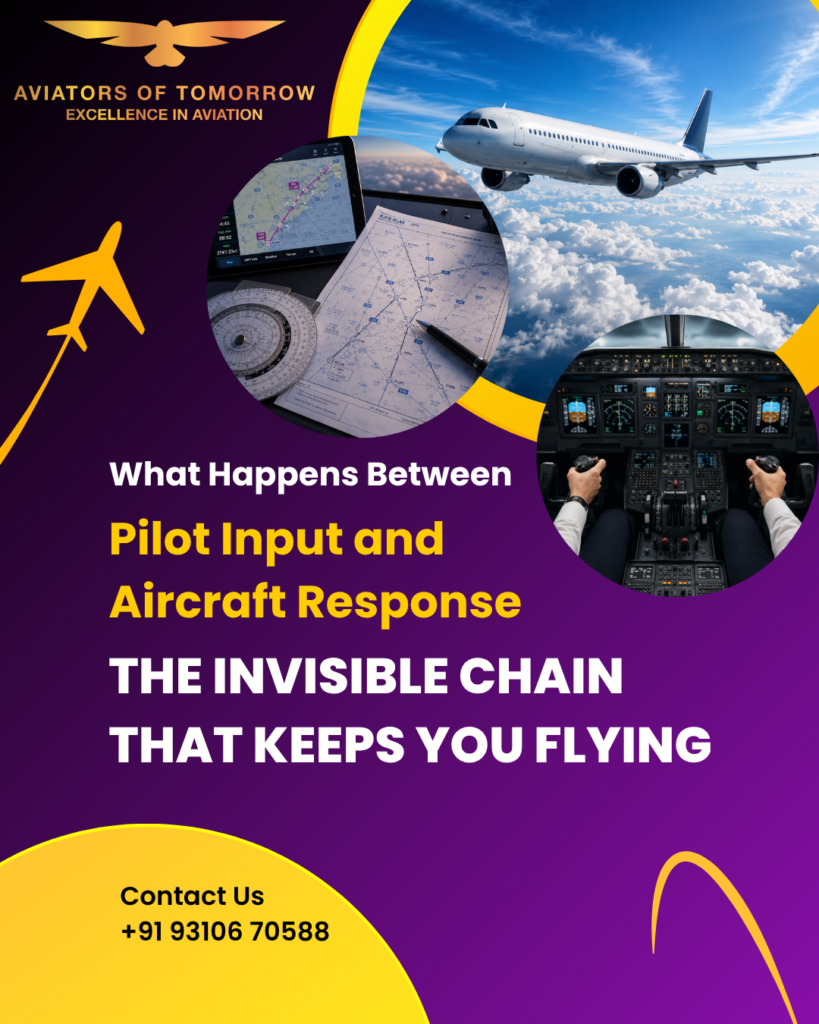
Table of Contents
The Anatomy of Pilot Input and Aircraft Response in Modern Aircraft
When a pilot moves the control column, pushes a rudder pedal or advances the throttle, a carefully engineered sequence begins. This is not magic, it is mechanical precision, hydraulic force and digital intelligence working in harmony.
Modern aircraft translate cockpit commands through one of three primary systems:
- Mechanical linkages – cables and pulleys in older or lighter aircraft
- Hydraulic flight controls – used in most commercial and military jets
- Fly by wire technology – digital signals replacing physical connections
Each system carries the pilot’s intention from hand and foot to wing and tail, but the journey differs dramatically depending on the aircraft type. For future pilots, recognising which system you are operating is the very first step towards mastering aircraft handling.
Mechanical Flight Controls: The Direct Connection
In light aircraft such as the Cessna 172, pilot input travels through a direct mechanical path. Steel cables run from the yoke through the fuselage and connect to ailerons, elevators and rudder surfaces. When you pull back, the elevator rises almost immediately. The control surface deflection is instant and proportional. Understanding Pilot Input and Aircraft Response helps pilots feel how control movements affect the aircraft directly.
This directness is why light aircraft are excellent training platforms. The pilot feels every air load, every gust, every stall buffet through the controls. There is no computer filtering the experience. The aerodynamic feedback is raw and honest, a conversation between pilot and machine that no simulator can fully replicate.
However, this system has limits. As aircraft grow larger and faster, the aerodynamic loads on control surfaces become enormous. A human hand alone cannot overcome them. This is where more advanced systems take over.
Hydraulic Flight Controls Power Behind the Movement
Large aircraft rely on hydraulic flight control systems to multiply the pilot’s physical effort. When a pilot inputs a command, that movement activates a hydraulic valve. High-pressure fluid, typically operating between 3,000 and 5,000 PSI, powers an actuator that physically moves the control surface.
The result is that a light wrist movement can deflect a surface the size of a small car against hundreds of kilometres per hour of airflow. Hydraulic actuation makes the aircraft feel light and responsive regardless of speed or altitude.
Most commercial aircraft carry two or three independent hydraulic circuits. Should one fail, the others maintain flight control authority. This redundancy is not optional; it is mandated by airworthiness regulations across every major aviation authority, including the CAA, EASA and FAA. Understanding hydraulics is not just engineering knowledge; it is airmanship.
Fly-By-Wire Technology in Modern Aircraft
The most revolutionary development in modern aviation is fly-by-wire flight control. Aircraft such as the Airbus A320 family, Boeing 777 and virtually all new-generation jets use this technology.
Here, the pilot’s physical input is converted into an electrical signal. That signal travels to flight control computers, which interpret the command, cross-check it against aircraft state data, speed, altitude, angle of attack, load factor and then send an output signal to the hydraulic or electro-hydraulic actuators that move the surfaces.
The entire process happens in milliseconds.
What makes fly-by-wire genuinely transformative is the layer of flight envelope protection built into the software. The aircraft will not allow commands that exceed structural limits or aerodynamic boundaries. A pilot cannot inadvertently over-bank, over-speed or stall the aircraft beyond recovery; the computers intervene silently and instantly.
This does not remove pilot authority. It redefines it. The pilot commands an outcome: a bank angle, a pitch attitude, a rate of climb and the system finds the most efficient and safe way to achieve it. Modern aircraft use computers to optimize Pilot Input and Aircraft Response for safety and efficiency.
The Role of Control Surfaces in Pilot Input and Aircraft Response
Regardless of how the command travels, the actual response of an aircraft depends entirely on aerodynamic control surfaces. These are:
Primary Controls:
- Ailerons – roll control, situated on the outer wing trailing edge
- Elevator – pitch control, on the horizontal stabiliser
- Rudder – yaw control, on the vertical stabiliser
Secondary Controls:
- Flaps – increase lift and drag for take-off and landing
- Spoilers – reduce lift, increase drag, assist roll
- Trim tabs – relieve sustained control loads on the pilot
When a control surface deflects, it changes the local camber and angle of attack of that section of the aircraft. This alters the pressure distribution, generating a force that rotates the aircraft about its centre of gravity. The aircraft does not merely turn; it rotates in three dimensions simultaneously.
Understanding this is the gateway to mastering aircraft handling qualities and becoming the kind of pilot who is always ahead of the aircraft rather than behind it.
Understand how your inputs become aircraft movements and every flight will feel more controlled, more predictable and more professional.
Stand a chance to win 100% scholarship & start training with India’s trusted aviation institute. Apply & Check Eligibility.
Apply Now!Time Lag: Why Response Is Never Truly Instant
One of the most important concepts for student pilots is that aircraft response latency exists even in the most advanced jets. There is always a brief delay between input and motion, caused by:
- Hydraulic valve opening time
- Actuator travel distance
- Aerodynamic build-up of force
- Aircraft inertia
In light aircraft, this lag is measured in fractions of a second. In large, heavy jets, it can feel more pronounced, particularly at low speeds where aerodynamic forces are weaker.
This is precisely why anticipation is a core pilot skill. Experienced aviators learn to lead their inputs, making small corrections ahead of need rather than reacting after the fact. It is the difference between chasing the aircraft and flying it. Every hour you spend understanding control response behaviour makes you a sharper, calmer and safer pilot.
Stability and Control: The Balance That Makes Flight Possible
Aircraft are deliberately designed with a degree of inherent aerodynamic stability. A stable aircraft, when disturbed, tends to return towards its trimmed condition without pilot intervention. This makes the pilot’s workload manageable and reduces fatigue on long sectors.
There are three axes of stability:
- Longitudinal stability – pitch (nose up/nose down)
- Lateral stability – roll (wing up/wing down)
- Directional stability – yaw (nose left/nose right)
The interplay between stability and pilot authority is a careful balance. Too stable and the aircraft is sluggish, requiring large inputs for manoeuvre. Too unstable and it is dangerously difficult to control. Modern aircraft design philosophy aims for neutral to slightly positive stability across all flight regimes, giving the pilot both safety and agility.
Why Student Pilots Must Understand Pilot Input and Aircraft Response
For future pilots, understanding the pilot aircraft interface is not just theoretical knowledge for a written examination. It shapes how you fly from day one. Student pilots should study Pilot Input and Aircraft Response from the beginning of their training.
When you know that your yoke input travels through cables to an elevator that deflects against airflow to rotate you about a pitch axis, you fly with intention. You stop being surprised by the aircraft. You start reading its behaviour as a language.
Simulator training has made this education more accessible than ever. Modern full-flight simulators replicate the feel and response characteristics of specific aircraft types with extraordinary fidelity. Hours spent in the sim, ingraining the relationship between control input and flight path response, pay dividends the moment you strap into a real cockpit.
The student pilot who understands the physics behind every input will always develop faster, make fewer errors and build situational awareness far more quickly than one who simply memorises procedures.
Advanced Concepts Auto Trim and Active Load Alleviation
Modern airliners go beyond simple fly-by-wire. Systems such as auto trim continuously adjust the tailplane angle to maintain the commanded pitch attitude without pilot effort. Active load alleviation systems use accelerometers to detect gust-induced structural loads and deflect control surfaces to counteract them faster than any human pilot could react.
These systems do not replace the pilot. They allow the pilot to focus on strategic flight management, where to fly, how to manage fuel and how to navigate weather rather than spending cognitive resources on moment-to-moment stabilisation.
The aviator of tomorrow must understand these systems deeply because when they fail and all systems can fail, the pilot must revert to raw manual flying skill and fundamental aerodynamic understanding. Technology is a tool. The pilot remains the commander.
Summary of Pilot Input and Aircraft Response
From the moment a pilot applies control input to the moment the aircraft responds, a remarkable chain unfolds:
- Physical or electrical signal generated at the controls
- Signal transmitted via mechanical, hydraulic or fly-by-wire pathway
- The flight control computer (if applicable) processes and validates the command
- The actuator drives the control surface to the commanded position
- Aerodynamic force generated by surface deflection
- An aircraft rotates about its centre of gravity
- New flight path established
Each link in this chain must function correctly for safe, precise flight. Each link is also a subject of study, certification and maintenance scrutiny. Knowing this chain gives every student pilot a mental map that turns confusion into clarity inside the cockpit.
You May Read Our Blog “Flutter in Aircraft: Dangerous Vibration Explained“
Conclusion
The journey between pilot input and aircraft response is one of aviation’s most fascinating and essential concepts. It begins with a pilot’s intention and ends with a precise movement of the aircraft through three dimensional space. For aspiring aviators, especially those preparing for Directorate General of Civil Aviation (DGCA) exams and flight training in India, understanding this relationship is fundamental. It builds confidence during your first solo flight, improves manual handling skills and prepares you to operate advanced aircraft equipped with hydraulic and fly by wire systems.
This knowledge also highlights an important truth: no matter how sophisticated modern technology becomes, the principles of aerodynamics and flight control remain the same. The best pilots are those who understand exactly how every control input affects the aircraft in real time. Study the fundamentals, trust your training, and stay committed to mastering the science of flight. The sky is not the limit it is your beginning.
Every movement of the controls tells a story. Master pilot input and aircraft response and you will fly with confidence, precision and purpose.
Stand a chance to win 100% scholarship & start training with India’s trusted aviation institute. Apply & Check Eligibility.
Apply Now!