CG Shift During Flight is one of the most underestimated risks in modern aviation. Whether you are a student pilot or a seasoned aviator, understanding CG Shift During Flight and its impact on aircraft weight and balance can be the difference between a safe landing and a catastrophic loss of control.
Proper aircraft stability and control depend heavily on maintaining correct aircraft performance and balance throughout every phase of flight. Pilots and aviation crews must continuously monitor CG limits aviation standards to ensure operational safety.
The aircraft balance point does not remain static once the wheels leave the runway. As fuel burns, passengers move and cargo shifts, the CG travels sometimes dangerously beyond safe limits.
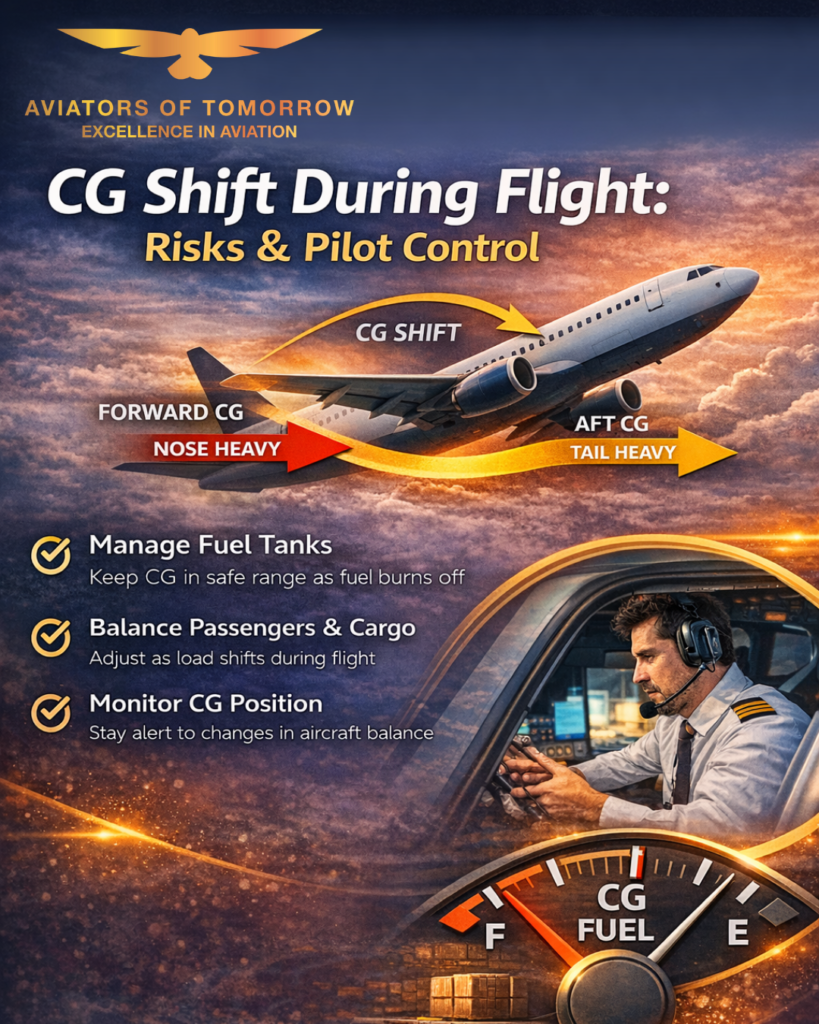
Table of Contents
Why Centre of Gravity Matters in Aviation
The aircraft centre of gravity is the precise point at which the aircraft balances in all axes. When this point sits within the CG envelope, the aircraft behaves predictably. When it drifts outside, pilots face serious flight stability issues.
A forward CG makes the nose heavy, demanding greater elevator input. An aft CG reduces pitch stability, making the aircraft harder to recover from upsets. Both conditions significantly increase pilot workload and reduce safety margins.
Common Causes of CG Shift During Flight
Understanding the triggers of in-flight CG movement helps crews anticipate and manage the risk before it becomes a crisis.
Fuel Burn and Weight Distribution
Fuel is the primary driver of CG shift during flight. As engines consume fuel, the weight removed from wing or fuselage tanks alters the weight-and-balance relationship. Aircraft with fuel stored across multiple tank locations experience the most dramatic shifts.
Proper fuel management procedures, such as burning from specific tanks in a defined sequence, are critical to keeping CG within limits throughout the entire flight.
Passenger and Cargo Movement
On commercial and charter flights, passengers moving to use lavatories, crew serving meals in the cabin or cargo shifting in the hold all contribute to dynamic CG change. A handful of passengers relocating from economy to business class can measurably affect longitudinal balance.
Even small cabin movement changes can influence aircraft weight and balance and contribute to CG Shift During Flight conditions.
Payload Shifting in Turbulence
Improperly secured cargo is a serious aviation hazard. During turbulent flight conditions, unsecured loads can slide aft or forward, causing sudden and severe CG displacement. This is particularly dangerous during the approach and landing phases when the aircraft is already at reduced speed.
How CG Shift During Flight Affects Aircraft Performance and Balance
The effects of centre of gravity movement ripple across every aspect of aircraft performance.
Pitch Control Degradation
When CG moves aft beyond limits, the aircraft becomes pitch unstable. Pilots may find the nose pitching up without input, a condition that can rapidly lead to an aerodynamic stall. Recovery from a stall with an aft CG is significantly more difficult and altitude-consuming.
Increased Stall Speed
A forward CG raises the aircraft’s stall speed because more elevator authority is required to maintain level flight. In this condition, the approach speed must be increased, affecting landing distance and runway requirements.
Reduced Control Authority
In extreme cases of CG shift during flight, control surfaces may become insufficient to counteract the imbalance. This directly reduces the pilot’s ability to manage the aircraft, particularly during critical phases such as go-around or emergency manoeuvres.
Understanding CG Limits Aviation Rules and Flight Envelope
Every aircraft has a defined centre of gravity range published in its Aircraft Flight Manual (AFM). This range, expressed in inches or percentage of Mean Aerodynamic Chord (%MAC) represents the boundaries within which the aircraft is certified to operate safely.
Operators and load planners use weight and balance calculations before departure to confirm the CG sits within limits. However, the pre-flight calculation only captures the starting point. A well-trained crew plans ahead, anticipating how fuel burn profile and passenger movement will shift the CG as the flight progresses.
The Role of Load Planning in Preventing CG Shift
Effective aircraft load planning is the first line of defence against dangerous CG movement. Load controllers must consider:
- Total takeoff weight and zero fuel weight
- Fuel load and burn sequence
- Passenger seating distribution
- Cargo hold allocation and payload balance
- Trim settings at departure
Modern aircraft load systems generate a loadsheet that projects CG position at takeoff, cruise and landing. Reviewing this document critically, not merely signing it is a professional responsibility every crew member shares. Proper aircraft weight and balance procedures are essential to prevent dangerous CG Shift During Flight situations. Aviation professionals rely on CG limits aviation standards to maintain safe aircraft stability and control throughout all phases of flight. Failure to monitor aircraft performance and balance can lead to severe operational risks.
Stay within limits, stay in control CG awareness saves lives.
Stand a chance to win 100% scholarship & start training with India’s trusted aviation institute. Apply & Check Eligibility.
Apply Now!In-Flight CG Management Techniques
Pilots are not entirely passive once airborne. Several in-flight balance techniques can help manage CG movement:
Fuel transfer systems on larger aircraft allow crews to move fuel between tanks to maintain optimal CG position throughout cruise. This improves aerodynamic efficiency and maintains stability.
Ballast management on some aircraft types allows for dedicated ballast fuel or water ballast to be used specifically for balance correction.
On smaller aircraft, passenger reseating during flight can provide a practical correction when the CG has drifted unexpectedly.
CG Shift Incidents: Lessons From Aviation History
Aviation history contains sobering examples of accidents attributed to uncontrolled CG movement.
Several cargo aircraft accidents have been linked directly to improper load securing, where freight shifted dramatically during rotation, causing an unrecoverable aft CG condition. These incidents have shaped modern cargo restraint regulations and reinforced the importance of load planning culture across the industry.
The investigation findings consistently highlight one theme: crews and ground staff underestimated how quickly in-flight weight redistribution could exceed controllable limits.
Regulatory Framework Around Aircraft Balance
Aviation regulators including EASA and the CAA in the United Kingdom mandate strict compliance with weight and balance procedures. Operators must demonstrate through approved documentation that every flight departs within certified CG parameters.
Continuing airworthiness regulations also require that any modification affecting weight distribution, such as cabin reconfiguration or avionics installation, triggers a fresh weight and balance schedule to confirm the CG envelope remains valid.
Failure to comply is not merely a paperwork issue. It is a direct compromise of flight safety standards.
Training Pilots to Detect CG Shift During Flight Symptoms
Awareness is a powerful tool. Pilots trained to recognise the symptoms of CG shift can intervene before the situation becomes unmanageable.
Key indicators include:
- Unusual pitch trim requirements compared to expected values
- Persistent nose-up or nose-down tendency without control input
- Unexpected changes in aircraft handling characteristics
- Deviations from planned fuel burn suggest abnormal drag
Simulator training scenarios involving abnormal weight and balance conditions help crews build muscle memory and decision-making skills for real-world encounters.
The Future of CG Monitoring Technology
Aviation of Tomorrow is keenly focused on how emerging technologies will transform real-time CG monitoring. Several manufacturers are developing onboard systems that continuously calculate and display live CG position to the flight crew, using data from fuel sensors, load cells and passenger check-in systems.
These innovations promise to close the gap between the pre-flight load calculation and actual in-flight conditions, giving crews the situational awareness they need to manage balance dynamically throughout every phase of flight.
Structural health monitoring, combined with AI-driven flight data analysis, may soon provide predictive CG alerts before any limit is approached.
You May Read Our Blog “Understanding the 20 Major Aircraft Instruments: A Complete Technical Guide for Student Pilots“
Summary: Never Underestimate CG Shift During Flight
CG shift during flight is a dynamic, continuous process that demands respect from every aviation professional. From the load planner on the ground to the captain making fuel transfer decisions at cruise altitude, managing the aircraft centre of gravity is a shared responsibility.
Understanding the causes, recognising the symptoms and applying correct procedures protects lives, aircraft and the integrity of every flight operation. Regulatory bodies like the Directorate General of Civil Aviation (DGCA) further reinforce strict compliance with weight and balance standards to ensure operational safety.
As aviation continues to evolve, so too must the industry’s approach to weight, balance and in-flight stability management.
Balance the aircraft, balance the outcome master CG before it masters you.
Stand a chance to win 100% scholarship & start training with India’s trusted aviation institute. Apply & Check Eligibility.
Apply Now!