If you are planning to become a commercial airline pilot and are looking for an airline-linked training pathway, the IndiGo Chimes Cadet Pilot Program 2026 is one of the programmes you should understand thoroughly before making a career or financial decision.
The programme is conducted by Chimes Aviation Academy (CAA) in partnership with IndiGo and provides a structured pathway covering pilot selection, Ground School, Commercial Pilot Licence (CPL) flight training, multi-engine training, simulator training and Airbus A320 Type Rating.
CAA currently lists the programme as a full-time 20-month programme. The published programme fee is ₹104.00 lakh, while the ADAPT Assessment fee is ₹35,000. The programme’s published training structure includes 185 hours of single-engine flying, 15 hours of multi-engine flying on the Diamond DA42 and 30 hours of simulator training, followed by Airbus A320 Type Rating with MCC and JOT.
However, getting into the programme is not simply about meeting the academic eligibility requirements.
Candidates must successfully progress through a multi-stage selection process:
ADAPT Assessment → Group Task Assessment → Personal Interview
Candidates who successfully complete the selection process are invited to enrol and sign the Letter of Intent (LoI) with IndiGo.
This complete guide explains the IndiGo Chimes Cadet Pilot Program 2026, including eligibility, educational requirements, DGCA medical requirements, fees, ADAPT preparation, Group Task preparation, Personal Interview preparation, training phases, flying hours, aircraft, A320 Type Rating, LoI, programme duration, additional expenses, cadet versus CPL comparison and practical preparation strategies.
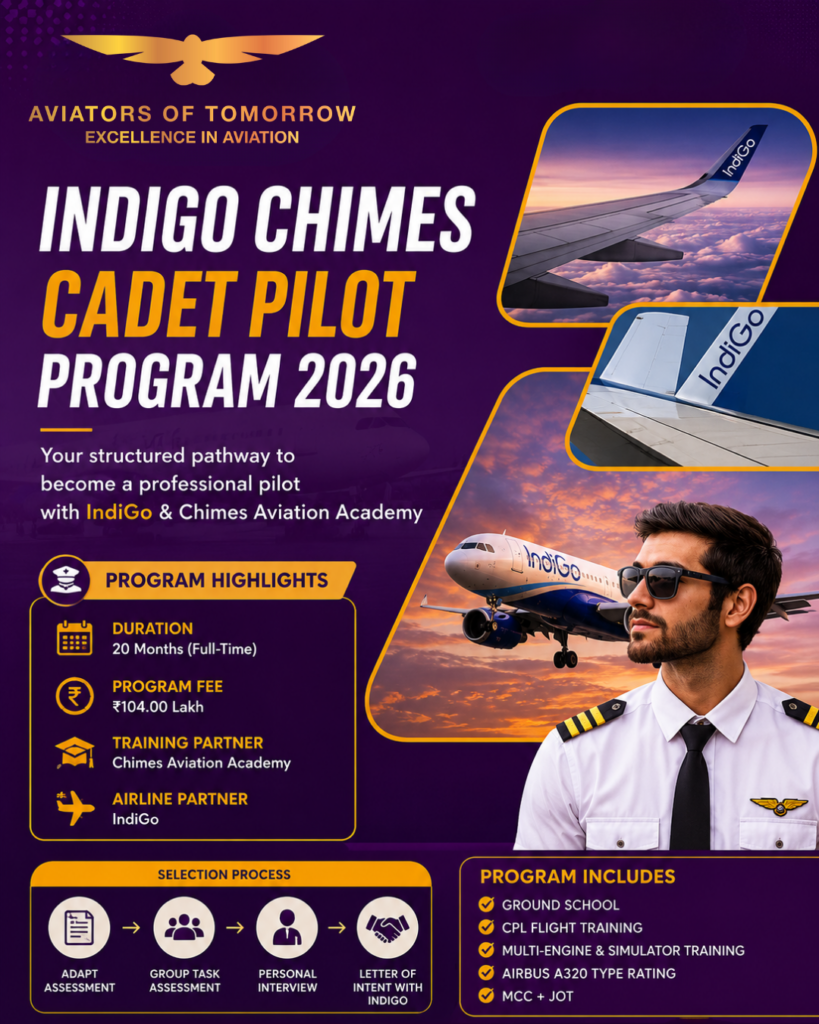
Table of Contents
IndiGo Chimes Cadet Pilot Program 2026: Quick Overview
| Programme Detail | Information |
| Training Academy | Chimes Aviation Academy |
| Airline Partner | IndiGo |
| Programme Type | Airline-Linked Cadet Pilot Programme |
| Programme Duration | Full-Time 20 Months |
| Published Programme Fee | ₹104.00 lakh |
| ADAPT Assessment Fee | ₹35,000 |
| Ground School Location | Gurugram |
| Flight Training Locations | Dhana & Neemuch |
| Single-Engine Flying | 185 Hours |
| Multi-Engine Flying | 15 Hours |
| Multi-Engine Aircraft | Diamond DA42 |
| Simulator Flying | 30 Hours |
| Type Rating | Airbus A320 |
| Additional Training | MCC + JOT |
| Selection Stage 1 | ADAPT Assessment |
| Selection Stage 2 | Group Task |
| Selection Stage 3 | Personal Interview |
| Post-Selection Milestone | Letter of Intent with IndiGo |
CAA’s current programme information provides the published programme structure and fee details.
What Is the IndiGo Chimes Cadet Pilot Program?
The IndiGo Chimes Cadet Pilot Program is an airline-linked pilot training pathway offered through the partnership between Chimes Aviation Academy and IndiGo.
The programme is designed to provide aspiring pilots with a structured route from initial training through the major stages required for an airline pilot career.
Instead of completing only a CPL and then independently approaching airlines, the cadet pathway introduces an airline selection process at the beginning.
The overall journey can be understood as:
Eligibility
↓
CAA-IndiGo Selection
↓
ADAPT Assessment
↓
Group Task
↓
Personal Interview
↓
Letter of Intent
↓
Ground School
↓
CPL Flight Training
↓
Multi-Engine & Simulator Training
↓
Airbus A320 Type Rating
↓
Airline Career Pathway
IndiGo currently lists Chimes Aviation Academy among its Cadet Pilot Programme partners.
The programme therefore combines several stages of pilot development into a structured pathway.
Why Do Students Choose an Airline Cadet Pilot Programme?
There are different ways of pursuing an airline pilot career.
One option is the traditional CPL route, where a student independently selects a flight training organisation, completes the required training, obtains a CPL and then applies to airlines.
The other option is an airline-linked cadet programme.
A cadet programme can provide a more structured pathway because the candidate enters an airline-specific selection process before progressing into the training programme.
The CAA-IndiGo pathway combines:
- Pilot selection
- Ground School
- CPL flight training
- Multi-engine training
- Simulator training
- A320 Type Rating
- MCC
- JOT
This structured approach can be attractive to candidates who already know that they want to pursue an airline career.
However, a cadet programme is not automatically the right choice for everyone.
Candidates should compare:
- Total cost
- Training structure
- Contractual conditions
- Airline pathway
- Flexibility
- Medical requirements
- Alternative CPL routes
- Long-term career goals
before making a decision.
IndiGo Chimes Cadet Pilot Program Eligibility 2026
Before preparing for the selection process, candidates should first confirm whether they satisfy the current eligibility requirements.
CAA currently specifies requirements related to:
- Education
- Age
- DGCA Class 1 Medical
- Passport
- Criminal Record Check
- English proficiency
- BMI
- Tattoo policy
Let’s understand each requirement in detail.
1. Educational Qualification
Candidates must have completed 10+2 and achieved at least 51% individually in Physics, Mathematics and English.
This is an important point.
The requirement is not simply about your overall Class 12 percentage.
Your individual marks in:
Physics + Mathematics + English
must satisfy the published criteria.
CAA also specifies equivalent requirements for CBSE candidates in terms of Grade Point 6 or Grade C1.
Candidates should carefully check their individual subject marks before applying.
2. Can NIOS Students Apply for the IndiGo Chimes Cadet Programme?
Yes.
CAA states that candidates who completed their education through National Institute of Open Schooling (NIOS) can be considered, provided they satisfy the required minimum marks individually in:
- Mathematics
- Physics
- English
Students with alternative educational backgrounds should always verify their documents against the latest official eligibility requirements before applying.
3. Foreign Educational Qualifications
Candidates with foreign educational qualifications may need to obtain an academic equivalency certificate from the Association of Indian Universities (AIU).
This ensures that the candidate’s educational qualification can be evaluated against the applicable Indian academic requirements.
If you completed your education outside India, do not wait until the final admission stage to check your equivalency documentation.
4. Age Requirement
CAA currently lists the age requirement for the programme as:
18 to 40 years
Candidates should verify the applicable age condition for the specific batch before submitting an application because programme requirements may be updated.
5. DGCA Class 1 Medical Requirement
A valid Indian DGCA Class 1 Medical Certificate is currently required.
This is one of the most important requirements for anyone planning a professional pilot career.
Before committing a significant amount of money to flight training, aspiring pilots should understand their medical eligibility and complete the applicable medical process.
A medical issue discovered after substantial financial investment can create significant difficulties.
For this reason, medical planning should be treated as an early step rather than something to deal with at the end.
6. Indian Passport Requirement
Candidates must possess a:
Valid Indian Passport
This is part of the current eligibility requirements published by CAA.
Make sure your passport and other identification documents are valid and that your personal details are consistent across your documentation.
7. Criminal Record Check
CAA currently requires candidates to provide a:
Criminal Record Check (CRC) Basic Disclosure Certificate
Candidates should follow the latest instructions provided by CAA regarding the format and validity of the required documentation.
8. English Language Requirement
Candidates are expected to demonstrate:
Written and Spoken English Fluency
English is particularly important throughout an airline pilot’s career because aviation communication requires clarity, discipline and accuracy.
For the selection process, candidates should be comfortable with:
- Speaking clearly
- Understanding questions
- Expressing ideas logically
- Participating in group discussions
- Answering follow-up questions
- Communicating professionally
Strong English communication is especially useful during the Group Task and Personal Interview stages.
9. BMI Requirement
CAA currently requires a BMI certificate showing a BMI between:
18 and 25
The certificate must be obtained from a NABL-accredited hospital or laboratory according to the published eligibility information.
Candidates should verify the latest certificate requirements before arranging the document.
10. Tattoo Policy
CAA’s current published eligibility criteria state that candidates with visible tattoos will not be considered.
Candidates who have questions about specific tattoos or locations should confirm the applicable policy directly with the academy.
Dreaming of the cockpit? Take the first step toward becoming an IndiGo pilot today.
Stand a chance to win 100% scholarship & start training with India’s trusted aviation institute. Apply & Check Eligibility.
Apply Now!IndiGo Chimes Cadet Pilot Eligibility Checklist
Before applying, make sure you have reviewed the following:
Academic Requirements
- 10+2 completed
- Minimum required marks in Physics
- Minimum required marks in Mathematics
- Minimum required marks in English
Age
- Within the published age requirement
Medical
- Valid DGCA Class 1 Medical
Documents
- Valid Indian passport
- Required CRC documentation
- Required BMI certificate
Communication
- Written English proficiency
- Spoken English proficiency
Other Requirements
- Compliance with the current tattoo policy
If you satisfy the requirements above, the next step is to understand the selection process.
IndiGo Chimes Cadet Pilot Selection Process 2026
The CAA-IndiGo selection process currently consists of three major stages.
Stage 1: ADAPT Assessment
↓
Stage 2: Group Task Assessment
↓
Stage 3: Personal Interview
↓
Successful Candidates
Enrolment + Letter of Intent with IndiGo
Each stage evaluates a different set of abilities.
That is why candidates should not prepare only for the first assessment.
Stage 1: IndiGo ADAPT Assessment
The first stage is the ADAPT Assessment.
CAA describes ADAPT as an online psychometric and aptitude assessment designed for aspiring pilots.
The assessment is intended to evaluate behavioural and cognitive proficiencies relevant to individuals pursuing an aviation career.
The currently published ADAPT Assessment fee is:
₹35,000
Because assessment formats and procedures can change, candidates should prepare the underlying aptitude skills rather than rely on unofficial claims about exact assessment questions.
What Skills Should You Prepare for ADAPT?
A strong ADAPT preparation programme can include the following areas.
Numerical Reasoning
Develop your ability to process numerical information quickly and accurately.
Practice:
- Mental mathematics
- Numerical patterns
- Basic calculations
- Number relationships
- Timed numerical exercises
Logical Reasoning
Logical reasoning helps you identify patterns, relationships and conclusions.
Practice:
- Sequences
- Patterns
- Relationships
- Logical conclusions
- Problem-solving exercises
Spatial Awareness
Spatial awareness is an important area of preparation for aviation aptitude testing.
Practice:
- Directions
- Positions
- Rotations
- Shapes
- Spatial relationships
Memory
Memory exercises can help improve your ability to retain and recall information.
Practice:
- Visual memory
- Numerical memory
- Pattern memory
- Short-term recall
- Information retention
Attention and Concentration
Assessment environments can require sustained concentration.
Candidates should practise maintaining accuracy over longer periods rather than focusing only on short exercises.
Multitasking
Develop the ability to manage multiple information sources while maintaining accuracy.
Speed and Accuracy
One of the biggest challenges in aptitude assessments is balancing:
Speed + Accuracy
Going extremely fast while making frequent errors is not useful.
Likewise, working extremely slowly may prevent you from completing the required tasks.
The goal is to develop consistent performance.
How to Prepare for the ADAPT Assessment
A structured approach is better than random practice.
Step 1: Take a Baseline Test
Before starting serious preparation, identify your current strengths and weaknesses.
Measure:
- Accuracy
- Response time
- Numerical performance
- Memory
- Spatial ability
- Logical reasoning
- Attention
Step 2: Work on Individual Skills
Spend dedicated time on each area.
For example:
Monday: Numerical Reasoning
Tuesday: Logical Reasoning
Wednesday: Spatial Awareness
Thursday: Memory
Friday: Attention
Saturday: Multitasking
Sunday: Review and mock practice
Step 3: Introduce Time Limits
Once your fundamentals improve, introduce timed exercises.
Track:
- Completion time
- Accuracy
- Number of errors
- Performance consistency
Step 4: Combine Different Skills
Do not practise only one skill at a time.
Start combining multiple exercises to replicate the mental switching required during assessments.
Step 5: Complete Mock Assessments
Eventually, practise under conditions similar to an assessment environment.
The purpose is to become comfortable with:
- Time pressure
- Continuous concentration
- Different task types
- Limited distractions
- Performance pressure
What You Should Avoid During ADAPT Preparation
Candidates should be careful about preparation sources claiming:
- “Exact ADAPT questions”
- “Leaked ADAPT questions”
- “Guaranteed ADAPT selection”
- “Official ADAPT question bank”
Responsible preparation should focus on developing the skills needed for aptitude and psychometric assessments.
The objective should be: Skill Development, Not Question Memorisation
Stage 2: IndiGo Chimes Group Task Assessment
Candidates who successfully progress from the ADAPT stage move to the:
Group Task Assessment with IndiGo Panellists
CAA describes this stage as assessing candidates’ collaborative and problem-solving skills.
This is significantly different from an individual aptitude assessment.
During the Group Task, the panel can observe how you interact with other people.
What Is Evaluated During a Group Task?
Candidates should focus on demonstrating:
Communication
Can you communicate your thoughts clearly?
Listening
Can you listen to another candidate without immediately trying to interrupt?
Teamwork
Can you work towards a shared objective?
Problem-Solving
Can you contribute useful solutions?
Decision-Making
Can you make sensible decisions in a group situation?
Leadership
Can you take initiative without trying to control everyone?
Professional Behaviour
Can you disagree respectfully?
The Most Common Group Task Mistake
Many candidates believe:
“The person who speaks the most will look like the leader.”
That is not necessarily true.
A good group participant is someone who contributes meaningfully.
For example, instead of repeatedly interrupting others, you can:
Listen → Understand → Add Value → Move the Discussion Forward
A useful contribution can be:
“I agree with that point. We could also consider another factor…”
Or:
“We have discussed two options. Perhaps we can compare the advantages of both and decide which one is more practical.”
This demonstrates participation without unnecessary dominance.
Group Task Mistakes to Avoid
1. Dominating the Conversation
Speaking continuously can prevent other candidates from contributing.
2. Staying Completely Silent
You need to demonstrate your communication skills.
3. Interrupting
Let others finish their thoughts.
4. Rejecting Every Idea
Disagreement is acceptable. Disrespect is not.
5. Turning the Task Into a Competition
The objective is to solve the problem as a team.
6. Acting Like a Forced Leader
Leadership should appear natural.
How to Prepare for the IndiGo Group Task
Preparation should include:
- Live Group Discussions
- Group Task simulations
- Team problem-solving
- Decision-making exercises
- Aviation topics
- General topics
- Current affairs
- Communication practice
- Body language
- Individual feedback
After every practice session, ask:
Did I contribute?
Did I listen?
Did I communicate clearly?
Did I interrupt too often?
Did I help the group?
Did I become too passive?
Did I help the team reach a conclusion?
This type of self-analysis is extremely valuable.
Stage 3: IndiGo Personal Interview
The final major selection stage is the:
Personal Interview with IndiGo Panellists
CAA states that candidates who progress through the earlier stages move to the Personal Interview stage, where they can discuss their aspirations and experiences.
The interview is your opportunity to demonstrate that you understand:
- Why you want to become a pilot
- What the profession involves
- Why you want an airline career
- Why you selected the cadet pathway
- Why you are interested in IndiGo
- What you know about the programme
- How you handle responsibility
- How you work with others
indigo chimes cadet pilot Interview Preparation
Candidates should prepare for different categories of questions.
Personal Questions
- Tell us about yourself.
- Describe your educational background.
- What are your interests?
- What are your strengths?
- What is one weakness you are working on?
Motivation Questions
- Why do you want to become a pilot?
- Why aviation?
- Why do you want an airline career?
- Why did you choose the cadet route?
IndiGo Questions
- Why do you want to join IndiGo?
- What do you know about IndiGo?
- Why did you choose the IndiGo cadet pathway?
Programme Questions
- What do you know about the CAA-IndiGo programme?
- What is a CPL?
- What is an A320 Type Rating?
- What is MCC?
- What is JOT?
Behavioural Questions
- Tell us about a time you worked in a team.
- Tell us about a failure.
- Tell us about a difficult decision.
- How do you handle pressure?
- Describe a situation where you took responsibility.
These should be treated as preparation areas rather than a fixed list of questions guaranteed to appear in every interview.
How to Answer Pilot Interview Questions
One of the best ways to structure behavioural answers is:
Situation: explain what happened.
Action: explain what you did.
Result: explain the outcome.
Learning: explain what you learned.
For example, if you are asked about a difficult situation, do not simply say:
“I handled it successfully.”
explain the actual situation and your role in it.
This makes your answer more genuine and easier for the interviewer to understand.
Why You Should Not Memorise Interview Answers
Memorised answers often sound artificial.
Instead of memorising complete paragraphs, prepare:
- Your experiences
- Your achievements
- Your failures
- Your motivation
- Your reasons for choosing aviation
- Your reasons for choosing the programme
- Your long-term goals
Then practise explaining them naturally.
The goal is not to sound rehearsed.
The goal is to sound:
Confident + Genuine + Prepared + Professional
What Happens After You Clear the IndiGo Chimes Selection Process?
Candidates who successfully complete the selection process are invited to enrol and sign the Letter of Intent (LoI) with IndiGo, according to CAA’s current programme information.
The LoI is an important milestone because it marks the transition from the selection stage into the structured cadet pathway.
CAA has also reported LoI ceremonies for recent CAA-IndiGo batches during 2026.
Candidates should carefully read the actual LoI and programme documentation applicable to them.
Do not rely on interpretations from:
- Social media
- WhatsApp groups
- YouTube videos
- Coaching advertisements
- Old blogs
The official documentation should be treated as the authoritative source for the applicable terms and conditions.
CAA-indigo chimes cadet pilot Training Structure
Once candidates enter the training pathway, the programme is divided into three broad phases.
Phase 1
Ground School
↓
Phase 2
CPL Flight Training
↓
Phase 3
Airbus A320 Type Rating + MCC + JOT
Phase 1: Ground School Training
The Ground School component is conducted at CAA’s facility in:
Gurugram
CAA’s published curriculum includes:
- Aviation Meteorology
- Air Regulations
- Air Navigation
- Technical General
- Technical Specific – Single Engine
- Radio Telephony
- Aviation English Language Proficiency (AELP)
Ground School provides the theoretical foundation required for professional pilot training.
Why Ground School Is Important
Becoming a professional pilot is not simply about learning to control an aircraft.
A pilot must understand:
- Weather
- Navigation
- Regulations
- Aircraft systems
- Communication
- Procedures
- Operational limitations
- Safety
A pilot’s decisions are based on a combination of all these factors.
Ground School therefore forms the theoretical foundation behind practical flying.
Phase 2: CPL Flight Training
After Ground School, cadets progress to practical flight training.
CAA currently lists:
Dhana
and
Neemuch
as the flight training locations for the programme.
CAA lists the following aircraft in its training fleet:
- Cessna 172
- Piper Archer DX
- Tecnam P2010 TDI
- Diamond DA42
IndiGo Chimes Published Flight Training Hours
The current programme information lists:
| Training Component | Published Hours |
| Single-Engine Flying | 185 Hours |
| Multi-Engine Flying | 15 Hours |
| Diamond DA42 | 15 Hours |
| Simulator Flying | 30 Hours |
The combination provides exposure to different stages of professional flight training.
Single-Engine Training
Single-engine aircraft form a major part of CPL flight training.
During this stage, students progressively develop skills such as:
- Aircraft handling
- Take-off procedures
- Landing procedures
- Navigation
- Radio communication
- Instrument flying
- Cross-country operations
- Emergency procedures
- Situational awareness
- Decision-making
The exact progression depends on the approved training programme and the student’s individual performance.
Multi-Engine Training
CAA currently lists:
15 Hours on the Diamond DA42
The Diamond DA42 provides students with experience operating a multi-engine aircraft.
Multi-engine flying introduces additional considerations involving:
- Aircraft systems
- Engine management
- Performance
- Procedures
- Emergency handling
- Crew coordination
This experience is valuable before progressing towards the airline training environment.
Simulator Training
CAA currently publishes:
30 Hours of Simulator Flying
Simulator training allows students to practise procedures and scenarios in a controlled environment.
It can provide valuable practice in areas such as:
- Instrument procedures
- Cockpit procedures
- Emergency scenarios
- Decision-making
- Repetition
- Systems familiarisation
Phase 3: Airbus A320 Type Rating
After successfully completing the CPL stage, cadets progress towards:
Airbus A320 Type Rating
CAA states that this phase is conducted through a Type Rating Training Organisation partner approved by IndiGo.
The published programme structure also includes:
- Multi Crew Coordination (MCC)
- Jet Orientation Training (JOT)
This stage represents the transition from general flight training towards the operating environment associated with a modern airline jet.
What Is Airbus A320 Type Rating?
A pilot licence alone does not automatically allow a pilot to operate every aircraft type.
A pilot needs appropriate type-specific training and qualification for the aircraft they are authorised to operate.
The Airbus A320 Type Rating provides training specific to the A320 family and its operating environment.
This includes understanding:
- Aircraft systems
- Procedures
- Automation
- Cockpit operations
- Performance
- Multi-crew operations
- Normal procedures
- Abnormal procedures
- Emergency procedures
What Is MCC?
MCC stands for Multi Crew Coordination.
Commercial airline operations involve pilots working together as a crew.
MCC training focuses on areas such as:
- Communication
- Crew coordination
- Task sharing
- Cross-checking
- Decision-making
- Situational awareness
- Standard procedures
This is one reason teamwork is relevant even during the cadet selection process.
What Is JOT?
JOT stands for Jet Orientation Training.
It helps candidates transition towards the operational environment associated with jet aircraft.
The CAA-IndiGo programme includes JOT as part of the published A320 training pathway.
How Long Is the IndiGo Chimes Cadet Pilot Program?
CAA currently lists the programme as a:
Full-Time 20-Month Programme
However, candidates should understand that a published programme duration does not necessarily mean that every candidate will complete every stage on exactly the same date.
Actual training progression can depend on:
- Individual performance
- Training schedules
- Weather
- Aircraft availability
- Operational factors
- Regulatory requirements
- Training progress
Candidates should therefore confirm the current expected timeline directly with CAA.
IndiGo Chimes Cadet Pilot Program Fees 2026
The cost of pilot training is one of the most important considerations for any aspiring pilot.
CAA’s current programme page lists:
₹104.00 lakh
as the published programme fee.
The ADAPT Assessment fee is separately listed as:
₹35,000
Because fees can change, candidates should confirm the current fee applicable to their batch before making any payment.
Why Do Different Websites Show Different Fees?
If you search online for the CAA-IndiGo programme, you may find different fee figures.
This can happen because:
- Programme fees are updated
- Older articles remain indexed
- Different batches may have different fee structures
- Websites may publish outdated information
- Additional charges may or may not be included in a quoted amount
Therefore, the most important question is:
“What is the current official fee for the batch I am applying to?”
At the time of this article’s August 2026 update, CAA’s official programme page lists the fee as ₹104.00 lakh.
What Should You Check Before Paying the Programme Fee?
Before making a major financial commitment, ask for clarity regarding:
Programme Fee
What exactly is included?
Payment Schedule
When are instalments due?
Assessment Fee
Is the assessment fee separate?
Accommodation
Is accommodation included or charged separately?
Food
Are meals included?
Medical Expenses
Which medical expenses are excluded?
Examination Expenses
Are all examination fees included?
Additional Training
What happens financially if additional training is required?
Refund Policy
What are the applicable withdrawal and refund conditions?
Training Delays
How are delays handled?
Progression Requirements
What conditions must a cadet satisfy to progress through the programme?
These questions should be answered before signing programme documents.
Additional Expenses to Consider
The published programme fee should not automatically be treated as your complete personal aviation budget.
Candidates may need to consider additional expenses such as:
- Medical examinations
- Travel
- Accommodation
- Food
- Personal expenses
- Documentation
- Passport-related expenses
- Regulatory fees
- Examination charges
- Additional training, where applicable
- Other personal requirements
Always calculate the total financial commitment, not only the advertised tuition figure.
Financing for Pilot Training
CAA states that it has tie-ups with loan service providers including Kuhoo Finance and GradRight.
However, students should not select a loan simply because financing is available.
Compare:
- Interest rate
- Processing fee
- Moratorium period
- Repayment duration
- Collateral requirement
- Total repayment amount
- Conditions for disbursement
A loan for pilot training can remain a financial commitment for many years.
Therefore, families should evaluate the complete repayment amount before signing a loan agreement.
CAA-indigo chimes cadet pilot Programme vs Traditional CPL
One of the most common questions aspiring pilots ask is:
“Should I join a cadet programme or do a normal CPL?”
There is no universal answer.
Both routes have advantages and disadvantages.
CAA-IndiGo Cadet Route
The cadet route provides a structured airline-linked pathway.
Potential Advantages
- Airline-linked selection
- Structured training
- Integrated CPL pathway
- Multi-engine training
- Simulator training
- A320 Type Rating
- MCC and JOT
- Defined progression
Things to Consider
- High financial commitment
- Airline-specific pathway
- Competitive selection
- Less flexibility compared with independently choosing every training stage
- Need to understand contractual conditions
Traditional CPL Route
With the traditional route, the student generally chooses a DGCA-approved flying school and completes the requirements for a Commercial Pilot Licence.
After obtaining the required qualifications, the candidate can apply to airlines and other aviation opportunities.
Potential Advantages
- Greater flexibility
- Ability to compare FTOs
- Greater control over training location
- Ability to make airline decisions later
- Potentially different financial structures
Things to Consider
- Airline selection generally comes later
- Student manages more of the process independently
- Type Rating may be separate
- Career planning is more independent
Detailed Cadet vs CPL Comparison
| Feature | CAA-IndiGo Cadet Programme | Traditional CPL |
| Airline-linked | Yes | No specific airline |
| Airline selection | Early in pathway | Usually later |
| Ground School | Integrated | Independently selected |
| Flight Training | CAA | Student chooses FTO |
| CPL | Included | Main qualification |
| Multi-Engine | Included in published structure | Depends on FTO/programme |
| Simulator | Included in published structure | Depends on programme |
| A320 Type Rating | Included in pathway | Generally separate |
| Training Flexibility | Lower | Higher |
| Structure | Highly structured | More flexible |
| Career Planning | Airline-linked | Student-managed |
Which Route Should You Choose?
Choose based on your priorities.
A cadet programme may suit you if:
- You want an airline-linked pathway.
- You prefer structured training.
- You are comfortable with the financial commitment.
- You want to go through airline selection before training.
- You want an integrated CPL-to-A320 pathway.
A traditional CPL may suit you if:
- You want more flexibility.
- You want to compare multiple FTOs.
- You prefer independent career planning.
- You want to choose your airline opportunities later.
Neither route should be chosen solely because it sounds more prestigious.
Is the IndiGo Chimes Cadet Pilot Program Worth It?
The programme can be attractive because it combines multiple stages of pilot training into one structured pathway.
The published programme includes:
Ground School
→ CPL Training
→ Multi-Engine Training
→ Simulator Training
→ A320 Type Rating
→ MCC + JOT
CAA also describes the programme as preparing cadets for their careers as Junior First Officers with IndiGo.
However, candidates should evaluate the programme based on their own:
- Financial situation
- Career goals
- Medical eligibility
- Training preferences
- Risk tolerance
- Long-term plans
Questions You Should Ask Before Joining
Before signing anything, ask:
Financial Questions
- What is the total current programme cost?
- What is included?
- What is excluded?
- What additional costs should I budget for?
- What happens if additional training is required?
Training Questions
- What is the expected training timeline?
- What happens if training is delayed?
- What are the progression requirements?
- What happens if a student does not meet a training standard?
Contract Questions
- What are the LoI conditions?
- What are the withdrawal terms?
- What are the refund conditions?
- What are the applicable post-training requirements?
Career Questions
- What is the current progression pathway?
- What conditions apply after training?
- What documents should I understand before signing?
These questions can help you make a much more informed decision.
How to Prepare for the Complete IndiGo Chimes Selection Process
Do not prepare for only one stage.
Your preparation should follow the same structure as the selection process.
Stage 1
ADAPT
Build:
- Cognitive skills
- Numerical reasoning
- Logical reasoning
- Spatial awareness
- Memory
- Attention
- Multitasking
- Speed
- Accuracy
Stage 2
GROUP TASK
Build:
- Communication
- Listening
- Teamwork
- Problem-solving
- Decision-making
- Leadership
- Professional behaviour
Stage 3
PERSONAL INTERVIEW
Build:
- Confidence
- Communication
- Aviation awareness
- IndiGo awareness
- Programme knowledge
- Motivation
- Behavioural responses
- Personal storytelling
60-Day IndiGo Cadet Selection Preparation Plan
Days 1–15: ADAPT Fundamentals
Focus on:
- Numerical reasoning
- Logical reasoning
- Spatial reasoning
- Memory
- Attention
Take a baseline assessment.
Identify weak areas.
Days 16–30: Speed and Accuracy
Introduce:
- Timed tests
- Multitasking
- Memory drills
- Spatial exercises
- Numerical speed
- Logical reasoning
Track your performance.
Days 31–45: Group Task Preparation
Practise:
- Group Discussions
- Group Tasks
- Team problem-solving
- Leadership situations
- Aviation discussions
- Current affairs
- Communication
Focus on meaningful participation.
Days 46–55: Interview Preparation
Prepare:
- Personal introduction
- Pilot motivation
- Why aviation?
- Why IndiGo?
- Why Chimes?
- Why a cadet programme?
- Strengths
- Weaknesses
- Failure
- Teamwork
- Leadership
- Career goals
Days 56–60: Full Mock Selection
Complete:
ADAPT Mock
↓
Group Task
↓
Personal Interview
Then analyse your complete performance.
30-Day ADAPT Preparation Strategy
Week 1 – Fundamentals
Focus on accuracy and understanding different question types.
Week 2 – Speed
Introduce time limits.
Week 3 – Pressure
Combine different cognitive tasks.
Week 4 – Simulation
Complete full mock assessment sessions.
The objective is not simply to become faster.
It is to become:
Fast + Accurate + Consistent
30-Day Interview Preparation Strategy
Days 1–7
Build your personal story.
Know your:
- Education
- Experiences
- Achievements
- Interests
- Motivation
Days 8–14
Prepare:
- Why pilot?
- Why aviation?
- Why IndiGo?
- Why a cadet programme?
- Why CAA?
Days 15–21
Prepare behavioural examples involving:
- Teamwork
- Leadership
- Failure
- Pressure
- Responsibility
- Decision-making
Days 22–30
Conduct repeated mock interviews.
Add:
- Follow-up questions
- Cross-questioning
- Unexpected questions
- Time pressure
Common Mistakes Made by Cadet Pilot Applicants
Mistake 1: Preparing Only for ADAPT
The selection process continues after ADAPT.
Prepare for all three stages.
Mistake 2: Starting Preparation Too Late
Do not wait until you receive your assessment date.
Mistake 3: Memorising Interview Answers
Prepare your experiences and ideas rather than memorising paragraphs.
Mistake 4: Ignoring Aviation Knowledge
If you want to become a professional pilot, demonstrate genuine interest in aviation.
Mistake 5: Dominating the Group Task
Leadership does not mean speaking continuously.
Mistake 6: Staying Completely Silent
You must also demonstrate your own communication skills.
Mistake 7: Not Researching IndiGo
Know the airline and understand why you want to pursue its cadet pathway.
Mistake 8: Not Understanding the Programme
Know the duration, training structure, selection stages and published fee.
Mistake 9: Ignoring Medical Requirements
Medical eligibility should be addressed early.
Mistake 10: Trusting Outdated Information
Pilot training fees and programme requirements can change.
Always verify important information with the official source.
How Aviators Of Tomorrow Can Help With IndiGo Cadet Preparation
Preparing for an airline cadet selection process requires more than practising random aptitude questions. Candidates need structured preparation across aptitude assessments, group activities and personal interviews.
At Aviators Of Tomorrow, cadet preparation can be focused on the key stages of the selection journey, helping candidates build the skills, confidence and accuracy required to perform effectively.
ADAPT Preparation
Candidates can prepare for areas such as:
- Cognitive Aptitude
- Numerical Reasoning
- Logical Reasoning
- Spatial Awareness
- Memory & Recall
- Attention & Concentration
- Multitasking
- Speed & Accuracy
- Mock Assessment Practice
Group Task & GD Preparation
Candidates can develop the skills required to perform confidently in group-based assessments, including:
- Effective Communication
- Teamwork & Collaboration
- Problem-Solving
- Active Participation
- Leadership Skills
- Decision-Making
- Handling Disagreements
- Professional Body Language
- Group Discussion Practice
- Mock Group Exercises
Personal Interview Preparation
Interview preparation can cover:
- HR Interview Questions
- Motivation & Career Questions
- Aviation Awareness
- Airline Awareness
- Programme Awareness
- Behavioural Questions
- Teamwork-Based Questions
- Leadership Examples
- Situational Questions
- Mock Interviews
- Cross-Questioning Practice
- Personalised Feedback
Why Prepare With AOT?
A strong cadet preparation strategy combines aptitude practice, communication skills, aviation awareness and interview readiness. With focused practice and realistic mock assessments, candidates can approach each stage of the selection process with greater confidence and preparedness.
Why Complete Selection Preparation Matters
The CAA-IndiGo selection process is not one single examination.
It is a sequence.
You may perform well in ADAPT but still need to demonstrate your abilities during the Group Task.
You may perform well in the Group Task but still need to communicate your motivation and experiences effectively during the Personal Interview.
Therefore, your preparation should follow the same sequence:
ADAPT → GROUP TASK → PERSONAL INTERVIEW
Preparing for the complete process allows candidates to identify weaknesses before the actual assessment.
Frequently Asked Questions About the IndiGo Chimes Cadet Pilot Program
What is the IndiGo Chimes Cadet Pilot Program?
It is an airline-linked pilot training programme conducted by Chimes Aviation Academy in partnership with IndiGo.
What is the IndiGo Chimes Cadet Pilot Program fee in 2026?
CAA’s current published programme fee is ₹104.00 lakh.
How much is the ADAPT Assessment fee?
CAA currently lists the ADAPT Assessment fee as ₹35,000.
How long is the CAA-indigo chimes cadet pilot Program?
CAA currently lists the programme as a full-time 20-month programme.
What is the age limit?
CAA currently lists the age requirement as 18 to 40 years.
What marks are required?
Candidates must have at least 51% individually in Physics, Mathematics and English according to the current published eligibility requirements.
Can NIOS students apply?
Yes. CAA states that NIOS candidates can be considered if they meet the required subject-wise marks.
Is DGCA Class 1 Medical required?
Yes. A valid Indian DGCA Class 1 Medical Certificate is part of the current eligibility requirements.
What is the IndiGo Chimes selection process?
The current selection process consists of:
ADAPT Assessment → Group Task → Personal Interview
What is the ADAPT Assessment?
CAA describes ADAPT as an online psychometric and aptitude assessment for aspiring pilots, designed to assess behavioural and cognitive proficiencies.
What comes after ADAPT?
Candidates who progress through the process move to the Group Task Assessment, followed by the Personal Interview.
What happens after the Personal Interview?
Successful candidates are invited to enrol and sign the Letter of Intent with IndiGo, according to CAA’s published programme information.
How many flying hours are included?
CAA currently publishes:
185 hours of single-engine flying
15 hours of multi-engine flying
30 hours of simulator flying
Which aircraft are used for training?
CAA currently lists:
- Cessna 172
- Piper Archer DX
- Tecnam P2010 TDI
- Diamond DA42
Is Airbus A320 Type Rating included?
Yes. The published programme structure includes Airbus A320 Type Rating along with MCC and JOT through an IndiGo-approved TRTO partner.
Where is Ground School conducted?
CAA’s Ground School is conducted in Gurugram.
Where does flight training take place?
CAA currently lists Dhana and Neemuch as flight-training locations.
Can candidates who have already cleared DGCA examinations apply?
CAA’s FAQ states that candidates who have already cleared some or all DGCA Flight Crew Examinations can apply. However, the programme fee is not reduced and candidates are required to attend the Ground Classes included in the CAA curriculum.
Can a diploma replace Class 12?
CAA’s FAQ states that a diploma cannot be substituted for the required Class XI and XII qualification for the indigo chimes cadet pilot Programme.
Does CAA provide financing options?
CAA states that it has tie-ups with loan service providers including Kuhoo Finance and GradRight.
Candidates should independently evaluate the complete loan terms before borrowing.
Final Verdict: Should You Apply for the IndiGo Chimes Cadet Pilot Program 2026?
The IndiGo Chimes Cadet Pilot Program 2026 provides a structured airline-linked pathway for aspiring commercial pilots.
The currently published programme structure includes:
20-Month Full-Time Programme
₹104.00 lakh Published Programme Fee
₹35,000 ADAPT Assessment Fee
185 Hours Single-Engine Flying
15 Hours Multi-Engine Flying
30 Hours Simulator Training
Airbus A320 Type Rating
MCC + JOT
ADAPT → Group Task → Personal Interview
For an aspiring pilot, however, the first major challenge is not the aircraft.
It is getting through the selection process.
You need to demonstrate cognitive and behavioural abilities during ADAPT, teamwork and problem-solving during the Group Task, and communication, motivation and professional maturity during the Personal Interview.
That is why preparation should begin before the assessment date.
Start Preparing for the IndiGo Chimes Cadet Selection Process
Your preparation should follow the same path as the selection process:
01. ADAPT
Develop the cognitive, aptitude and assessment skills required to perform under time pressure.
02. GROUP TASK
Learn how to communicate clearly, listen effectively, contribute constructively and work towards a common solution.
03. PERSONAL INTERVIEW
Develop the confidence to explain your motivation, experiences, aviation knowledge and career goals.
ADAPT → GROUP TASK → PERSONAL INTERVIEW
A complete preparation strategy prepares you for all three.
Prepare With Aviators of tomorrow
If you are preparing for the indigo chimes cadet pilot Program, Aviators of tomorrow can help you prepare for the complete selection process.
ADAPT Preparation
Aptitude, cognitive reasoning, psychometric preparation, speed, accuracy and mock assessment practice.
Group Task & GD Preparation
Communication, teamwork, leadership, problem-solving, group participation and professional interaction.
Personal Interview Preparation
Mock interviews, HR questions, aviation awareness, IndiGo awareness, motivation questions, behavioural questions and cross-question practice.
Complete Selection Preparation
ADAPT → Group Task/GD → Personal Interview
The objective is not to memorise answers or claim access to confidential assessment material.
The objective is to help candidates become better prepared, more confident and more capable of performing under selection conditions.
You May Read Our Blog “Microburst Aviation: The Hidden Killer in the Sky Every Pilot Must Know“
Important Information for Applicants
Pilot training programmes can change their fees, eligibility requirements, batch schedules, assessment procedures, training arrangements and other conditions.
The information in this article has been prepared using programme information available in August 2026. Candidates should verify the latest official programme brochure, fee structure, eligibility requirements, batch information, LoI and contractual terms directly with Chimes Aviation Academy before applying or making any payment.
Do not make a major financial decision based on an old blog, social-media post or unofficial fee figure. Always verify the latest information with the programme provider.
Official programme information should take precedence over third-party articles.
Ready to take the first step toward your airline pilot career? Start your IndiGo Cadet Pilot preparation today.
Stand a chance to win 100% scholarship & start training with India’s trusted aviation institute. Apply & Check Eligibility.
Apply Now!