Static margin is one of the most important concepts in aircraft stability. Every aviator, whether a student pilot or an aerospace engineer, must understand this stability concept before they can truly grasp how an aeroplane behaves in the air. In simple terms, static margin tells us how stable or unstable an aircraft will be during flight. Without a proper understanding of static margin, designing a safe and controllable aircraft becomes nearly impossible.
In this blog, we will explore what this concept actually means, how it is calculated and why it plays such a crucial role in longitudinal stability. We will also look at how static margin connects to centre of gravity, neutral point and overall flight dynamics.
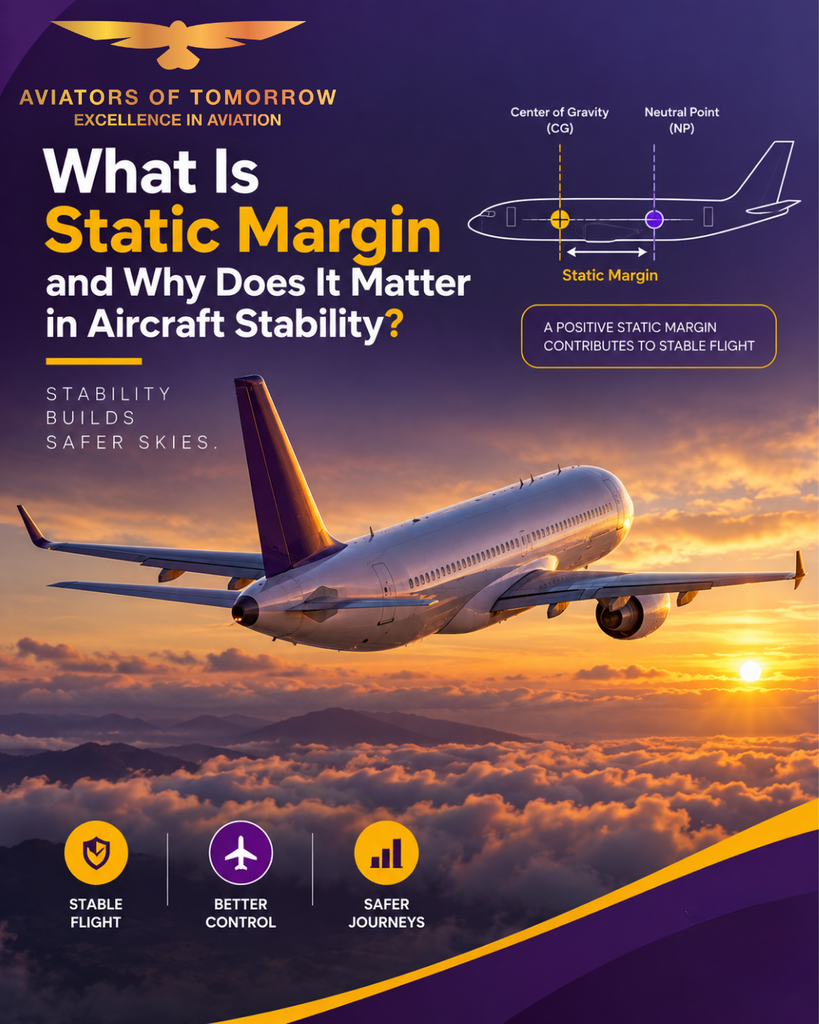
Table of Contents
What Is Static Margin?
Static margin is a measure of an aircraft’s inherent stability. It shows the distance between the centre of gravity and the neutral point of the aircraft, expressed as a percentage of the mean aerodynamic chord.
In simpler words, this measure tells engineers and pilots how far the centre of gravity sits ahead of the neutral point. This single figure determines whether an aircraft will naturally return to stable flight after a disturbance or whether it will continue to diverge from its original path.
Definition of Static Margin
It can be defined as the horizontal distance between the centre of gravity and the neutral point of an aircraft, divided by the mean aerodynamic chord. This value is usually expressed as a percentage.
A higher static margin generally means greater static stability. A lower static margin or a negative one, means the aircraft becomes less stable or even unstable.
Static Margin Formula
The basic formula for static margin is:
Static Margin = (Neutral Point − Centre of Gravity) ÷ Mean Aerodynamic Chord × 100
This calculation helps aerospace engineers determine how a particular aircraft design will behave once it is airborne. By adjusting the centre of gravity or redesigning the tail, engineers can directly influence the static margin of an aircraft.
Why Static Margin Matters in Aircraft Stability
This concept matters because it directly affects longitudinal stability, which is the aircraft’s ability to maintain a steady pitch attitude without constant pilot correction. Aircraft stability depends heavily on how the centre of gravity relates to the neutral point and static margin is the number that captures this relationship.
If the static margin is too small, the aircraft generally has reduced longitudinal static stability and may respond more readily to pitch disturbances and control inputs. If the static margin is too large, the aircraft may feel less responsive in pitch and require greater control inputs.Getting the balance right is essential for safe and predictable flight.
Positive Static Margin and Stable Aircraft
When an aircraft has a positive value, the centre of gravity lies ahead of the neutral point.This configuration creates a naturally stable aircraft.
A stable aircraft with this configuration will tend to return to its original trimmed condition after a disturbance, such as turbulence or a gust of wind. This is why conventional commercial aeroplanes are generally designed with positive longitudinal static stability, providing predictable handling characteristics and helping the aircraft respond appropriately to disturbances.
Negative Static Margin and Unstable Aircraft
A negative value occurs when the centre of gravity moves behind the neutral point. This creates an unstable aircraft that will continue to diverge from its flight path unless corrected.
Fighter aircraft may be designed with a low or negative static margin as part of a relaxed-static-stability configuration, which can provide greater pitch responsiveness and manoeuvrability. Such aircraft typically rely on sophisticated fly-by-wire flight-control systems to continuously manage their stability and control characteristics.
Zero Static Margin
When the centre of gravity aligns exactly with the neutral point, the static margin becomes zero. The aircraft is then neutrally statically stable, meaning it has no inherent tendency to return to its original trimmed condition or to diverge further following a small disturbance.
Static Margin and Centre of Gravity
The centre of gravity plays a direct role in determining static margin. As fuel is consumed or when the distribution of passengers and cargo changes, the centre of gravity may shift depending on the aircraft’s fuel and loading configuration. This movement can therefore affect the aircraft’s longitudinal stability during flight.
This is why pilots and loadmasters carefully calculate weight and balance before every flight. Keeping the centre of gravity within approved limits ensures the static margin remains within a safe and stable range throughout the entire journey.
Static Margin and Neutral Point
The neutral point is the aerodynamic location at which the aircraft’s pitching moment does not change with changes in angle of attack. When the centre of gravity is located at the neutral point, the aircraft has zero margin and is neutrally statically stable. It represents the balance point of aerodynamic forces acting on the wings and tail.
Understanding the neutral point is essential for calculating static margin accurately. Engineers use wind tunnel testing and computational fluid dynamics to determine the exact location of the neutral point for any given aircraft design.
How Pilots and Engineers Use Static Margin
Aerospace engineers use static margin during the design phase to ensure an aircraft will handle predictably. They adjust wing placement, tail size and fuselage length to achieve the desired static margin before the aircraft ever leaves the drawing board.
Pilots, on the other hand, rely on static margin indirectly through weight and balance calculations. By loading an aircraft correctly, pilots help maintain the static margin within safe limits, ensuring the aircraft behaves as designed.
Flight instructors often teach static margin concepts to student pilots so they understand why certain loading configurations feel different in the air. A well-trained aviator recognises the link between static margin and control feel almost instinctively.
Factors That Affect Static Margin
Several factors influence the static margin of an aircraft, including:
- Centre of gravity position – shifts due to fuel burn, cargo or passenger movement
- Tail size and design – tail volume, aerodynamic effectiveness and tail location can significantly influence the neutral point and therefore the static margin
- Wing placement – affects the location of the neutral point
- Fuselage geometry – fuselage length and aerodynamic characteristics can influence the location of the neutral point
- Aircraft loading – improper loading can push the centre of gravity out of limits
Each of these factors must be carefully considered during aircraft design and daily flight operations to maintain proper stability.
Static Margin in Different Aircraft Types
Different categories of aircraft require different static margin values depending on their mission.
Commercial airliners typically maintain a moderate positive static margin. This balance provides passenger comfort while still allowing reasonable manoeuvrability for the flight crew.
Military fighter aircraft often use a low or even negative static margin. This design choice, known as relaxed static stability, allows for rapid manoeuvring during combat situations, though it depends heavily on computerised flight control systems.
General aviation aircraft, particularly training aircraft, are commonly designed to provide predictable and stable handling characteristics. This can make them more forgiving for student pilots and easier to manage during training.
Common Mistakes Aviators Make With Static Margin
Many student pilots overlook the importance of static margin because it feels like a purely theoretical concept. However, ignoring static margin can lead to serious real-world consequences.
Loading an aircraft incorrectly, for example, can shift the centre of gravity too far aft, reducing the static margin dangerously close to zero or even into negative territory. This can make the aircraft difficult or impossible to control safely.
Another common mistake is assuming static margin stays constant throughout a flight. In reality, as fuel is consumed, the centre of gravity moves and static margin changes accordingly. Aviators must account for this throughout every phase of flight.
You May Read Our Blog “How Does an Aircraft Auxiliary Power Unit (APU) Work?“
Conclusion
Static margin is far more than an abstract engineering term. It is a fundamental concept in aircraft stability, directly influencing how an aeroplane responds to disturbances and control inputs. A solid understanding of static margin helps aviators understand aircraft behaviour and appreciate why proper weight and balance procedures are essential for safe flight.
For student pilots and aviation professionals, understanding static margin provides an important foundation for studying flight dynamics, aircraft design and aircraft stability. As aviation training in India follows standards and requirements established by the Directorate General of Civil Aviation (DGCA), developing a strong understanding of fundamental aerodynamic and stability concepts is an important part of building sound aviation knowledge.