Every aspiring pilot and aviation engineer eventually asks the same question: how does an Aircraft Auxiliary Power Unit (APU) actually work? For aspiring pilots and aviation engineers, understanding the APU is an important part of learning modern aircraft systems.This small but powerful gas turbine engine provides essential electrical and pneumatic power when the main engines are switched off, making it an important component of modern aviation.
In this blog, we will break down the working, components and importance of the Aircraft Auxiliary Power Unit (APU) in simple, easy to understand language, ideal for aviation students and future pilots.
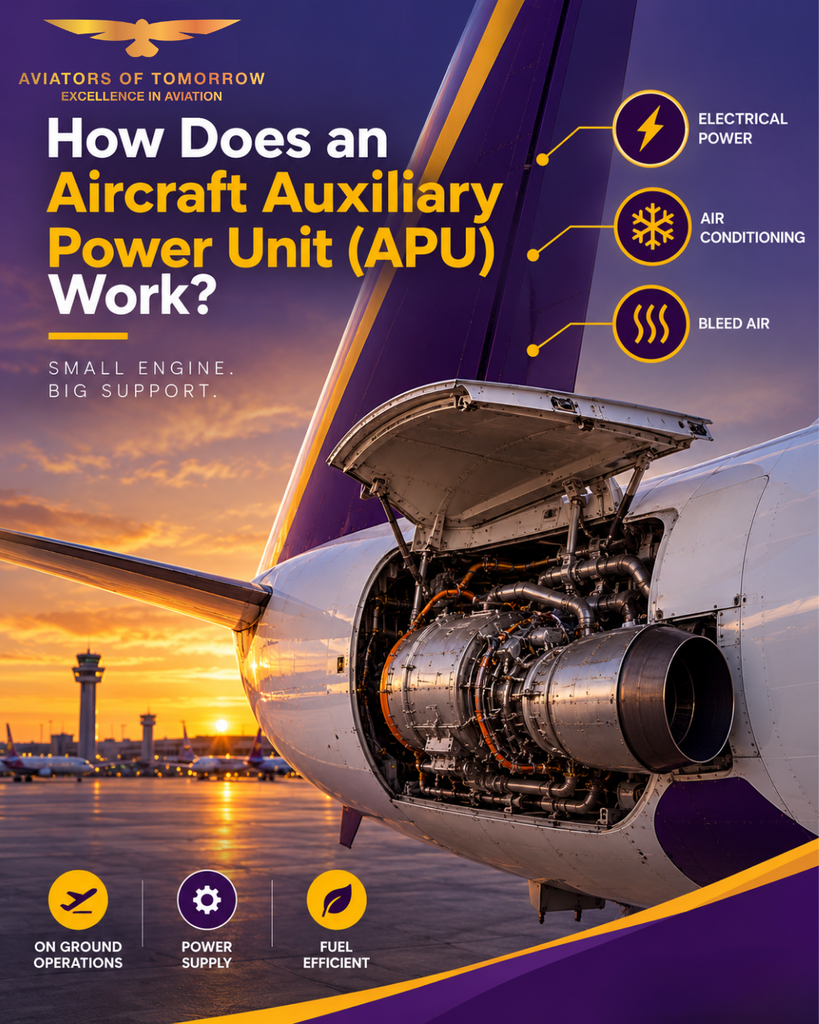
Table of Contents
What Is an Aircraft Auxiliary Power Unit (APU)?
An Aircraft Auxiliary Power Unit (APU) is a small gas turbine engine located, in most commercial aircraft, at the rear of the fuselage inside the tail cone. Unlike the main engines, which provide thrust for flight, the APU does not propel the aircraft. Instead, it provides electrical power and pneumatic (bleed) air while the aircraft is on the ground and can also serve as a backup power source during certain phases of flight.
For aviation students, think of the APU as the aircraft’s own personal generator; it lets the plane “wake up” before the main engines even start.
Why Do Aircraft Need an APU?
Before the main engines are started, an aircraft still needs power for lighting, avionics, air conditioning and various cockpit systems. This is where the Aircraft Auxiliary Power Unit (APU) becomes essential. Without an APU, aircraft would depend entirely on external ground power units, which are not always available at every airport or gate.
Key Functions of the APU
- Supplying electrical power to aircraft systems on the ground
- Providing bleed air for cabin air conditioning and pressurisation
- Starting the main jet engines using pneumatic power
- Acting as a backup power source during certain in-flight emergencies
How Does the Aircraft Auxiliary Power Unit (APU) Work?
The working principle of an Aircraft Auxiliary Power Unit (APU) is based on the same Brayton cycle used by main turbine engines, but on a much smaller scale. Let’s understand the process step by step.
Step 1: Starting the APU
The APU has its own starter motor, usually electrically operated using battery power. Once started, air is drawn in through an APU inlet located on the aircraft’s fuselage.
Step 2: Compression
The intake air passes through a compressor section, where it is compressed to increase its pressure and temperature. This compressed air is essential for combustion and later used as bleed air for other aircraft systems.
Step 3: Combustion
The compressed air mixes with fuel in the combustion chamber and is ignited. This produces high energy exhaust gases that expand rapidly.
Step 4: Turbine Rotation
These expanding gases pass through a turbine, causing it to spin. The turbine is connected to a shaft that drives the compressor, the generator and other accessories, keeping the whole cycle self-sustaining.
Step 5: Power Output
Once running, the APU generator provides electrical power for aircraft systems, while bleed air can be supplied for air conditioning, pressurisation and starting the main jet engines through pneumatic starters.
From the APU to the cockpit, every system matters. Learn more, train smarter, and prepare for your aviation career.
Stand a chance to win 100% scholarship & start training with India’s trusted aviation institute. Apply & Check Eligibility.
Apply Now!Components of an Aircraft Auxiliary Power Unit (APU)
Understanding the individual components helps aviation students grasp how the entire aircraft ground power system functions smoothly.
1. Air Inlet
Allows outside air to enter the APU compressor section.
2. Compressor
Increases air pressure before combustion.
3. Combustion Chamber
Where fuel and compressed air mix and ignite to produce energy.
4. Turbine
Extracts energy from expanding gases to drive the compressor and generator.
5. Gearbox
Transfers mechanical power from the turbine to accessories like the generator and starter.
6. Exhaust System
Releases combustion gases safely away from the aircraft body.
Role of the APU in Engine Starting
One of the most critical uses of the Aircraft Auxiliary Power Unit (APU) is starting the main engines. The APU supplies pneumatic power (bleed air) to the air turbine starter of each jet engine. This spins the engine’s compressor fast enough to allow fuel ignition, eliminating the need for external ground start carts at most airports.
APU and Cabin Comfort
Before boarding, passengers often enjoy a cool or warm cabin this comfort comes directly from the APU. The bleed air produced is routed through the aircraft’s air conditioning packs, maintaining a comfortable cabin temperature even when the main engines are shut down.
APU as an Emergency Power Source
In certain aircraft systems, the APU can also be started in flight to provide backup electrical and pneumatic power, particularly if one or more main engine driven generators fail. This makes the Aircraft Auxiliary Power Unit (APU) an important safety feature, not just a ground convenience.
Limitations of the APU
While extremely useful, the APU does have operational limits:
- Its performance and available pneumatic output can be limited at high altitudes due to reduced air density and operating conditions.
- It consumes fuel, adding to operating costs when used unnecessarily
- It requires regular aircraft maintenance and inspection like any turbine engine
- Excessive use can lead to increased wear on APU components
Importance of APU Knowledge for Aviation Students
For future pilots and aviation engineers, understanding aircraft systems like the APU is a foundational part of aviation training. Knowledge of the Aircraft Auxiliary Power Unit (APU) helps in understanding pre-flight procedures, ground operations, engine start sequence and even certain emergency protocols. It also builds a stronger overall understanding of how a modern aircraft functions as an integrated system.
You May Read Our Blog “Flutter in Aircraft: Dangerous Vibration Explained“
Conclusion
The Aircraft Auxiliary Power Unit (APU) may be small compared to the main engines, but its role in aviation is enormous. From powering cabin systems to enabling engine starts and providing backup power, the APU is truly an important part of modern aircraft operations. For aspiring pilots and aviation professionals, understanding APU systems is an important step toward building a strong foundation in aviation systems and preparing for DGCA-aligned aviation training and examinations.
Understand the systems that power every flight. Start your aviation learning journey today.
Stand a chance to win 100% scholarship & start training with India’s trusted aviation institute. Apply & Check Eligibility.
Apply Now!