Every student pilot reaches a moment in training where two terms start causing real confusion track vs heading in aviation. They sound similar, they’re used together constantly and yet mixing them up can throw your entire navigation off course.
If you’re training to become a pilot, understanding the difference between track and heading is not optional. It is a fundamental skill that affects how you navigate, plan fuel, calculate flight time and stay safe in the air.
Let’s break it down clearly, simply and in a way that actually sticks.
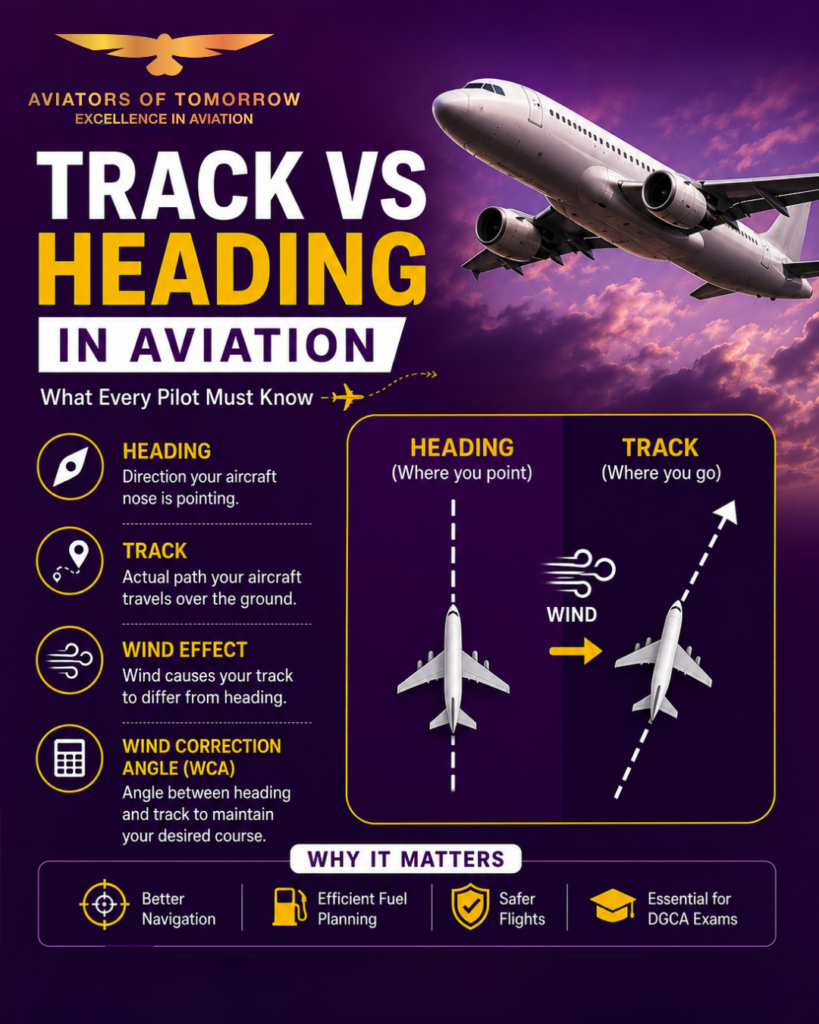
Table of Contents
What Is Heading in Aviation?
Heading is the direction your aircraft’s nose is pointing. It is measured in degrees from north magnetic north, true north or compass north depending on context.
When you sit in the cockpit and look at your compass or Heading Indicator (HI), that reading is your heading. It tells you where the aircraft is aimed but not necessarily where it is going.
This is the crucial bit most beginners miss.
Your heading is entirely about aircraft orientation, not movement across the ground.
Types of Heading You Need to Know
- True Heading (TH) — measured from True North
- Magnetic Heading (MH) — corrected for magnetic variation
- Compass Heading (CH) — corrected for compass deviation
- Indicated Heading — what you read directly on your cockpit instruments
Each type feeds into flight planning calculations. In practical flying, magnetic heading is used most frequently in navigation.
What Is Track in Aviation?
Track (also called Track Made Good) is the actual path your aircraft travels over the ground. It is the line drawn on a map from where you were to where you are now.
Unlike heading, track accounts for wind. If there is a crosswind pushing you sideways, your aircraft will drift and your track will be different from your heading.
Think of it this way:
You point your nose east. A northerly wind pushes you south as you fly. Your heading is east, but your track is south-east.
That drift is the difference between the two and it is caused entirely by wind effects on aircraft.
Track vs Heading in Aviation The Core Difference
| Feature | Heading | Track |
| What it measures | Direction aircraft nose points | Actual path over the ground |
| Wind affected? | No | Yes |
| Found on | Cockpit instruments | Charts / GPS / Navigation log |
| Used for | Aircraft control | Flight planning & navigation |
| Expressed in | Degrees (magnetic/true) | Degrees (true or magnetic) |
The simplest way to remember it:
Heading = Where you’re pointing Track = Where you’re actually going
Why Wind Makes All the Difference
Wind is the reason track and heading are never exactly the same (unless you’re flying directly into or away from the wind).
In aviation, pilots must calculate the Wind Correction Angle (WCA) the number of degrees they need to angle their heading into the wind to maintain the desired track.
The Wind Triangle
The wind triangle is a classic navigation tool that shows the relationship between:
- True Airspeed (TAS) — the aircraft’s speed through the air
- Wind speed and direction — the movement of the air mass
- Ground speed — actual speed over the ground
- Track — the actual path over the ground
- Heading — the direction the nose must point
Mastering the wind triangle is essential for any serious student going through PPL navigation training or preparing for instrument flying.
Practical Example: Flying From Delhi to Jaipur
Let’s say you plan a flight from Delhi to Jaipur. Your desired track is 240° magnetic.
Weather briefing shows a 30-knot northerly wind at your cruising altitude.
If you simply flew heading 240°, the wind would push you southward of your intended track. You would miss your destination.
Instead, you calculate your Wind Correction Angle and fly a heading of, say, 232°. Now the wind pushes your aircraft along the ground in exactly the 240° direction your desired track.
This is crosswind correction in flight in action. It is one of the most used real-world skills in VFR cross-country flying.
How GPS Has Changed the Game But Not the Basics
Modern aircraft and even simple handheld GPS units display both track and heading simultaneously. Many student pilots now fly with moving maps that show their actual track over the ground in real time.
This is helpful but it has also led to a dangerous habit: ignoring the fundamentals.
Understanding aircraft navigation fundamentals means you must be able to:
- Calculate WCA manually using flight computer (E6B)
- Understand what your instruments are actually telling you
- Recognise when GPS track data is misleading due to errors
If your GPS fails mid-flight, your ability to mentally separate heading from track could be the skill that gets you home safely. This is why dead reckoning navigation skills remain part of every serious pilot’s training.
Common Mistakes Student Pilots Make
1. Treating Heading and Track as the Same Thing
Many students set their heading to the track they want and assume they’re on course. Without wind correction, you will drift off your planned route every single time there is a crosswind.
2. Ignoring Magnetic Variation
True track from a chart must be converted to magnetic heading using the local magnetic variation. Skipping this step introduces navigational error especially over long distances.
3. Forgetting Compass Deviation
Even magnetic heading needs correcting for compass deviation the error caused by magnetic fields within your own aircraft. This is found on the compass deviation card in your cockpit.
4. Not Updating WCA in Flight
Wind rarely stays constant. A wind correction angle calculated on the ground may need adjusting as conditions change. Regular in-flight position checks help you stay on track.
Track vs Heading in Aviation During Instrument Flying
In IFR flying, the distinction becomes even more critical.
When flying an instrument approach or airways navigation, ATC may give you headings to fly whilst your navigation equipment displays your track. Confusing the two in low visibility or high workload situations is a genuine safety concern.
Understanding IFR navigation concepts properly starts with knowing this difference cold long before you ever enter a cloud.
How to Calculate Wind Correction Angle
The manual method uses the E6B flight computer (or its digital equivalent):
- Note your True Airspeed (TAS)
- Note the wind direction and speed
- Set up the wind triangle on the E6B
- Read off the Wind Correction Angle and Ground Speed
The formula approach (useful for quick mental estimates):
WCA (degrees) ≈ (Wind Speed × sin of wind angle) ÷ TAS
For example, a 20-knot crosswind with TAS of 100 knots: WCA ≈ 20 ÷ 100 = 0.2 radians ≈ about 11°
This is pilot navigation calculation at its most basic and it is tested in every PPL ground exam.
Track vs Heading in Aviation Exam Tips for Student Pilots
For those sitting their DGCA pilot ground exams or UK CAA PPL written papers, here is what to focus on:
- Know the definitions of both terms precisely
- Be able to convert True Track → Magnetic Track → Magnetic Heading → Compass Heading
- Understand the five-step navigation calculation process
- Practice E6B wind triangle problems until they become second nature
- Recognise questions that use track and heading interchangeably as traps
Aviation exams love testing whether you truly understand the relationship between magnetic variation and deviation and whether you can correctly apply them when calculating headings.
Master the basics today. Fly with confidence tomorrow.”
Start your DGCA pilot training journey with the right aviation fundamentals.
Stand a chance to win 100% scholarship & start training with India’s trusted aviation institute. Apply & Check Eligibility.
Apply Now!Quick Reference: Key Aviation Navigation Terms
| Term | Definition |
| Track | Actual path over the ground |
| Heading | Direction aircraft nose points |
| Wind Correction Angle (WCA) | Angle between heading and track |
| Ground Speed | Actual speed over the ground |
| True Airspeed (TAS) | Speed through the air mass |
| Magnetic Variation | Difference between True and Magnetic North |
| Compass Deviation | Error in compass due to aircraft magnetism |
| Dead Reckoning | Navigation using heading, speed and time |
Why This Knowledge Matters Beyond the Exam
Aviation is an unforgiving environment. Understanding track vs heading in aviation is not just academic, it has real consequences.
Pilots who are fuzzy on this concept:
- Miss waypoints and get lost
- Burn extra fuel flying inefficient routes
- Arrive late or not at all at destinations
- Struggle to interpret ATC instructions correctly
- Are unprepared for advanced navigation training
Pilots who master it early find that all further navigation training airways, IFR, oceanic flying builds naturally on this foundation.
You May Read Our Blog “IndiGo Chimes Cadet Pilot Program 2026: Eligibility, Fees, Selection Process, ADAPT Test, Training & Interview Guide“
Final Thoughts on Track vs Heading in Aviation
Track vs heading in aviation is one of those concepts that seems simple on the surface but runs deep. The moment you truly understand it, not just memorise it, your navigation improves dramatically.
For DGCA pilot ground exams, knowing the difference between track and heading is essential. Every time you calculate a wind correction angle or check your actual track against your planned route, you are applying this knowledge. It makes you a more precise, confident, and safer pilot.
Keep the basics sharp. The skies reward pilots who never stop learning.
Your dream of becoming a pilot starts with mastering every detail.”
Prepare smarter. Train better. Take the first step toward your aviation career.
Stand a chance to win 100% scholarship & start training with India’s trusted aviation institute. Apply & Check Eligibility.
Apply Now!