If you are an aspiring aviator, understanding ETOPS explained is not optional, it is essential. Extended-Range Twin-Engine Operations, commonly known as ETOPS, is one of the most significant regulatory frameworks in modern commercial aviation. It governs how far a twin-engine aircraft can fly from a diversion airport, making ultra long haul routes possible without the need for four engine jets.
Whether you are studying for your ATPL, training in a simulator or simply passionate about the world of flight, grasping Extended-range Twin-engine Operational Performance Standards will sharpen your operational knowledge and set you apart as a well rounded aviation professional.
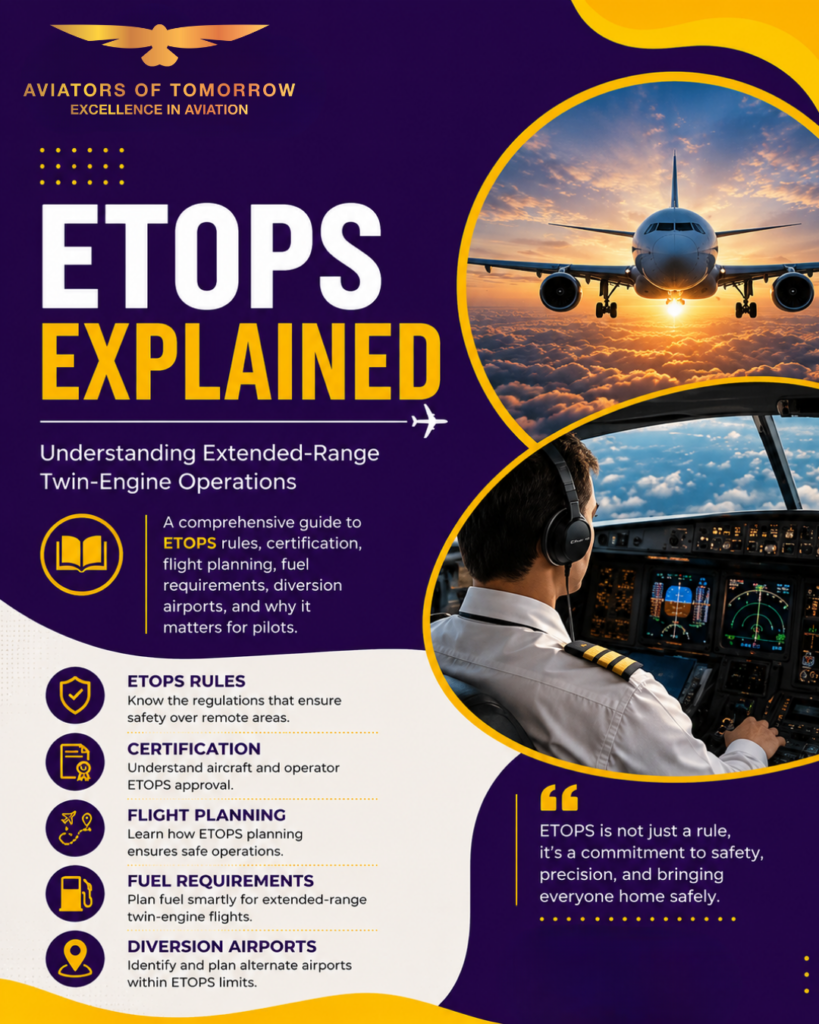
Table of Contents
What Does ETOPS Actually Mean?
ETOPS stands for Extended-Range Twin-Engine Operational Performance Standards. Before this regulation existed, twin-engine commercial aircraft were required to remain within 60 minutes of a suitable diversion airport at all times. This rule, known as the “60-minute rule,” severely limited the routes that aircraft like the Boeing 737 or early Airbus A300 could operate.
The introduction of Extended-range Twin-engine Operational Performance Standards changed everything. It allowed certified twin-engine aircraft to fly routes that take them further from diversion airports provided the aircraft, airline and crew meet strict airworthiness and training standards.
Today, ETOPS approval ratings are expressed in minutes. Common approvals include:
- ETOPS-120 — up to 120 minutes from a diversion airport
- ETOPS-180 — the standard for most transoceanic routes
- ETOPS-240 — used for extended Pacific and polar operations
- ETOPS-370 — the highest current rating, used by aircraft like the Boeing 787 and Airbus A350
A Brief History of ETOPS Regulations
To truly appreciate twin-engine long-range operations, you must understand where the rules came from.
In the early days of commercial aviation, regulators required multi-engine aircraft because jet engines were far less reliable than they are today. The more engines an aircraft had, the safer it was considered. Four-engine jets such as the Boeing 747 and Douglas DC-8 dominated long-haul routes for decades.
By the 1980s, however, engine technology had improved dramatically. Manufacturers began lobbying regulators particularly the FAA in the United States and the CAA in the United Kingdom to revise the 60-minute rule. In 1985, the FAA granted the first Extended-range Twin-engine Operational Performance Standards approval to Trans World Airlines for Boeing 767 operations across the North Atlantic.
This moment marked a turning point in commercial aviation safety standards, proving that twin-engine aircraft could match the reliability of their four-engine counterparts.
How Does ETOPS Certification Work?
Extended-range Twin-engine Operational Performance Standards is not simply handed to an airline. Both the aircraft type and the operator must receive separate approvals. Here is how the process works:
Aircraft Type Certification
The aircraft manufacturer must demonstrate to the relevant aviation authority such as EASA, the FAA or the UK CAA that the aircraft’s systems are reliable enough for extended operations. This includes:
- Engine reliability data
- Redundancy in critical systems (hydraulics, electrics, pressurisation)
- In-flight shutdown rates (IFSD rates must be extremely low)
- Fire detection and suppression systems
Operator Approval for ETOPS
Once the aircraft type is certified, the airline must also obtain its own Extended-range Twin-engine Operational Performance Standards operational approval. This involves:
- Demonstrated maintenance procedures
- Crew training specific to Extended-range Twin-engine Operational Performance Standards operations
- Diversion airport planning and fuel planning protocols
- Dispatch procedures including weather minima at alternates
This dual-certification approach ensures that flight safety regulations are met at every level from the factory floor to the flight deck.
ETOPS Planning: What Happens Before the Flight?
One of the most crucial aspects of Extended-range Twin-engine Operational Performance Standards flight planning is the pre-flight process. Dispatchers and pilots must work together to ensure all diversion airports along the planned route are usable at the time the aircraft would need them.
Key considerations include:
1. Equal Time Points (ETPs) An Equal Time Point is the point along a route where it takes the same amount of time to continue to the destination as it does to divert to the nearest suitable airport. Pilots must calculate ETPs for each critical alternate.
2. Fuel Planning ETOPS fuel requirements are significantly more complex than standard fuel calculations. Crews must carry contingency fuel for single-engine cruise speeds, as a failed engine dramatically increases fuel burn and flight time.
3. Weather at Alternates Diversion airports must meet specific weather minima at the projected time of aircraft arrival. If an airport is forecast to be below minima, it cannot be used as a valid Extended-range Twin-engine Operational Performance Standards alternate.
4. ETOPS Entry Point and Exit Point The dispatcher designates an Extended-range Twin-engine Operational Performance Standards Entry Point where the aircraft enters the ETOPS zone and an ETOPS Exit Point where it leaves. All planning revolves around this window.
ETOPS and Modern Long-Haul Aircraft
The aircraft that benefit most from extended diversion time approval are modern twin-engine widebodies. Let us look at some key examples:
Boeing 787 Dreamliner
The 787 holds one of the highest Extended-range Twin-engine Operational Performance Standards ratings available ETOPS-330 and in some cases ETOPS-370. Its composite construction, highly efficient GEnx or Trent 1000 engines and advanced electrical systems make it ideal for ultra-long-haul operations over the Pacific and Indian Oceans.
Airbus A350
The A350 XWB is ETOPS-370 certified, allowing airlines to operate routes such as Singapore to New York or Perth to London routes that cross some of the most remote airspace on the planet.
Airbus A320neo and Boeing 737 MAX
Even narrow-body aircraft now carry Extended-range Twin-engine Operational Performance Standards ratings. The A320neo family and 737 MAX are both ETOPS-180 certified, enabling them to operate transatlantic and transpacific island routes that were previously the domain of larger jets.
Why ETOPS Matters for the Next Generation of Pilots
For student pilots and trainee aviators, understanding Extended-range Twin-engine Operational Performance Standards is a window into the broader world of airline operations and regulatory compliance. Here is why it matters directly to you:
Operational knowledge: Airlines increasingly expect pilots to understand dispatch, fuel planning and alternate selection. Extended-range Twin-engine Operational Performance Standards sits at the heart of all three.
Career progression: Type ratings on ETOPS-capable aircraft such as the B787 or A350 are among the most sought-after in the industry. Knowing the regulatory framework before you enter the sim puts you ahead of the curve.
CRM and decision-making: Extended-range Twin-engine Operational Performance Standards scenarios such as an engine shutdown over the mid-Pacific demand flawless cockpit resource management. Understanding the procedures before they matter is what separates competent pilots from exceptional ones.
Regulatory awareness: Aviation authorities across the world, including EASA and the UK CAA, require operators to demonstrate crew competency in Extended-range Twin-engine Operational Performance Standards procedures. This is assessed during line checks and simulator evaluations.
Common ETOPS Myths, Debunked
There are several misconceptions about Extended-range Twin-engine Operational Performance Standards that even experienced aviation enthusiasts get wrong. Let us address a few:
Myth 1: ETOPS only applies over oceans Not true. Extended-range Twin-engine Operational Performance Standards applies to any route where the aircraft is more than the approved diversion time from a suitable airport. This includes routes over remote land areas such as Siberia, the Sahara and the Canadian Arctic.
Myth 2: ETOPS means flying with one engine Extended-range Twin-engine Operational Performance Standards planning accounts for the possibility of an engine failure, but the vast majority of Extended-range Twin-engine Operational Performance Standards flights are completed without incident. The rating simply certifies that the aircraft could safely divert on one engine if necessary.
Myth 3: Four-engine aircraft are always safer Modern twin-engine jets have engine in-flight shutdown rates so low that statistically, they are as reliable if not more so than older four-engine aircraft. The data supports this conclusion unambiguously.
ETOPS and Fuel: The Critical Calculation
Fuel is arguably the most important variable in Extended-range Twin-engine Operational Performance Standards route planning. Unlike standard domestic operations, Extended-range Twin-engine Operational Performance Standards fuel requirements must account for:
- Single-engine cruise to the nearest alternate
- Extended flight time at reduced speed
- Holding fuel at the alternate airport
- Contingency reserves
Dispatchers use specialised flight planning software to calculate these figures precisely. As a future pilot, you will work closely with your dispatcher before every Extended-range Twin-engine Operational Performance Standards departure to verify that all fuel and alternate requirements are satisfied.
Understand Extended-range Twin-engine Operational Performance Standards. Fly smarter. Train better.
Stand a chance to win 100% scholarship & start training with India’s trusted aviation institute. Apply & Check Eligibility.
Apply Now!The Role of Aviation Authorities in ETOPS
In the United Kingdom, Extended-range Twin-engine Operational Performance Standards operations fall under the jurisdiction of the UK Civil Aviation Authority (CAA). In Europe, EASA sets the overarching regulatory framework. The FAA governs US-registered aircraft.
Each authority publishes detailed guidance material on Extended-range Twin-engine Operational Performance Standards approval, maintenance and crew training. For UK-based aviators, the relevant document is CAA CAP 697 and associated Air Operations Regulations.
Keeping up to date with aviation regulatory changes is a professional obligation that begins the moment you commit to a career in commercial aviation.
ETOPS in Practice: A Real-World Scenario
Imagine you are a co-pilot on a Boeing 787 flying from London Heathrow to Tokyo Haneda. Roughly four hours into the flight, somewhere over the Siberian wilderness, the aircraft experiences an engine malfunction.
Your Extended-range Twin-engine Operational Performance Standards training kicks in immediately:
- You identify the Equal Time Point on your flight plan
- You assess diversion airports perhaps Novosibirsk or Khabarovsk
- You check weather at those alternates against your pre-filed minima
- You calculate single-engine fuel burn to your chosen diversion
- You declare the appropriate emergency and coordinate with ATC
Every single one of those steps is governed by Extended-range Twin-engine Operational Performance Standards procedures. This is not theoretical knowledge, this is life safety critical aviation expertise.
Key ETOPS Terms Every Aviator Should Know
Here is a quick reference glossary for aspiring aviators:
- ETOPS – Extended-Range Twin-Engine Operational Performance Standards
- IFSD – In-Flight Shutdown (of an engine)
- ETP – Equal Time Point
- Critical Fuel Scenario – Worst-case fuel calculation for Extended-range Twin-engine Operational Performance Standards diversion
- ETOPS Alternate – An airport pre-approved for use as a diversion during Extended-range Twin-engine Operational Performance Standards flight
- Diversion time – The time in minutes used to define Extended-range Twin-engine Operational Performance Standards approval (e.g., 180 minutes)
- Entry/Exit Point – The boundaries of the Extended-range Twin-engine Operational Performance Standards segment on a given route
You May Read Our Blog “Track vs Heading in Aviation: What Every Pilot Must Know“
Final Thoughts on ETOPS for Aspiring Aviators
Extended-range Twin-engine Operational Performance Standards explained is more than a regulatory topic; it is a reflection of how far aviation has come. From the rigid 60-minute rule of the 1950s to today’s 370-minute approvals over the most remote corners of the Earth, Extended-range Twin-engine Operational Performance Standards represents the triumph of engineering, safety culture and operational excellence.
For the aviators of tomorrow, this knowledge is foundational. For aspiring pilots in India, understanding DGCA regulations and Extended-range Twin-engine Operational Performance Standards requirements is equally important as it forms an essential part of professional aviation knowledge and operational awareness. Whether you are flying a narrow-body across the Atlantic or commanding a widebody over the Pacific, Extended-range Twin-engine Operational Performance Standards will shape your planning, your decision-making and your professional standards.
Study it. Understand it. Respect it. Because one day, at 35,000 feet over the middle of nowhere, it may be exactly what brings everyone home safely.
Ready to master Extended-range Twin-engine Operational Performance Standards? Start your aviation journey today.
Stand a chance to win 100% scholarship & start training with India’s trusted aviation institute. Apply & Check Eligibility.
Apply Now!