FADEC (Full Authority Digital Engine Control) is one of the most revolutionary systems ever introduced into modern aviation. If you are an aspiring aviator, the moment you step into a modern cockpit, you are already working alongside FADEC, whether you realise it or not. This intelligent digital system silently manages your engine’s every function, making flight safer, smoother and far more efficient than ever before.
For student pilots, understanding FADEC is not merely a theoretical requirement for examinations; it is a practical competency that shapes how pilots interact with modern aircraft throughout their careers. From initial type rating to command upgrade, FADEC remains an integral part of everyday flight operations.
In this complete guide, we break down everything you need to know about FADEC, how it works, why it matters, its key components, its role in sustainable aviation and what the future holds for digital engine management systems. Let us begin.
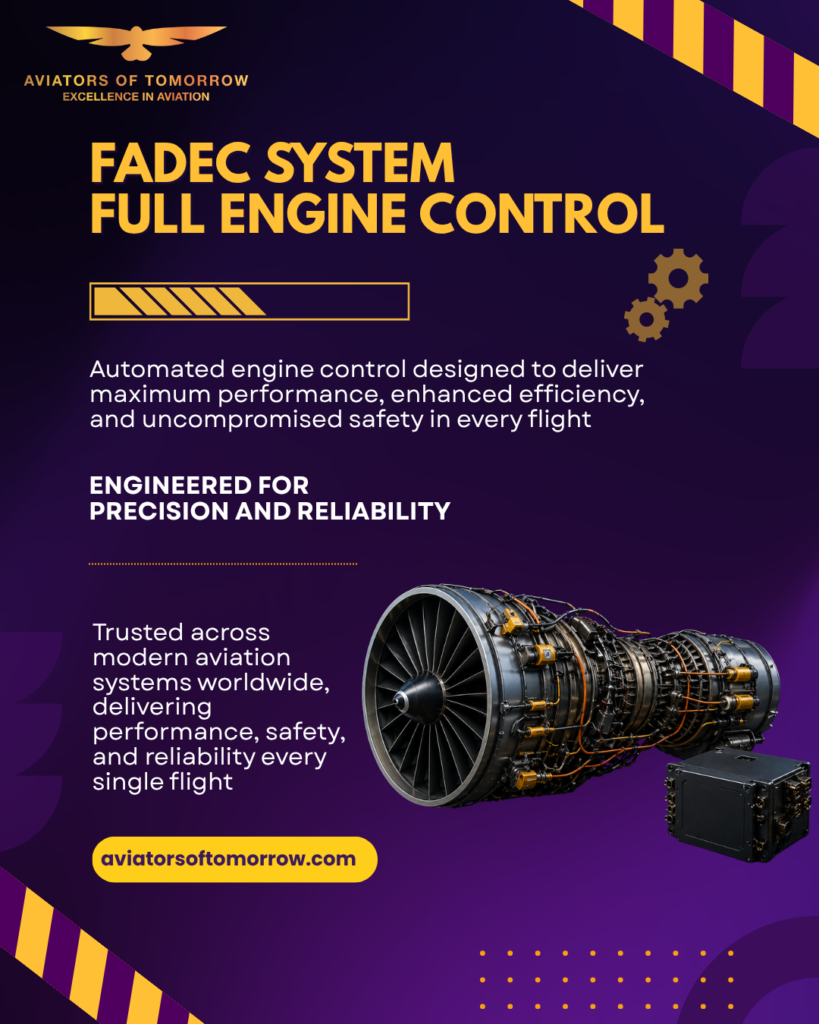
Table of Contents
What Is FADEC?
Defining Full Authority Digital Engine Control
At its most fundamental level, Full Authority Digital Engine Control is a fully digital computer system that assumes complete authority over an aircraft engine’s operation. The word “full authority” is critical here; unlike older systems, where the pilot retained manual override capability over certain engine functions, a true Full Authority Digital Engine Control system manages everything digitally with no direct mechanical backup.
The pilot provides input through the thrust lever. Full Authority Digital Engine Control takes that input and determines the precise fuel flow, ignition timing, bleed valve positions and dozens of other parameters required to deliver the demanded performance all within safe engine limits, all within milliseconds.
Why Is FADEC Called the Engine’s Brain?
The human brain receives signals from the body, processes them and sends commands back to keep everything functioning correctly. Full Authority Digital Engine Control does the same for a jet engine. It receives data from sensors positioned throughout the engine, processes that data through its Electronic Control Unit (ECU) and sends precise commands to actuators and valves to keep the engine performing optimally at all times.
Without FADEC, the complexity of modern turbofan engines would make manual management practically impossible, particularly at high altitude, in extreme temperatures or during rapid power changes.
How Does Full Authority Digital Engine Control Work?
The Core Operating Principle
Full Authority Digital Engine Control operates through a continuous closed-loop system. Sensors feed live data into the ECU, which compares actual engine performance against the desired performance demanded by the pilot’s throttle position. Any difference between the two triggers an immediate corrective adjustment.
This process repeats hundreds of times per second, ensuring that the engine always operates at precisely the right conditions no more, no less.
What Does FADEC Control?
A digital engine control system manages a wide range of critical engine functions:
- Fuel metering – precise fuel delivery to the combustion chamber at all flight phases
- Ignition timing – ensuring reliable and efficient combustion
- Thrust management – accurate power output matching pilot demand
- Variable bleed valves – regulating compressor airflow to prevent surge
- Engine limiters – automatic protection against over-temperature and over-speed
- Starting sequence – fully automated engine start from initiation to idle
Ready to master modern aviation systems? Start your journey into the world of advanced aircraft technology today.
Stand a chance to win 100% scholarship & start training with India’s trusted aviation institute. Apply & Check Eligibility.
Apply Now!Full Authority Digital Engine Control Dual-Channel Redundancy
One of the most important features of any FADEC system is its dual-channel architecture. Every Full Authority Digital Engine Controlunit contains two completely independent channels: Channel A and Channel B. Both channels monitor the engine simultaneously, but only one is active at any given time.
If the active channel detects a fault within itself, it automatically transfers authority to the standby channel without any pilot input. This built-in redundancy is a cornerstone of aviation safety systems and is one of the key reasons Full Authority Digital Engine Control is trusted on every modern commercial and military aircraft worldwide.
History and Development of Full Authority Digital Engine Control
From Manual Control to Digital Mastery
The story of FADEC begins in the 1970s when engineers first began exploring digital control for jet engines. Early aircraft required pilots to manually manage fuel flow, mixture and engine temperatures, a demanding and error-prone process, particularly during high-workload phases of flight.
Throughout the 1980s, early versions of digital engine management were introduced, primarily on military platforms where performance demands exceeded what analogue systems could reliably deliver.
FADEC Enters Commercial Aviation
By the late 1980s and into the 1990s, manufacturers including Rolls-Royce, General Electric and CFM International began integrating Full Authority Digital Engine Control technology into commercial turbofan engines. Airbus adopted FADEC across its fly by wire family and Boeing followed with its next-generation aircraft.
Today, Full Authority Digital Engine Control systems are standard equipment on virtually every modern jet engine, from narrow-body short-haul aircraft to wide-body long-haul jets and advanced military platforms.
Key Components of a FADEC System
Electronic Control Unit (ECU)
The ECU is the heart of the FADEC system. It is the central processor that receives all sensor data, runs the control algorithms and sends commands to every actuator in the engine. The ECU operates across both channels simultaneously, ensuring continuous monitoring and instant fault response.
Sensors and Probes
Accurate data is the foundation of effective digital engine control. Sensors and probes measure:
- Engine inlet temperature and pressure
- Compressor and turbine speeds (N1 and N2)
- Exhaust Gas Temperature (EGT)
- Fuel flow and fuel pressure
- Ambient air pressure and temperature
All of this data feeds continuously into the ECU, enabling real-time engine optimisation.
Actuators and Valves
Actuators are the physical components that carry out FADEC’s commands. They adjust fuel metering valves, variable stator vanes, bleed valves and thrust reversers based on the precise instructions issued by the ECU.
Independent Power Supply
A critical design feature of any Full Authority Digital Engine Control system is its independent power supply. The system generates its own electrical power through a dedicated Permanent Magnet Alternator (PMA) driven directly by the engine. This means Full Authority Digital Engine Control remains fully operational even if the aircraft’s main electrical system fails, an essential aspect of aircraft engine safety.
Why Full Authority Digital Engine Control Matters
Reduced Pilot Workload
Full Authority Digital Engine Control removes the burden of manual engine management from the pilot. Complex tasks such as fuel trimming, temperature monitoring and power balancing on multi-engine aircraft are handled automatically. This allows pilots to dedicate their full attention to navigation, communication, threat assessment and passenger safety, particularly critical during high-pressure phases such as take-off, go-around and emergency procedures.
Enhanced Fuel Efficiency
By continuously optimising the combustion process, digital engine management ensures that every drop of fuel is used as efficiently as possible. Airlines operating FADEC-equipped aircraft consistently report lower fuel burn per flight hour, which translates directly into reduced operating costs and lower carbon emissions, a priority that sits at the very heart of sustainable aviation.
Automatic Engine Protection
FADEC systems constantly guard against potentially catastrophic engine events. Over-temperature, over-speed, compressor surge and flame-out conditions are all monitored in real time. If any parameter approaches a dangerous limit, the engine protection system intervenes automatically, often before the pilot has even registered the warning.
Predictive Maintenance Support
Every parameter that FADEC monitors is recorded and available for review during maintenance inspections. This supports predictive engine maintenance, allowing engineers to identify deteriorating components and developing faults before they cause in-service failures. For airlines, this means higher dispatch reliability and significantly lower unscheduled maintenance costs.
FADEC in Military Aviation
Performance Beyond Human Limits
In military aviation, the demands placed on jet engines far exceed those of commercial operations. Fighter jets, attack aircraft and fast jets require instant throttle response, afterburner management and thrust vectoring control all at extreme speeds and altitudes.
FADEC technology manages these complex demands with a precision that no human pilot could achieve manually. Military FADEC systems are also designed to withstand far greater environmental extremes, including high-G manoeuvres, electromagnetic interference and battle damage scenarios.
FADEC and Sustainable Aviation
The Green Role of Digital Engine Control
Sustainability is now one of the defining challenges of the global aviation industry. FADEC plays a direct and meaningful role in reducing aviation’s environmental impact.
By optimising every combustion event, FADEC minimises waste fuel, reduces unburnt hydrocarbons and lowers NOx emissions. As next-generation aircraft engines are developed around sustainable aviation fuels (SAF), hydrogen combustion and hybrid-electric propulsion, FADEC technology will evolve to manage these new energy sources with the same precision and reliability it brings to conventional jet fuel today.
Tips for Student Pilots Studying FADEC
1. Understand the Logic First
Before memorising facts, understand why FADEC makes the decisions it does. Study the relationship between throttle lever angle, engine demand and ECU response.
2. Know Your Aircraft’s FADEC Behaviour
Every aircraft type has specific FADEC characteristics. Studying your Flight Crew Operating Manual (FCOM) thoroughly, the systems section on engine control is essential reading before your type rating.
3. Master Abnormal Procedures
Know exactly what to do in the event of a FADEC fault. Understand degraded modes, manual reversion procedures and associated limitations for your aircraft type.
4. Use Simulator Sessions Wisely
Use simulator time to practise recognising FADEC-related warnings on the ECAM or EICAS. Responding correctly to these messages under pressure is a key competency for any modern aviator.
5. Connect Theory to Practice
Every time you fly, relate what you see on the engine instruments to what FADEC is doing behind the scenes. This builds genuine systems understanding rather than surface-level exam knowledge.
You May Read Our Blog “Navigating the Skies: Understanding Airspace and Flight Rules“
Conclusion: FADEC, Your Career and the DGCA
FADEC (Full Authority Digital Engine Control) is far more than a technical subject to pass in an exam. It is a living, breathing system that you will work alongside every single day of your flying career.
For student pilots in India preparing for their DGCA (Directorate General of Civil Aviation) examinations, FADEC features prominently across multiple technical subjects, including Aircraft General Knowledge (AGK), Technical General and type-specific systems papers. A thorough understanding of digital engine management, dual-channel architecture, ECU function and engine protection systems is not optional for DGCA candidates; it is a core requirement.The DGCA syllabus increasingly reflects the realities of modern glass cockpit, FADEC-equipped aircraft and examiners expect candidates to demonstrate not just memorised facts but genuine systems understanding. Whether you are sitting your DGCA PPL, CPL or ATPL papers, investing time in truly understanding FADEC will give you a measurable advantage both in the exam room and in the cockpit.
Build a strong aviation foundation with industry-focused pilot training and DGCA preparation.
Stand a chance to win 100% scholarship & start training with India’s trusted aviation institute. Apply & Check Eligibility.
Apply Now!