AI-Based Digital Co-Pilot technology is rapidly becoming one of the most revolutionary developments in modern aviation and India is beginning to take notice. As artificial intelligence reshapes industries across the globe, the cockpit of an Indian aircraft is becoming the next frontier for intelligent, data-driven transformation. For Aviators of Tomorrow, this is not a distant concept; it is an unfolding reality that every aspiring Indian aviator and aerospace engineer must understand and prepare for.
From reducing pilot workload to enhancing flight safety and optimising fuel efficiency, the AI-based digital co-pilot is redefining what it means to fly and India’s aviation sector stands at the threshold of this extraordinary leap forward.
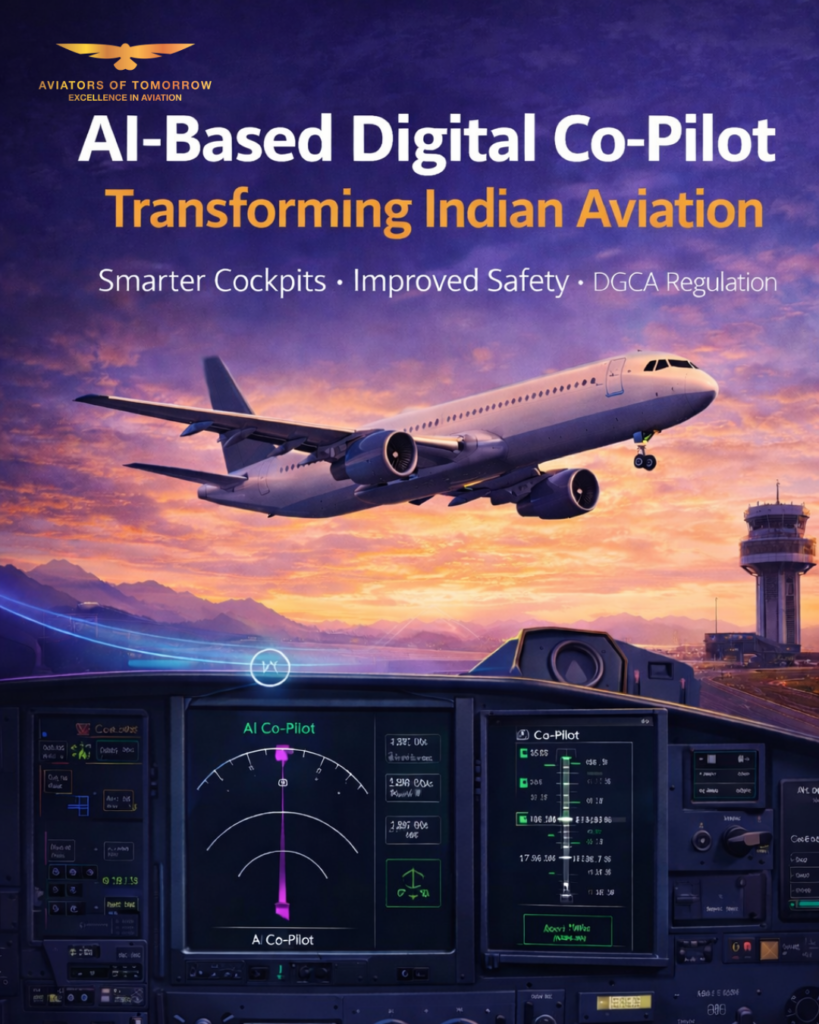
Table of Contents
What Is an AI-Based Digital Co-Pilot?
An AI-based digital co-pilot is an advanced artificial intelligence system designed to assist, support and in certain scenarios autonomously manage critical flight functions alongside a human pilot. Unlike traditional autopilot systems that follow pre-programmed instructions, a digital co-pilot uses machine learning in aviation, real-time data processing and intelligent decision-making algorithms to actively respond to dynamic flight conditions.
The digital co-pilot does not replace the human pilot; it empowers one. By handling routine tasks, monitoring aircraft systems, analysing vast streams of flight data and providing real-time recommendations, the AI co-pilot system allows the human pilot to focus on higher-order decision-making, situational awareness and passenger safety.
Think of it as the most capable, tireless and data-intelligent first officer ever to sit in a cockpit, one that never gets fatigued, never gets distracted and processes information at speeds no human mind can match.
Why India Needs AI-Based Digital Co-Pilot Technology
India’s aviation sector is growing at an extraordinary pace. With over 700 aircraft currently operating domestically and orders for hundreds more placed by carriers such as IndiGo, Air India, Akasa Air and SpiceJet, the demand for qualified pilots is rising sharply.
The Directorate General of Civil Aviation (DGCA) has repeatedly flagged India’s growing pilot shortage as a serious concern for the sector. Training a commercial pilot in India takes years and costs a significant investment and supply is simply not keeping pace with demand.
This is precisely where AI-based digital co-pilot technology presents a powerful and timely solution. By augmenting the capabilities of existing pilots and reducing the workload on the flight deck, digital co-pilot systems can help India’s aviation industry manage its rapid growth more safely and sustainably.
Beyond the pilot shortage, India’s diverse and challenging flying environment, including complex monsoon weather patterns, high-altitude airports such as Leh Kushok Bakula Rimpochhe Airport and some of the world’s busiest airspace over cities like Mumbai and Delhi makes intelligent cockpit assistance not just desirable but critically important.
Key Features of an AI-Based Digital Co-Pilot
The capabilities of a modern AI-based digital co-pilot are wide-ranging and deeply impressive. Here is what these intelligent systems bring to the Indian cockpit:
Real-Time Flight Data Analysis
An AI co-pilot system continuously processes enormous volumes of data from aircraft sensors, weather systems, air traffic control communications and navigation databases all simultaneously and in real time. It identifies patterns, anomalies and potential risks far faster than any human operator, providing the pilot with timely, actionable intelligence throughout every phase of flight.
Intelligent Weather Navigation
India’s monsoon season creates some of the most challenging flying conditions anywhere in the world. AI-based systems can analyse meteorological data with extraordinary precision, recommending optimal routing adjustments to avoid turbulence, thunderstorms and severe weather, improving both passenger comfort and flight safety in India.
Predictive Maintenance Alerts
One of the most valuable contributions of artificial intelligence in aviation is its ability to predict mechanical issues before they become critical failures. By continuously monitoring engine health, hydraulic systems, avionics performance and hundreds of other parameters, the digital co-pilot can alert maintenance teams to developing faults, dramatically reducing unscheduled downtime and improving aircraft reliability across Indian fleets.
Automated Routine Task Management
From managing fuel systems and monitoring cabin pressure to handling radio communications and updating flight plans, a significant proportion of cockpit workload involves routine, repetitive tasks. The AI digital co-pilot handles these autonomously, freeing the human pilot to concentrate on strategic decision-making and overall situational awareness.
Enhanced Emergency Response
In emergency situations, the speed and accuracy of decision-making is everything. AI-powered flight assistance systems can instantly evaluate emergency scenarios, cross-reference thousands of similar historical incidents and present the pilot with the most effective response options supporting faster, better-informed decisions when every second counts.
India’s skies are evolving are you ready for the AI cockpit?
Stand a chance to win 100% scholarship & start training with India’s trusted aviation institute. Apply & Check Eligibility.
Apply Now!AI-Based Digital Co-Pilot and Indian Defence Aviation
The application of AI-based digital co-pilot technology extends well beyond commercial aviation. India’s defence aviation sector, encompassing the Indian Air Force (IAF), Indian Navy and Indian Army Aviation Corps, stands to gain enormously from intelligent cockpit systems.
HAL’s Tejas Light Combat Aircraft and the forthcoming Advanced Medium Combat Aircraft (AMCA) are platforms where AI-driven cockpit assistance could deliver decisive operational advantages. In high-intensity combat environments, the cognitive demands on a fighter pilot are extreme. An AI co-pilot system that manages non-combat tasks, monitors aircraft health and provides tactical recommendations allows the pilot to focus entirely on mission execution.
DRDO is actively researching AI applications for Indian defence aerospace and the integration of digital co-pilot capabilities into next-generation Indian military aircraft is an area of growing strategic importance for the nation’s defence establishment.
Machine Learning in Aviation: The Engine Behind the Digital Co-Pilot
The intelligence that powers an AI-based digital co-pilot is built on machine learning in aviation, the ability of AI systems to learn from vast datasets of flight information, improve their performance over time and adapt to new and unforeseen situations.
Indian aviation generates enormous volumes of data every single day from flight recorder information and engine telemetry to weather observations and air traffic patterns. Machine learning algorithms fed with this data can identify safety trends, optimise flight paths, predict maintenance needs and continuously refine the digital co-pilot’s decision-making capabilities.
India’s world-renowned strength in software engineering and data science gives the country a natural advantage in developing and refining the machine learning systems that underpin AI aviation technology. Indian technology companies and research institutions are already contributing to global AI development and aviation is an increasingly important application domain.
Indian Institutions Driving AI Aviation Research
Several leading Indian institutions are actively engaged in research that directly supports the development of AI-based digital co-pilot technology.
IIT Bombay and IIT Madras. Both institutions have active research programmes in AI, autonomous systems and aerospace engineering disciplines that converge directly in the development of intelligent cockpit systems.
National Aerospace Laboratories (NAL), Bengaluru. NAL is India’s premier civil aerospace research body and is increasingly exploring AI applications in avionics systems and flight management.
DRDO Aeronautical Development Establishment (ADE) ADE is involved in the development of unmanned aerial vehicles and autonomous flight systems capabilities that share significant technological overlap with AI digital co-pilot development.
Indian Institute of Science (IISc), Bengaluru. IISc’s work in robotics, autonomous systems and computational intelligence is directly relevant to the advancement of AI-powered flight assistance technology in India.
Challenges in Deploying AI-Based Digital Co-Pilot in India
Whilst the promise of AI-based digital co-pilot technology is immense, several significant challenges must be addressed before widespread deployment across Indian aviation becomes a reality.
Regulatory Approval by DGCA: The Directorate General of Civil Aviation must develop a robust and forward-looking certification framework for AI cockpit systems. This requires new testing methodologies, safety standards and ongoing performance monitoring protocols specifically tailored to intelligent flight systems.
Pilot Acceptance and Training Introducing AI into the cockpit requires not just technical integration but cultural acceptance. Indian pilots must be trained to work effectively alongside AI co-pilot systems, understanding both their capabilities and their limitations. This demands a new generation of aviation training programmes precisely in the area where Aviators of Tomorrow is focused.
Cybersecurity in Aviation AI systems connected to real-time data streams and communication networks introduce new cybersecurity risks in aviation. Protecting these systems from hacking, data manipulation and interference is a non-negotiable requirement for safe deployment.
Data Infrastructure: Effective machine learning in aviation requires vast, high-quality datasets. Building the data infrastructure necessary to train and continuously improve AI co-pilot systems across India’s diverse flying environment is a significant undertaking.
Cost of Integration Integrating AI digital co-pilot systems into existing aircraft fleets involves substantial investment. Developing cost-effective integration pathways, particularly for smaller Indian regional carriers, is an important challenge for the industry to address.
The Future of AI-Based Digital Co-Pilot in India
The trajectory for AI-based digital co-pilot technology in India is extraordinarily exciting. Over the coming decade, we can expect to see:
- DGCA pilot programmes trialling AI co-pilot systems on select domestic routes
- HAL and DRDO are integrating AI cockpit assistance into next-generation Indian defence aircraft
- Indian airlines are adopting AI-powered predictive maintenance systems as a first step towards full digital co-pilot integration
- Indian aviation startups are developing indigenous AI co-pilot technology tailored specifically for India’s unique flying environment
- Aviation training institutions across India are incorporating AI cockpit familiarisation into pilot and engineer training curricula
The single-pilot operations model, where one human pilot is supported by an AI co-pilot rather than two human crew members, is already being seriously discussed by global regulators. For India, this development has profound implications for addressing the pilot shortage whilst maintaining the highest standards of flight safety.
Preparing India for the AI Cockpit Revolution
At Aviators of Tomorrow, we recognise that the AI-based digital co-pilot is not a futuristic fantasy; it is an imminent reality that India’s aviation community must actively engage with and prepare for today.
Whether you are a student pilot at a flying academy in Pune, an avionics engineer at an MRO facility in Hyderabad or an aerospace researcher at an IIT, the rise of artificial intelligence in aviation will profoundly shape your career and your industry.
Aviators of Tomorrow is committed to ensuring that India’s next generation of aviation professionals understands this technology deeply, engages with it confidently and contributes to its development with the creativity and technical excellence that Indian engineers are known for across the world.
You May Read Our Blog “Aircraft Systems 101: What Every Pilot Needs to Know“
Conclusion: India’s Cockpit Is Getting Smarter
AI-based digital co-pilot technology is transforming aviation, and India is well-positioned to lead this shift. With strong tech talent and a growing aviation sector, the country has huge potential. Support from the Directorate General of Civil Aviation (DGCA) will be key to ensuring safe adoption. The future cockpit is being built today and India must be part of it.
Future cockpits need future-ready minds. Start your journey now.
Stand a chance to win 100% scholarship & start training with India’s trusted aviation institute. Apply & Check Eligibility.
Apply Now!