If you are beginning your aviation journey, VOR navigation is one of the most essential skills you will ever learn. From your first cross country flight to your instrument rating examination, VOR radio navigation appears at every stage of professional pilot training in the United Kingdom and across the world.
VOR navigation is not just a theoretical topic, it is a practical, hands-on skill used in real cockpits, in real weather and in real airspace. The aviators of tomorrow who become airline captains, charter pilots and military aviators all started by mastering these exact same fundamentals. This guide covers everything you need: what VOR is, how it works, how to track and intercept radials, cockpit instruments, limitations and how it fits into modern training.
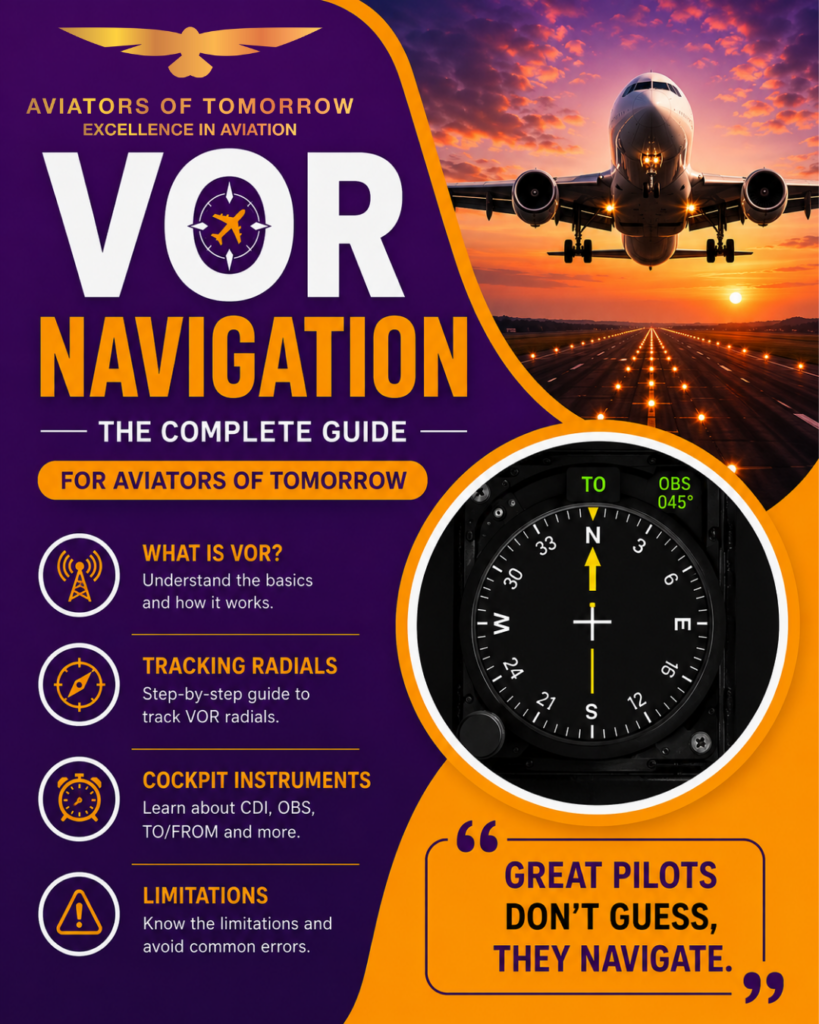
Table of Contents
What Is VOR Navigation?
VOR stands for Very High Frequency Omnidirectional Range. It is a ground-based radio navigation system that has been used in aviation since the 1950s and remains one of the most important instrument navigation aids in the world today.
A VOR station is a ground transmitter that sends radio signals outward in all 360 directions. Each direction is called a radial. Your aircraft’s VOR receiver picks up these signals and determines your position relative to the station. The VOR navigation system operates on frequencies between 108.0 MHz and 117.95 MHz and delivers a clear, reliable, visual indication of your position at all times.
What makes VOR radio navigation so powerful is its simplicity. Unlike older systems, it gives you a direct, easy to read cockpit display without complex manual calculations which is exactly why it became the global standard for instrument navigation.
How Does VOR Navigation Work?
Each VOR station transmits two signals simultaneously. The first is a reference signal that is omnidirectional and constant in phase. The second is a variable signal that rotates electronically 30 times per second, changing phase with direction.
Your VOR receiver compares the phase difference between these two signals and calculates your magnetic bearing from the station of your radial. This is then displayed on your Course Deviation Indicator (CDI) or Horizontal Situation Indicator (HSI) in the cockpit.
One critical point every student must understand VOR radials are always measured from the station, not towards it. This distinction causes confusion for many new pilots and is tested heavily during VOR instrument flying examinations.
Key VOR Navigation Terms You Must Know
Understanding the terminology of VOR navigation is essential before you ever touch the controls.
Radial — A magnetic bearing measured outward from the VOR station. There are 360 radials, one per degree. All VOR position fixing is built around identifying which radial you are currently on.
Course Deviation Indicator (CDI) — The primary cockpit instrument for VOR navigation. A vertical needle deflects left or right showing deviation from your selected course. Each dot of deflection equals roughly two degrees. Mastering the CDI in VOR navigation means making smooth, proportionate corrections never chasing the needle.
TO/FROM Flag — Tells you whether your selected course leads towards the station (TO) or away from it (FROM). Misreading this flag is one of the most common and dangerous errors in VOR tracking. Always check it before beginning any procedure.
Omni Bearing Selector (OBS) — A rotatable dial that lets you select your desired VOR course. Setting the OBS in VOR flying correctly is a fundamental cockpit skill that must become second nature.
Cone of Silence — A small zone directly above the VOR transmitter where signals become weak or absent. Pilots must account for this during VOR instrument approaches and overhead station procedures.
Morse Code Identifier — Every VOR station transmits a unique Morse code signal. You must always identify the station before using it for VOR radio navigation. Never skip this step.
Tracking a VOR Radial Inbound and Outbound
Radial tracking is the practical heart of VOR navigation; this is where theory becomes real cockpit skill.
Tracking Inbound — Tune and identify your VOR station. Rotate the OBS until the CDI needle centres with a TO flag showing. Fly the heading displayed and monitor the needle. If it drifts left, your aircraft has gone right turn left to correct. Apply a wind correction angle by heading slightly into the wind to hold the centreline. As you approach the station the needle becomes more sensitive and reduces your inputs. When the flag flips from TO to FROM, you have reached station passage.
Tracking Outbound — Set your desired outbound radial on the OBS and confirm the FROM flag. Centre the needle and fly the associated heading. Apply wind corrections exactly as you would inbound. Outbound VOR radial tracking is tested extensively during instrument rating training across the United Kingdom.
The golden rule in both directions always turns towards the needle, never away from it.
Intercepting a VOR Radial
Radial interception is used when you are not already on your desired course and need to manoeuvre onto it. This is a core VOR navigation technique tested in every instrument rating flight examination.
Tune and identify the station. Set the desired radial or inbound course on the OBS. Turn towards the radial at an interception angle of 30 to 45 degrees. Monitor the CDI needle as it begins moving from full deflection towards the centre, prepare to turn. Lead the turn slightly before the needle reaches the centre. If you wait until it is fully centred, you will overshoot.
Once established on the radial, apply your wind correction angle and settle into normal VOR radial tracking. Good interception is about anticipation, thinking ahead, not in the moment.
VOR Navigation Instruments in the Cockpit
Several cockpit instruments are directly involved in VOR navigation and knowing each one is essential.
The CDI is the standard instrument found in virtually every training aircraft in the UK. It displays course deviation, the TO/FROM flag and houses the OBS dial. The HSI is a more advanced instrument combining your directional gyro and VOR information into one geographically intuitive display, found in most modern training and commercial aircraft. The RMI uses a rotating compass card with bearing pointers to show the magnetic bearing to your selected VOR station, making it extremely useful for VOR position fixing. In glass cockpit aircraft, the MFD provides a full moving map with VOR symbols, radials and airways displayed digitally though the underlying VOR instrument navigation principles remain identical regardless of the display technology.
VOR Navigation and the Instrument Rating
For pilots pursuing the Instrument Rating (IR) under UK CAA regulations, VOR navigation is central to both the theoretical examinations and the practical flight test.
In theory papers, you will be tested on VOR system principles, CDI and HSI interpretation, approach procedures and system limitations. In the flight test, your examiner will assess inbound and outbound VOR radial tracking, radial interception, cross-radial position fixing and a complete VOR instrument approach to published minima. The required standard is demanding course centreline must be maintained to within plus or minus five degrees throughout.
Meeting this standard requires consistent practice and a genuine, deep understanding of VOR radio navigation not surface level exam preparation.
Learn the science behind every successful flight.
Stand a chance to win 100% scholarship & start training with India’s trusted aviation institute. Apply & Check Eligibility.
Apply Now!Limitations of VOR Navigation
Every pilot must understand the limitations of the VOR navigation system to use it safely.
Line of Sight — VOR signals cannot bend around terrain or the earth’s curvature. At low altitudes, hills and mountains can block reception. The higher you fly, the greater your reliable range from a VOR station.
Service Volume — Each station has a defined service volume. Flying outside it produces unreliable CDI indications. Always confirm your route keeps you within usable range.
Cone of Silence — Signals are unreliable directly overhead the transmitter. Be prepared for temporary needle unreliability during station passage.
Scalloping — In mountainous terrain, reflected signals cause the CDI needle to swing erratically. Treat this with caution and cross-check using other navigation sources.
Station Decommissioning — Some VOR stations are being gradually removed as GPS expands. Always check current NOTAMs to confirm your planned stations are operational.
VOR Navigation vs GPS Why VOR Still Matters
Many student pilots ask why they still need to learn VOR navigation when GPS exists. The answer is straightforward.
GPS can fail. Solar weather, radio frequency jamming, satellite outages and equipment faults can all knock out GPS at any time. VOR radio navigation is entirely independent of satellites, making it a reliable and immediate backup. UK CAA and EASA licensing regulations still require demonstrated VOR competency for instrument ratings and commercial licences and that requirement exists for very good reason.
For the aviators of tomorrow, mastering both systems is what builds a truly professional and safe pilot. Never rely on a single navigation source. Redundancy is not optional in aviation, it is the foundation of safety.
Top Tips for Mastering VOR Navigation
Always tune and identify every VOR station before using frequency alone is not enough. Develop the habit of checking the TO/FROM flag every single time you set a new course. Lead your turns during radial interception, anticipate, do not react. Practise extensively on a simulator before applying procedures in the aircraft. Force yourself to trust the instruments during training, especially when visual conditions tempt you to look outside. Study aviation charts thoroughly on the ground so your cockpit workload remains manageable in the air.
These habits, built early, will carry you through your entire aviation career.
You May Read Our Blog “How Pilots Use Trends Instead of Single Readings“
Final Thoughts on VOR Navigation
VOR navigation is far more than just a Directorate General of Civil Aviation (DGCA) examination topic. It is a foundational aviation skill that connects you to the history of flight, underpins modern airspace structure and gives you a reliable, independent navigation capability throughout your career. Every great pilot started exactly where you are learning radials, tracking needles and building the instrument discipline that defines professional aviation.
Master VOR navigation not only to excel in your DGCA examinations but also to build the strong flying foundation every professional pilot needs. Learn it well today and the skies will always be within your reach.
Your pilot journey starts with VOR Navigation.
Stand a chance to win 100% scholarship & start training with India’s trusted aviation institute. Apply & Check Eligibility.
Apply Now!