Every aspiring aviator must understand one golden rule of the cockpit: a single instrument reading tells you where you are, but a trend tells you where you are going. Learning how pilots use trends instead of single readings is one of the most critical skills separating a novice from a confident, safe pilot. For the aviators of tomorrow, mastering this concept is not optional, it is essential.
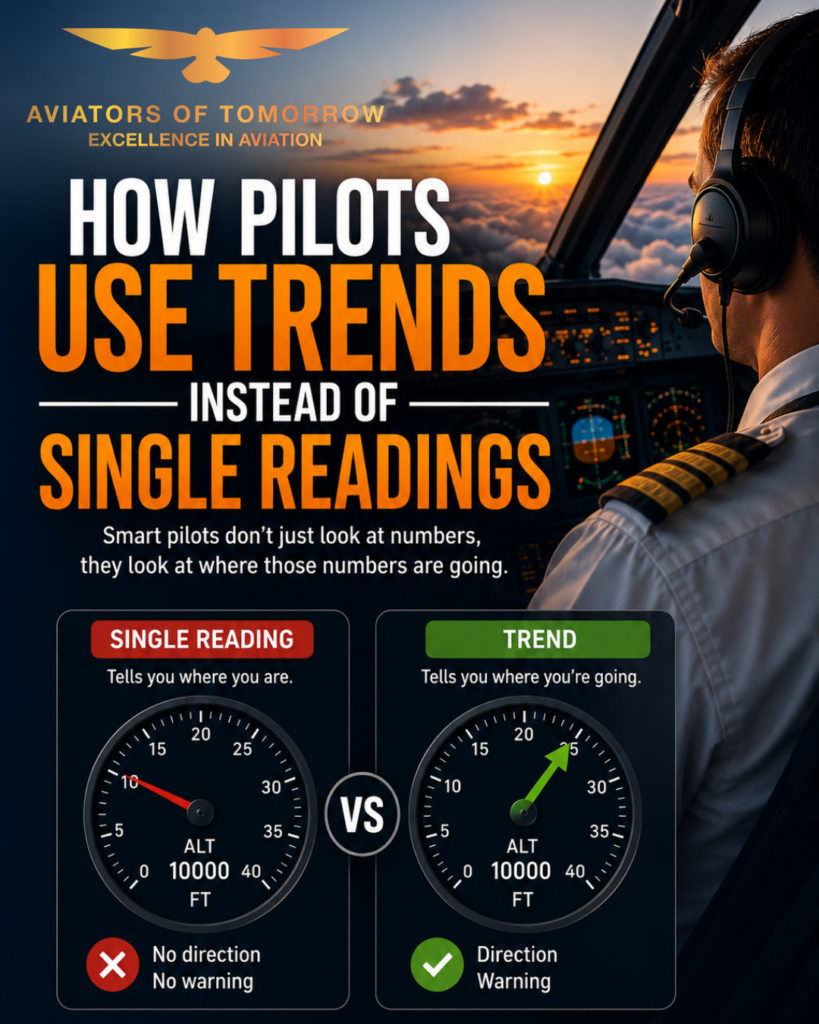
Table of Contents
Why a Single Reading Can Mislead You
Imagine glancing at your oil pressure gauge and seeing a normal value. Comfortable? You should not be not entirely. That one reading gives you a snapshot, nothing more. Cockpit instrument interpretation requires a pilot to observe movement over time, not just a static number.
A pressure reading of 75 PSI might look healthy in isolation. But if that reading was 80 PSI ten minutes ago and 77 PSI five minutes ago, you are now looking at a declining trend and that declining trend is your real warning signal.
Single readings are like a photograph. Trends are like a video. Pilots need the video.
How Pilots Use Trends Instead of Single Readings in Real Flight
1. Engine Monitoring and Performance Tracking
One of the clearest examples of aviation trend analysis is engine health monitoring. Experienced pilots do not simply check oil temperature once they track it across phases of flight.
During climb, a gradual rise in oil temperature is expected. But if the temperature keeps climbing during cruise, that upward movement signals a potential problem. This is progressive instrument scanning in action watching the story unfold, not reading a single page.
Modern aircraft use Engine Trend Monitoring (ETM) systems that log parameters over time. Airlines and flight schools use this data to catch mechanical issues before they become emergencies. The trend spotted on the ground saves lives in the air.
2. Altimeter and Vertical Speed Indicator
Student pilots often fixate on the altimeter reading. Instructors quickly correct this habit. The Vertical Speed Indicator (VSI) exists precisely because altitude as a number is less useful than altitude as a direction of movement.
Are you climbing? Descending? Stabilising? The VSI answers this. Combined with altimeter cross-checking, a pilot builds a dynamic cockpit awareness that single-instrument staring simply cannot provide.
This is the foundation of situational awareness in aviation knowing not just where the aircraft is, but where it is heading and at what rate.
3. Fuel Management Trend Over Time
Fuel is life in aviation. Yet many student pilots check fuel quantity without applying trend thinking. Seasoned pilots calculate fuel burn rate trends throughout flight.
If fuel burn is higher than planned during cruise, that trend identified early allows for a diversion decision while options still exist. Waiting for the low-fuel warning light is reactive. Tracking the burn trend is proactive pilot decision-making.
This is exactly the mindset that the aviators of tomorrow must cultivate from their very first solo flight.
The Science Behind Trend Based Flying
Instrument Scanning Techniques
Professional pilots use structured cockpit scanning patterns to gather trend data efficiently. Two popular methods are:
- The Selective Radial Scan — anchoring on the attitude indicator and cross-checking related instruments in sequence
- The Fixation-Free Scan — deliberately preventing the eye from resting too long on any single instrument
Both techniques prioritise movement and change over static values. They train the pilot’s mind to ask: Is this reading moving? In which direction? How fast?
This disciplined flight instrument monitoring is what separates situational awareness from cockpit confusion.
Master the skills that airlines value. Start your DGCA journey today and train to become a safer, smarter and more confident pilot.
Stand a chance to win 100% scholarship & start training with India’s trusted aviation institute. Apply & Check Eligibility.
Apply Now!The Trend Is the Warning
In professional aviation, the phrase “the trend is the warning” is widely respected. Airlines train crews to treat any sustained movement away from normal parameters as an immediate advisory, even if values remain within published limits.
A hydraulic pressure gauge reading within limits but falling steadily deserves attention now not when it drops below limits. This principle of predictive cockpit management is built entirely on trend interpretation.
How Aviators of Tomorrow Can Build Trend Awareness
Start on the Ground
Before you ever fly, practise instrument cross-checking in simulators. Modern flight simulators replicate real instrument behaviour, including trends. Use them to build the habit of watching movement, not just values.
Ask yourself during every simulator session: What is this instrument telling me about the direction of change?
Use a Logbook as a Trend Tool
Your pilot logbook is not just a record it is a personal aviation data log. Track your approach speeds, fuel burns, climb rates and circuit patterns across flights. Over weeks, you will begin to see your own performance trends.
Are your landings consistently long? That is a trend worth correcting. Are your cross-wind approaches improving? That positive trend deserves recognition and analysis.
Learn to Read Weather Trends
Aviation meteorology is almost entirely trend-based. A single METAR gives you current conditions. A sequence of METARs tells you whether conditions are improving or deteriorating and at what rate.
The pilot who reads three consecutive METARs before departure understands far more about the weather picture than the pilot who reads only the latest one. Weather trend reading is a cornerstone of sound pre-flight planning.
Trend Thinking in Multi-Crew Operations
In commercial aviation, Crew Resource Management (CRM) training specifically addresses trend awareness. Crews are taught to verbalise instrument trends during critical phases of flight.
Statements like “oil temperature has been climbing for the last five minutes” or “fuel burn is running two percent above plan” are examples of proactive CRM communication. They flag trends early, giving the crew time to assess and act without pressure.
This team-based approach to flight safety monitoring is a model that even student pilots can adopt by practising trend-based thinking from their earliest lessons.
Common Mistakes Pilots Make Without Trend Thinking
| Mistake | Consequence |
| Fixating on one instrument | Missing developing problems |
| Ignoring gradual changes | Delayed emergency response |
| Skipping fuel trend calculations | Running into fuel emergencies |
| Reading weather once pre-flight | Being caught by deteriorating conditions |
| Not cross-checking instruments | Misreading aircraft state |
Avoiding these mistakes requires nothing more than consistent trend awareness, a habit that can be built deliberately from day one of flight training.
Why How Pilots Use Trends Instead of Single Readings Matters More Today
Modern aviation is more data-rich than ever. Glass cockpits, digital engine monitors and electronic flight bags generate streams of real-time information. The challenge is no longer accessing data, it is interpreting it intelligently.
The aviators of tomorrow must be skilled aviation data analysts as much as stick-and-rudder pilots. The cockpit of a modern aircraft rewards those who understand trends, patterns and rates of change.
How pilots use trends instead of single readings is not a technique from the past, it is the core competency of the future pilot.
Quick Trend-Thinking Checklist for Student Pilots
During pre-flight — check if fuel levels match your planned load and calculate expected burn rate
During climb — monitor engine temps for direction of movement, not just current value
During cruise — cross-check instruments every few minutes and note any directional change
During descent — track VSI trends and compare to planned descent profile
During approach — monitor airspeed trend to ensure stable, consistent energy management
Post-flight — log your performance data and compare to previous flights for personal trend analysis
You May Read This Blog “DGCA Class 1 Medical Tests & Examinations – Everything You Need to Know in 2026“
Final Thoughts
The cockpit rewards pilots who think ahead, and thinking ahead means reading trends. A single instrument reading is data, but a series of readings over time is intelligence. The aviators of tomorrow who master how pilots use trends instead of single readings will make better decisions, manage emergencies more calmly and develop the situational awareness expected in DGCA training and professional aviation.
Whether you are in your first hours of flight training, preparing for your DGCA examinations or working towards your Commercial Pilot Licence (CPL), start watching your instruments for movement not just numbers. That shift in perspective may one day become one of the most valuable skills you carry into the cockpit
The best pilots don’t just read instruments they understand trends. Join our DGCA training and take the first step toward a successful aviation career.
Stand a chance to win 100% scholarship & start training with India’s trusted aviation institute. Apply & Check Eligibility.
Apply Now!