So you want to become a pilot? That is an amazing dream. Flying high in the sky, wearing that uniform and sitting in the cockpit it sounds like the coolest job in the world. But before you can fly a plane, there is one very important step you must clear: the DGCA Class 1 Medical Tests list & Examinations.
Don’t worry if you have never heard of this before. In this blog, we will explain everything in simple language just like a friend explaining it to you. By the end of this post, you will know exactly what the DGCA Class 1 Medical is, why it is needed, what tests are done and how you can prepare for it.
What Is DGCA and Why Does It Matter?
DGCA stands for Directorate General of Civil Aviation. It is the government body in India that controls everything related to flying and civil aviation. Think of it as the “boss” of all things aviation in India.
When you want to become a commercial pilot in India, DGCA makes sure you are healthy, fit and safe to fly a plane. They do this through something called the Class 1 Medical Certificate.
This certificate is mandatory (that means, you must have it) if you want to:
- Get a Commercial Pilot Licence (CPL)
- Fly a passenger aircraft professionally
- Work as a co-pilot or captain in an airline
Without clearing the DGCA Class 1 Medical Tests List & Examinations, you simply cannot become a licensed commercial pilot in India. That is how important this is.
Why Is the Class 1 Medical Examination So Important?
Imagine you are sitting in a plane at 35,000 feet in the air. The pilot’s job is to keep you and hundreds of other passengers safe. A small health problem like blurry vision, a weak heart or poor hearing could lead to a very serious accident.
That is why the DGCA Class 1 Medical Tests List & Examinations are so strict. They are not meant to scare you. They are designed to protect you, the passengers and everyone on the ground.
The medical exam checks if your body and mind are strong enough to handle the stress of flying. Pilots deal with long hours, changing time zones, high-pressure situations and sometimes emergencies. Your body needs to be ready for all of that.
Who Needs to Take the DGCA Class 1 Medical?
The Class 1 Medical is required for:
- Student Pilots who are starting their CPL (Commercial Pilot Licence) training
- Existing pilots who need to renew their medical certificate
- Aspiring cabin crew who later want to move into the cockpit
If you are in Class 10th or 12th right now and dreaming of becoming a pilot, you should start taking care of your health today. The earlier you know about these requirements, the better you can prepare.
Where Can You Get the DGCA Class 1 Medical Done?
The DGCA Class 1 Medical Tests List & Examinations can only be done at DGCA-approved medical centres across India. These are hospitals or clinics that are authorised (officially approved) by DGCA to conduct aviation medical exams.
Some well-known centres are located in cities like:
- New Delhi (Civil Aviation Medical Institute – CAMI)
- Mumbai
- Kolkata
- Hyderabad
- Bengaluru
You must never try to get this done at a random clinic. It has to be a DGCA-approved centre or it will not be accepted.
DGCA Class 1 Medical Tests List & Examinations Full Breakdown
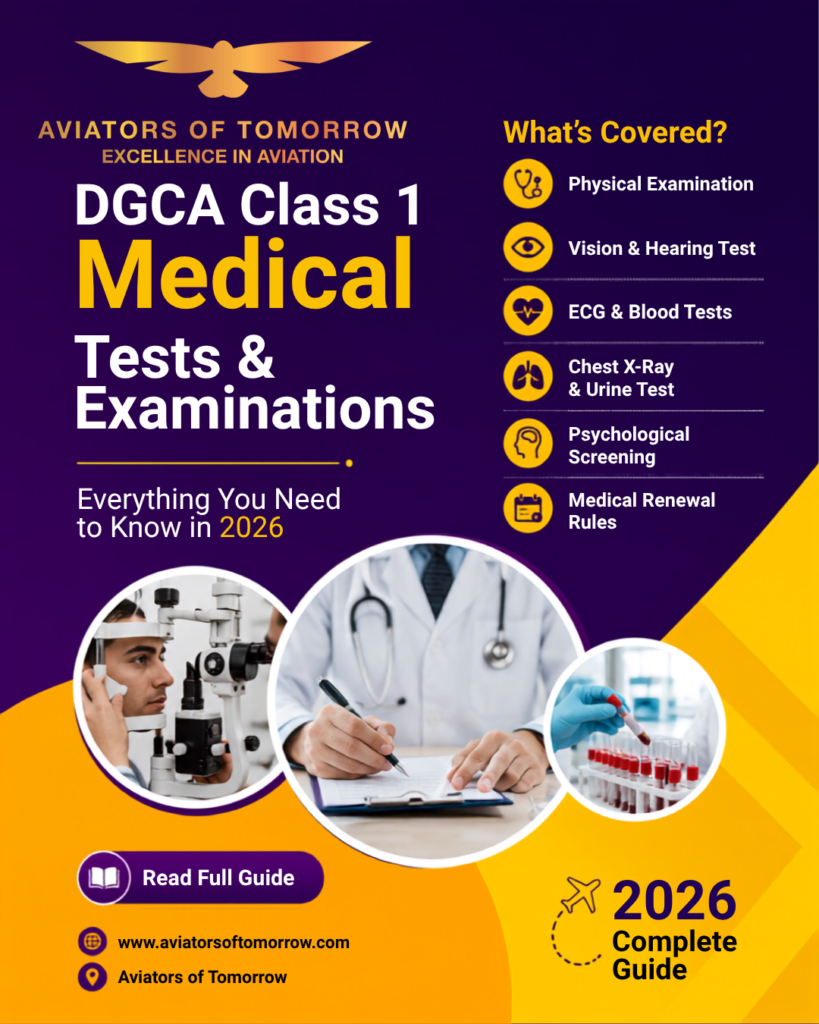
Now let’s get into the main part. Here is a complete, easy to understand breakdown of everything that is checked during the DGCA Class 1 Medical Tests List & Examinations.
1. Physical Examination – The Basic Body Check
The doctor will do a full physical check of your body. This is just like a general health check-up, but more detailed. Here is what is checked:
Height, Weight and BMI
The doctor will measure your height and weight and calculate your BMI (Body Mass Index). BMI tells us if a person is underweight, healthy, overweight or obese.
For pilots, there is no specific height requirement set by DGCA (unlike some other countries). However, you need to be able to comfortably reach all the controls in the cockpit. Being extremely overweight can also be a concern because it may affect your health and fitness.
Blood Pressure and Pulse
Your blood pressure needs to be within a normal range. High blood pressure (also called hypertension) can be dangerous when flying because changes in altitude and stress can make it worse.
Your pulse rate is also checked. A normal resting pulse is between 60-100 beats per minute.
Lungs, Heart and Abdomen
The doctor will use a stethoscope to listen to your heart and lungs. They are checking for:
- Any abnormal heart sounds
- Any breathing problems like asthma or bronchitis
- Any issues with your stomach or digestive organs
Bones and Joints
The doctor will check if you can move your arms, legs and neck properly. This is important because pilots need full range of movement to operate controls.
2. Vision and Hearing Standards – See Clearly, Hear Clearly
Good eyesight and hearing are absolutely essential for pilots. Let’s look at what the DGCA Class 1 Medical Tests List & Examinations require:
Distant Vision
You must be able to see clearly from a distance. The standard is 6/6 vision in both eyes. This can be with or without glasses (spectacles or contact lenses). 6/6 is basically what we call “perfect vision.”
If you wear glasses, don’t worry. You can still become a pilot as long as your corrected vision (with glasses) reaches the 6/6 standard. However, there are some limits on how strong your prescription can be.
Near Vision
You must be able to read clearly at close distances – like reading the instrument panel in a cockpit. Again, this can be with or without glasses.
Colour Vision
This is where many students face challenges. You must have normal colour vision. Pilots need to read coloured lights on runways, cockpit instruments and warning signals. Colour blindness is usually a disqualifying condition, though certain mild forms can be re-tested.
If you are worried about colour vision, get a colour blindness test (called an Ishihara Test) done at any eye clinic. It is quick and easy.
Hearing
You must be able to clearly hear a normal conversation from at least a few meters away. Pilots communicate constantly via radio and they need sharp hearing for safety.
Your hearing is tested using an audiometry test – you sit in a quiet room, wear headphones and press a button every time you hear a sound.
3. ECG, Blood Tests and Lab Investigations
This is one of the most detailed parts of the DGCA Class 1 Medical Tests List & Examinations. Various lab tests are done to check your internal health.
ECG (Electrocardiogram)
An ECG checks the electrical activity of your heart. It tells the doctors if your heart is beating in a regular rhythm or if there is any abnormality.
The test is completely painless. Small sticky pads are placed on your chest, arms and legs and a machine records your heart’s activity on a piece of paper. It takes only about 5-10 minutes.
Blood Tests
Several blood tests are done:
- Blood Sugar (Glucose): Checks for diabetes. High blood sugar over time can damage nerves and vision, which are critical for pilots.
- Cholesterol Levels: High cholesterol increases the risk of heart disease. This is a concern for long-term pilot fitness.
- Complete Blood Count (CBC): Checks for anemia (low hemoglobin), infections and other blood disorders.
- Liver Function Tests: Checks if your liver is healthy.
- Kidney Function Tests: Checks if your kidneys are working properly.
- Thyroid Tests: An overactive or underactive thyroid can affect mood, energy and concentration.
Urine Test
A urine test is done to check:
- Kidney health
- Presence of protein or glucose in urine (can indicate kidney disease or diabetes)
- Signs of urinary tract infections
Chest X-Ray
A chest X-ray is taken to get a clear picture of your lungs and heart. The doctors will check for:
- Tuberculosis (TB)
- Lung infections
- Any unusual growths or shadows
- Size and shape of the heart
This is a standard test, similar to what doctors do during a regular health check-up.
4. Psychological Screening and Mental Fitness
Flying is not just about physical strength. A pilot’s mental health is equally important. This is why psychological screening is a part of the DGCA Class 1 Medical Tests List & Examinations.
Why is this important? Think about it – a pilot may face sudden engine failure, bad weather, navigation errors or demanding passengers. They need to stay calm and make quick, smart decisions. A mentally unstable pilot could put everyone at risk.
Here is what the psychological screening checks:
Stress Handling
How do you react under pressure? Are you the kind of person who panics or the kind who stays calm? Pilots need to handle stress in a controlled and professional way.
Memory and Attention Tests
Pilots need to remember hundreds of procedures, checklists and instructions. Tests are done to check short-term memory and concentration. These are like simple puzzles or tasks that test how well you pay attention.
Personality Check
This is not to judge your character. It is to understand how you behave in team situations, how you take responsibility and whether you are mentally suited for a high-pressure job.
Good News for Students
Most students who are generally emotionally healthy will pass the psychological screening easily. The screening is not meant to disqualify you for normal nervousness or stress, everyone feels nervous. It is looking for serious conditions that could affect flight safety.
How Often Do You Need to Renew the Class 1 Medical?
Once you clear the DGCA Class 1 Medical Tests List & Examinations, you will receive a Class 1 Medical Certificate. But this is not a one time thing. The certificate has an expiry date and you must renew it regularly.
- Under 40 years of age: Renewal every 12 months (1 year)
- 40 years and above: Renewal every 6 months
As a student right now, you have plenty of time before this becomes relevant. But it’s good to know that pilots have to stay healthy throughout their career; it’s not a one time exam.
Tips to Prepare for the DGCA Class 1 Medical Start Now
If you are in Class 10th or 12th and you want to become a pilot, here are some simple, practical tips to stay healthy and be ready:
Take Care of Your Eyes
- Reduce screen time (mobile and laptop)
- Eat foods rich in Vitamin A – like carrots, spinach and eggs
- Never read in dim light
- Get regular eye check-ups
- Avoid rubbing your eyes excessively
Stay Physically Active
- Exercise regularly – walking, jogging, swimming or any sport you enjoy
- Maintain a healthy weight and BMI
- Avoid junk food, smoking and alcohol – these damage your heart and lungs
Take Care of Your Heart
- Eat a balanced diet with less oily and salty food
- Avoid stress through meditation or yoga
- Get enough sleep every night (7-8 hours)
Mental Health Matters
- Talk to friends and family if you feel stressed
- Read books, meditate or pursue hobbies that keep your mind calm
- Avoid overthinking or anxiety
Get Regular Check-Ups
- Visit a doctor once a year for a general health check-up
- If you have any existing conditions (like asthma, diabetes or vision problems), discuss them with your doctor early
Common Myths About DGCA Class 1 Medical
Myth 1: “If I wear glasses, I cannot become a pilot.” FACT: This is false. You can wear glasses or contact lenses and still be eligible, as long as your corrected vision meets the 6/6 standard.
Myth 2: “The psychological test is like a lie detector and they will know everything about me.” FACT: It is a simple personality and attention test. There is no lie detector involved. Just be honest and natural.
Myth 3: “One failed test means my pilot dream is over.” FACT: Not necessarily. Some conditions can be treated or managed. Some tests can be repeated. Always consult a DGCA-approved medical officer before giving up.
You May Read Our Blog “Which Stream is Best for Becoming a Pilot in India?“
Final Words Your Dream Is Within Reach
The DGCA Class 1 Medical Tests LIst & Examinations might seem like a big hurdle, but remember thousands of pilots clear it every year and go on to have amazing careers in aviation. The key is to start taking care of your health today, while you are young.
If you are in Class 10th or 12th right now, you have a golden opportunity. Build healthy habits, study hard for your science subjects Physics especially and keep your aviation dream alive.
The cockpit is waiting for you. Take care of yourself and one day, that captain’s uniform will be yours.