The Instrument Landing System is one of the most critical navigation tools in modern aviation. Whether you are a student pilot or a seasoned aviator, understanding how an instrument landing system works can be the difference between a safe touchdown and a serious incident. For aviators of tomorrow, mastering ILS technology is not optional, it is essential.
Every year, thousands of aircraft land safely in low visibility conditions, thick fog and heavy rain all thanks to the precision guidance of an instrument landing system. This ground-based radio navigation technology has saved countless lives and continues to serve as the backbone of precision approach procedures across global airports.
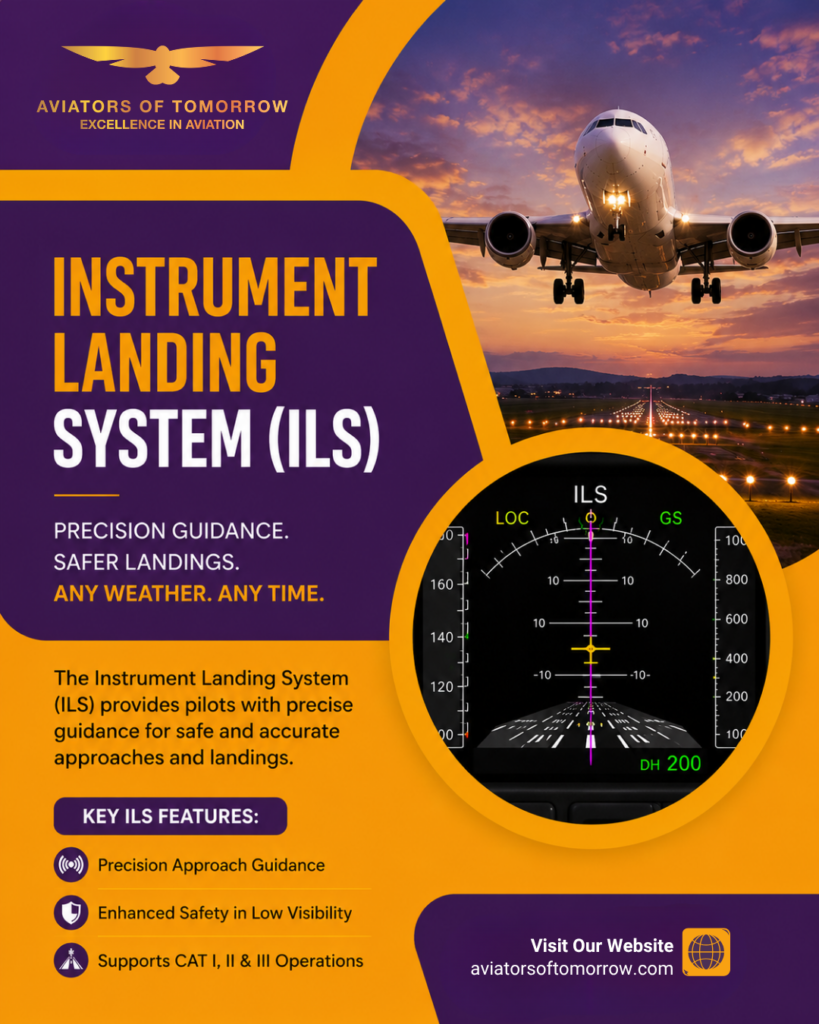
Table of Contents
How Does an Instrument Landing System Work
The instrument landing system operates through two core components that work in harmony: the localiser and the glide slope.
Localiser provides horizontal guidance. It transmits a radio signal along the extended centreline of the runway, keeping the aircraft aligned perfectly with the landing strip.
Glide Slope provides vertical guidance. It transmits a signal at a standard angle of approximately 3 degrees, directing the aircraft downward at the correct rate of descent towards the runway threshold.
Together, these two signals create an invisible electronic pathway in the sky, a precision approach corridor that pilots follow using their cockpit instruments. The ILS approach allows pilots to descend safely even when they cannot see the runway until the very last moment.
Additional components include:
- Marker Beacons — outer, middle and inner markers that signal distance from the runway
- Distance Measuring Equipment (DME) — provides range information to the runway
- Approach Lighting Systems — visual aids that assist during the final stages of landing
ILS Categories Explained for Student Pilots
Not all instrument landing systems are equal. The International Civil Aviation Organisation (ICAO) classifies ILS into three main categories based on visibility minimums and decision heights.
Category I (CAT I)
The most common ILS category found at airports worldwide. CAT I allows a decision height of 200 feet with a runway visual range of at least 550 metres. Most commercial aircraft operations rely on CAT I approaches during routine flight operations.
Category II (CAT II)
CAT II lowers the decision height to between 100 and 200 feet with a runway visual range of 300 metres. This category requires additional aircraft avionics, pilot training and airport ground equipment. Precision approach procedures under CAT II are significantly more demanding.
Category III (CAT III)
This is the most advanced level of instrument landing system capability. CAT III is further divided into:
- CAT IIIa — Decision height below 100 feet, RVR at least 175 metres
- CAT IIIb — Decision height below 50 feet or no decision height, RVR as low as 50 metres
- CAT IIIc — Zero visibility, zero decision height (rarely implemented operationally)
CAT III operations are what make autoland systems possible. Autoland technology works in conjunction with the ILS to bring an aircraft down completely automatically in near zero visibility.
Don’t let opportunity fly away—secure your aviation scholarship today.
Stand a chance to win 100% scholarship & start training with India’s trusted aviation institute. Apply & Check Eligibility.
Apply Now!The Role of ILS in Aviation Safety
Aviation safety depends heavily on reliable navigation infrastructure and the instrument landing system sits at the heart of that infrastructure. Since its widespread adoption in the mid-20th century, ILS has dramatically reduced approach and landing accidents worldwide.
According to aviation safety data, approach and landing accidents account for a disproportionate share of fatal aviation incidents. The instrument landing system directly addresses this risk by providing continuous, real time guidance during the most critical phase of flight.
For commercial aviation, airlines are required to carry out regular ILS checks and airports must maintain ILS ground equipment to strict ICAO and Civil Aviation Authority (CAA) standards. Even a minor signal error can trigger a go around demonstrating just how precise the system must be.
Instrument Landing System vs RNAV Approaches
Modern aviation has introduced RNAV approaches (Area Navigation) and RNP approaches (Required Navigation Performance) as alternatives to the traditional instrument landing system. These satellite-based approaches use GPS and onboard flight management systems to guide aircraft along curved paths that ILS cannot replicate.
However, the instrument landing system remains superior in one key area: precision. RNAV and RNP approaches are typically non-precision or approaches with vertical guidance, whereas ILS is a true precision approach system verified by ground-based radio signals. In high-traffic airports with demanding weather conditions, the ILS approach remains the gold standard.
Many airports now operate both ILS and RNAV approaches simultaneously, allowing air traffic control to assign the most appropriate procedure depending on traffic flow, weather and aircraft capability.
How Pilots Fly an ILS Approach
Flying an instrument landing system approach is a structured process that demands concentration, discipline and thorough preparation. Here is a simplified breakdown of what happens in the cockpit:
1. Briefing the Approach Before commencing descent, pilots brief the ILS approach plate. This includes reviewing the ILS frequency, inbound course, decision height, missed approach procedure and airport weather.
2. Tuning and Identifying the ILS Pilots tune the ILS frequency into the navigation radio and confirm the Morse code identifier. This step is crucial tuning the wrong frequency could lead to following an incorrect glide path.
3. Intercepting the Localiser As the aircraft is vectored by air traffic control, pilots intercept the localiser signal and track the centreline inbound. The course deviation indicator (CDI) needle centres on the instrument.
4. Intercepting the Glide Slope Once established on the localiser, pilots capture the glide slope signal and begin descent. Power and pitch adjustments maintain the correct descent profile.
5. Flying to Decision Height Pilots monitor the instruments while scanning for visual references. At decision height, a go-around is mandatory if the runway environment is not visible.
6. Landing or Go-Around If visual contact is established, the landing proceeds. If not, the missed approach procedure is executed immediately.
ILS Training for Aviators of Tomorrow
If you are pursuing a career in aviation, ILS training will form a major part of your instrument rating syllabus. The UK Civil Aviation Authority requires pilots to demonstrate instrument approach proficiency as part of the Instrument Rating (IR) and Multi-Crew Pilot Licence (MPL) examinations.
Simulator training plays a vital role here. Modern full-flight simulators replicate ILS signal behaviour with extraordinary accuracy, allowing pilots to practise CAT II and CAT III approaches in simulated fog, rain and crosswinds without any risk.
Key skills developed during ILS training include:
- Cross-checking multiple flight instruments simultaneously
- Managing cockpit automation including autopilot and autothrottle
- Applying proper crew resource management during high-workload approach phases
- Executing precise go-around procedures when visual contact is not achieved
For student pilots, the instrument landing system represents a gateway to the professional aviation world. Mastering it early builds confidence, discipline and the technical foundation required for airline operations.
Common ILS Errors and How to Avoid Them
Even experienced pilots can make errors during an ILS approach. Understanding the most common mistakes helps aviators at all levels fly more precisely.
Chasing the Needles One of the most frequent errors is over-correcting. When the localiser or glide slope needle deflects, pilots sometimes apply excessive input, causing the aircraft to oscillate. The correct technique is small, smooth corrections made early.
Late Configuration Arriving at the final approach fix with gear and flaps not set is a common issue. Proper approach preparation well before the final fix avoids this entirely.
Ignoring Raw Data In highly automated aircraft, pilots can become over-reliant on the flight director and autopilot. Monitoring raw ILS needle data independently ensures accuracy and builds genuine understanding of the precision approach.
Skipping the Identification Check Never assume the correct ILS frequency is tuned. Always verify the Morse code identification before commencing the instrument approach.
The Future of Instrument Landing Systems
As aviation evolves, so does approach technology. The instrument landing system faces competition from newer systems such as the Ground Based Augmentation System (GBAS) and Microwave Landing System (MLS). GBAS, in particular, uses GPS augmentation to deliver precision approach guidance comparable to ILS, but with greater flexibility in approach angles and paths.
Despite this, the instrument landing system is not disappearing anytime soon. The global infrastructure investment in ILS ground equipment is enormous and the system’s proven reliability means it will remain a dominant force in aviation for decades to come. Many aviation authorities project that ILS and GBAS will operate side by side well into the 2040s.
For aviators of tomorrow, learning the instrument landing system is therefore both a practical necessity today and a historical foundation for understanding where aviation navigation is headed.
You May Read Our Blog “FADEC: The Brain Behind Modern Aircraft Engines“
Key Takeaways for Every Aspiring Pilot
The instrument landing system is far more than a technical subject in your ground school syllabus. It represents the fusion of engineering precision, regulatory standards and airmanship that defines professional aviation.
To summarise:
- The instrument landing system provides both lateral and vertical guidance during approach
- ILS categories range from CAT I to CAT III, each with different visibility minimums
- ILS approaches are the gold standard for precision landings at major airports
- Training on ILS builds the foundation for airline-level instrument approach proficiency
- Future systems like GBAS will complement, not immediately replace, the ILS
Whether you are sitting in a classroom, flying a simulator, or lining up on final approach at a real airport, respect the instrument landing system. It is one of aviation’s finest achievements and your greatest ally when the clouds close in.
Your dream career in aviation starts with one application—apply for your scholarship today.
Stand a chance to win 100% scholarship & start training with India’s trusted aviation institute. Apply & Check Eligibility.
Apply Now!