The GPWS warning modes are one of the most critical safety systems ever introduced in commercial and private aviation. Whether you are a student pilot or an experienced aviator, understanding the ground proximity warning system is non-negotiable. These automated alerts have saved thousands of lives by warning flight crews of dangerous situations before it is too late.
In this blog, we break down every GPWS warning mode, explain how the terrain avoidance system works and give you the knowledge you need to respond correctly in the cockpit.
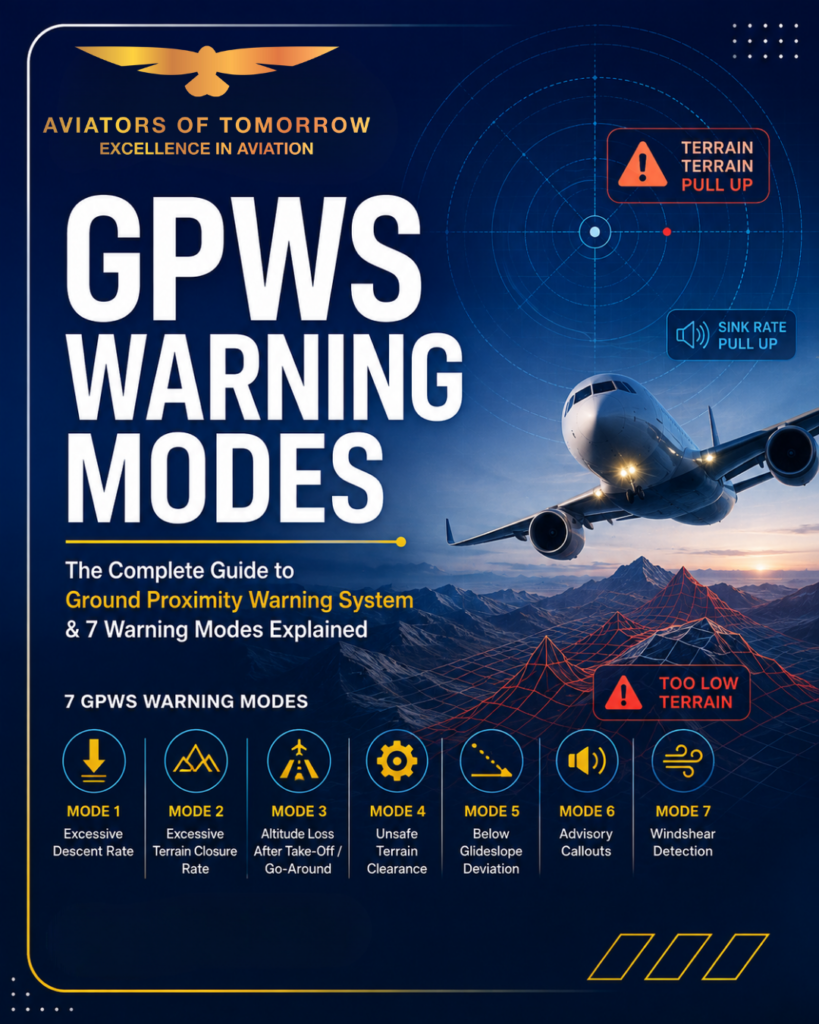
Table of Contents
What Is GPWS? A Quick Overview
The Ground Proximity Warning System, commonly known as GPWS, is an onboard avionics system designed to alert pilots when the aircraft is in danger of controlled flight into terrain (CFIT). Introduced in the 1970s following a series of fatal accidents, the system monitors flight parameters such as altitude, descent rate, gear position and flap configuration to detect unsafe conditions.
The modern version, known as Enhanced GPWS (EGPWS), adds a terrain database and GPS to provide even earlier warnings, making it far more effective than the original design.
The 7 Core GPWS Warning Modes Explained
Mode 1 – Excessive Descent Rate
This is perhaps the most well-known of all GPWS warning modes. Mode 1 triggers when the aircraft is descending too rapidly relative to its altitude above ground. The cockpit alert sounds “SINK RATE” followed by “PULL UP” if the situation worsens.
Key triggers:
- Descent rate exceeding limits at low altitude
- No gear or flap extension requirement
This mode is purely reactive to barometric descent rate and radio altimeter data.
Mode 2 – Excessive Terrain Closure Rate
Mode 2 activates when the aircraft is closing in on rising terrain at an unsafe speed. This is particularly relevant when flying over mountainous terrain or during instrument approaches in poor visibility.
The terrain closure warning provides the crew with an audible “TERRAIN, TERRAIN – PULL UP” alert, demanding immediate action.
Mode 3 – Altitude Loss After Take-Off or Go-Around
Mode 3 monitors for significant altitude loss shortly after take-off or during a missed approach. If the aircraft loses altitude while the gear is still retracting, the system triggers a “DON’T SINK” warning.
This is especially important for multi-engine failure scenarios or during degraded aircraft performance.
Mode 4 – Unsafe Terrain Clearance
Mode 4 is split into sub-modes based on flap and gear configuration:
- Mode 4A – Gear not down at low altitude
- Mode 4B – Flaps not in landing position at low altitude
- Mode 4C – Terrain proximity during cruise at low altitude
The alert sounds “TOO LOW – TERRAIN” or “TOO LOW – GEAR”, prompting the crew to reconfigure the aircraft or climb immediately.
Mode 5 – Below Glideslope Deviation
Mode 5 activates during an ILS approach when the aircraft descends significantly below the glideslope. The alert sounds “GLIDESLOPE” repeatedly, increasing in volume as deviation grows.
This approach warning system prevents runway undershoot and is particularly relevant during low-visibility operations where visual cues are limited.
Mode 6 – Advisory Callouts
Mode 6 is an advisory mode rather than a warning. It provides automated altitude callouts such as:
- “MINIMUMS”
- “DECISION HEIGHT”
- “ONE HUNDRED”
- “FIFTY, FORTY, THIRTY, TWENTY, TEN”
These radio altitude callouts assist the crew during the final stages of approach and are a standard feature across modern commercial aircraft.
Mode 7 – Windshear Detection
Mode 7 monitors for sudden changes in airspeed and vertical speed consistent with windshear. The alert sounds “WINDSHEAR, WINDSHEAR, WINDSHEAR” and is accompanied by visual cues on the Primary Flight Display.
Windshear avoidance is a critical skill, as this meteorological hazard can cause rapid loss of lift during approach or departure, leaving little time for crew response.
Stay prepared. Understand GPWS Warning Modes and make every flight safer.
Stand a chance to win 100% scholarship & start training with India’s trusted aviation institute. Apply & Check Eligibility.
Apply Now!Enhanced GPWS (EGPWS) The Next Generation
The Enhanced Ground Proximity Warning System builds upon the original GPWS by integrating:
- GPS positioning
- Worldwide terrain database
- Airport obstacle database
- Geometric altitude calculations
With EGPWS, the system can predict terrain conflicts well in advance rather than only reacting to present conditions. The terrain awareness and warning system (TAWS) classification used by ICAO and aviation regulators worldwide is largely based on EGPWS technology.
Modern aircraft such as the Boeing 737 NG, Airbus A320 family and ATR turboprops all use EGPWS as standard equipment.
How Pilots Should Respond to GPWS Alerts
Understanding the GPWS warning modes is only half the equation. The correct response is equally vital. Aviation authorities including the CAA (Civil Aviation Authority) in the United Kingdom recommend the following:
Immediate Action Drill
- Disconnect autopilot (if applicable)
- Apply maximum thrust
- Pitch up aggressively to the recommended escape manoeuvre attitude
- Retract speed brakes
- Do not pause to query the warning respond first, investigate later
The golden rule in CFIT prevention is: never ignore a GPWS alert. History has shown that hesitation in responding to these warnings has contributed to fatal accidents.
Common Causes of GPWS Nuisance Alerts
While the system is highly reliable, nuisance warnings do occur. Understanding the causes helps pilots distinguish genuine alerts from false ones:
- Steep visual approaches not aligned with ILS
- Gear-up touch and go circuits
- Incorrect QNH setting causing barometric errors
- Unusual aircraft configurations during training
Operators are advised to report nuisance alerts through their Safety Management System (SMS) to allow manufacturers to refine alerting logic over time.
GPWS in General Aviation What You Need to Know
GPWS and TAWS are no longer exclusive to commercial aviation. Lightweight portable TAWS units and integrated avionics such as the Garmin G1000 and Avidyne Entegra now bring terrain awareness to general aviation pilots.
In the UK, the CAA strongly recommends terrain awareness equipment for any aircraft operating in mountainous or hilly terrain, particularly in Scotland, Wales and the Lake District.
Training Requirements for GPWS Competency
Every commercial pilot operating under EASA or UK CAA regulations must demonstrate knowledge and competency in:
- Identifying all GPWS warning modes
- Executing the standard escape manoeuvre
- Understanding EGPWS terrain display interpretation
- Recognising conditions likely to trigger each mode
This training is covered in type rating courses, Line Oriented Flight Training (LOFT) and recurrent simulator checks.
The Future of Ground Proximity Warning Technology
The evolution of flight safety technology continues at pace. Future developments in terrain warning systems include:
- AI-based predictive alerting using machine learning
- Real-time terrain updates via satellite data link
- Integration with ATC surveillance for enhanced situational awareness
- Urban Air Mobility (UAM) TAWS for drones and electric air taxis
As aviation moves into a new era, the principles behind GPWS warning modes will remain central to safe flight operations, even as the technology evolves beyond recognition.
Key Takeaways for Tomorrow’s Aviators
| Mode | Alert Trigger | Audible Warning |
| Mode 1 | Excessive descent rate | SINK RATE / PULL UP |
| Mode 2 | Terrain closure rate | TERRAIN / PULL UP |
| Mode 3 | Altitude loss after T/O | DON’T SINK |
| Mode 4 | Unsafe terrain clearance | TOO LOW GEAR/TERRAIN |
| Mode 5 | Below glideslope | GLIDESLOPE |
| Mode 6 | Altitude callouts | MINIMUMS / DECISION HEIGHT |
| Mode 7 | Windshear detected | WINDSHEAR |
You May Read Our Blog “Instrument Landing System: The Ultimate Guide“
Final Thoughts on GPWS Warning Modes
The GPWS warning modes represent decades of hard-won lessons from accidents that should never be repeated. For every aviator pursuing a career in the skies, mastering this system is not simply a regulatory requirement it is a professional and moral obligation. These seven modes, combined with the advances of EGPWS and TAWS, form the backbone of controlled flight into terrain prevention worldwide.
Respect the warning. Execute the drill. Fly safely.
Master GPWS Warning Modes to enhance situational awareness and build a safer aviation career.
Stand a chance to win 100% scholarship & start training with India’s trusted aviation institute. Apply & Check Eligibility.
Apply Now!