RNP approach aviation is one of the most important topics in modern pilot training. Whether you are a student pilot preparing for your instrument rating or an airline cadet heading towards your first type rating, understanding RNP approach aviation will give you a clear edge in both your exams and your flying career.
Required Navigation Performance commonly called RNP is a type of precision navigation where the aircraft follows an extremely accurate flight path and simultaneously monitors its own navigation performance. If the accuracy drops below the required level, the system immediately alerts the flight crew. This self monitoring ability makes RNP approach aviation far more reliable and safe than older traditional navigation methods.
In today’s rapidly evolving aviation industry, performance based navigation is the global standard and RNP sits right at the heart of it.
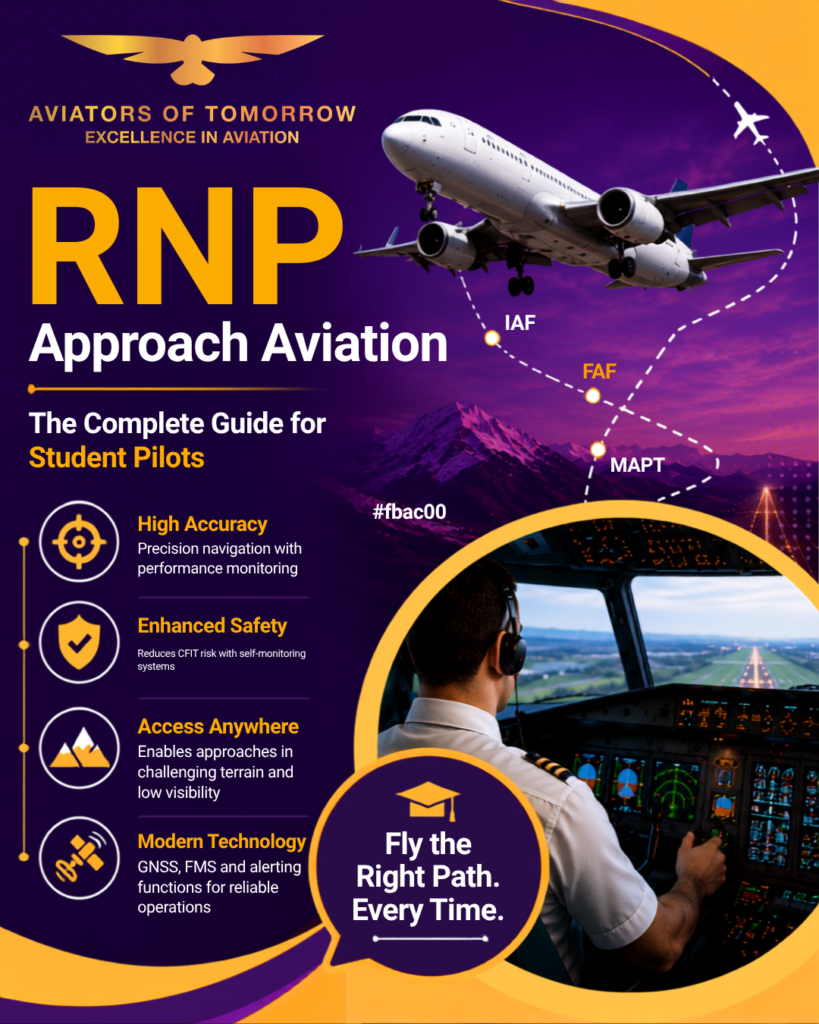
Table of Contents
What Makes RNP Approach Aviation Different?
Old Navigation vs RNP Navigation
Traditional approaches such as VOR and NDB procedures guided pilots using ground-based radio signals. These systems had limitations terrain interference, equipment dependency, and poor accuracy in bad weather. They could not monitor themselves, and pilots had no automatic warning if the guidance became unreliable.
The RNP approach to aviation changed everything. By combining GNSS satellite navigation with advanced onboard avionics and a Flight Management System, RNP delivers highly precise lateral and vertical guidance. More importantly, it continuously checks its own accuracy through a function called containment integrity and instantly alerts the crew if performance degrades.
This is the core difference every student pilot and airline cadet must understand:
RNAV tells you where to go. RNP tells you where to go AND confirms it is doing so accurately.
Types of RNP Approaches Explained Simply
RNP APCH – Standard Precision Approach
RNP APCH is the most widely used RNP approach procedure globally. It requires a lateral accuracy of 0.3 nautical miles on the final approach segment. For student pilots studying for their instrument rating, RNP APCH is the foundational procedure to master first.
It replaces older VOR and NDB approaches at thousands of airports and works effectively even in poor visibility conditions, making it a critical skill for any professional pilot.
RNP AR APCH – Advanced Authorisation Required Approach
RNP AR approach is the most sophisticated level of RNP approach aviation. With accuracy requirements as tight as 0.1 nautical miles, it enables aircraft to fly curved approach paths using RF (Radius-to-Fix) legs. This allows approaches around mountains, obstacles, and complex terrain that would be impossible with conventional navigation.
Airports in the Himalayan region, Southeast Asia, and mountainous parts of Europe rely on RNP AR procedures to safely land commercial aircraft every day. Airline cadets will frequently encounter these during simulator training on the Airbus A320 or Boeing 737.
LPV Approaches – Entry Level Precision Navigation
LPV (Localiser Performance with Vertical Guidance) approaches share core characteristics with RNP approach aviation and are commonly available on modern glass-cockpit training aircraft. For student pilots flying Garmin equipped aircraft, LPV approaches are often the first real experience of satellite based precision navigation.
How RNP Approach Systems Work
Understanding the technology behind RNP approach aviation is essential for exams and real world operations. Here is a simple breakdown of the key components:
GNSS Receiver Receives signals from navigation satellites to calculate the aircraft’s precise position throughout the RNP approach procedure
Flight Management System (FMS) Processes satellite data and generates accurate lateral and vertical guidance along the programmed RNP approach path
Alert Function Continuously monitors actual navigation performance (ANP) and compares it against the required threshold the core feature that defines RNP approach aviation
RF Leg Capability Enables curved flight paths during RNP AR approach operations, making complex terrain constrained approaches possible
Think of it this way: if GPS navigation is like Google Maps, then RNP approach aviation is like Google Maps with a built in safety alarm that tells you the moment directions become unreliable.
Master RNP Navigation. Build Your Future in Aviation.
Stand a chance to win 100% scholarship & start training with India’s trusted aviation institute. Apply & Check Eligibility.
Apply Now!Why RNP Approach Aviation Is Critical for Your Pilot Career
Safety Comes First
RNP approach aviation directly reduces the risk of Controlled Flight Into Terrain (CFIT) , one of the most dangerous accident categories in commercial aviation history. By providing continuous vertical guidance and real time performance monitoring, RNP precision approach procedures offer a far safer alternative to traditional non precision approaches.
Every airline, every regulator, and every safety organisation in the world supports the wide-scale adoption of RNP navigation procedures precisely because of this safety benefit.
Better Access to Challenging Airports
RNP approach procedures have made it possible to operate safely into airports that were previously unreliable or inaccessible in poor weather. Remote communities, mountain airports, and congested urban hubs all benefit from advanced RNP navigation that delivers precision even where terrain or obstacles make conventional approaches dangerous.
Fuel Savings and Environmental Benefits
RNP approach aviation enables optimised descent profiles particularly Continuous Descent Approaches (CDA) that significantly reduce fuel burn, engine noise, and carbon emissions. Airlines using RNP based approach optimisation consistently report lower operating costs and a reduced environmental footprint.
Lower Weather Minimums
RNP AR approach minimums can be dramatically lower than conventional procedures, sometimes allowing decision altitudes as low as 200 feet with reduced visibility requirements. This translates directly into fewer diversions, fewer cancellations, and better overall flight operation reliability.
RNP Approach Aviation and DGCA Standards
Performance-Based Navigation in India
The DGCA follows ICAO standards and actively promotes Performance-Based Navigation (PBN) implementation across Indian airspace. As part of India’s commitment to ICAO’s global PBN roadmap, RNP approach procedures are being adopted at airports across the country.
Modern Indian carriers operating Airbus A320 and Boeing 737 fleets use RNP approach systems on a daily basis. Understanding DGCA navigation requirements and how they align with ICAO PBN standards is essential for any cadet entering airline operations in India.
Key Document Every Student Must Study
ICAO Document 9613 – the Performance-Based Navigation Manual is the most important reference for RNP approach aviation theory. It is freely available online and is directly referenced by the DGCA and every major aviation authority worldwide. Pair your study of this document with the relevant DGCA Civil Aviation Requirements (CAR) and you will be thoroughly prepared.
RNP Approach Training What to Focus On
Ground School Essentials
When preparing for your instrument rating or CPL examinations, prioritise these topics:
- Fundamentals of GNSS and satellite navigation for pilots
- The difference between RNAV and RNP navigation standards
- RAIM (Receiver Autonomous Integrity Monitoring) and its role in RNP approach safety
- FMS programming and RNP approach setup procedures
- ICAO PBN concepts and performance-based navigation regulations
Simulator Training Priorities
During type rating on modern commercial aircraft, your simulator will include comprehensive RNP approach procedure practice. Focus especially on:
- Accurate FMS programming for RNP approach operations
- Go-around execution from RNP instrument approaches
- Effective crew coordination during RNP approach briefings
- Correct response to navigation performance alerts
Common Misconceptions About RNP Approach Aviation
“RNAV and RNP are the same thing” They are not. Basic RNAV provides area navigation guidance but has no self monitoring capability. RNP approach aviation adds the critical alerting and integrity monitoring function that RNAV lacks entirely.
“A basic GPS is enough for RNP” A consumer GPS or basic aviation GPS does not meet RNP avionics requirements. Certified RNP navigation systems require integrity monitoring, FMS integration, and approved avionics meeting specific performance standards.
“RNP means you do not need raw instrument skills” This is one of the most dangerous misconceptions. RNP approach aviation is a highly capable tool but raw instrument flying skills and solid airmanship remain absolutely essential, especially when automation fails.
The Future of RNP Approach Aviation
Next Generation Air Traffic Management
Performance-based navigation and RNP approach aviation sit at the core of next generation air traffic management programmes globally. Tighter separation standards, more efficient routing, and increased airspace capacity all depend on the widespread adoption of RNP navigation procedures.
Urban Air Mobility
As eVTOL (electric vertical take-off and landing) aircraft move towards certification for urban operations, RNP navigation standards are being adapted for low-altitude city environments. The pilots of tomorrow may well fly autonomous RNP approaches into rooftop vertiports guided by the same fundamental principles taught in flight schools today.
Growing Relevance in Asian Airspace
Asia Pacific airspace, one of the busiest and fastest growing aviation regions in the world, is rapidly expanding its RNP approach procedure network. For pilots building careers in this region, expertise in RNP approach aviation is quickly becoming a baseline expectation rather than an advanced skill.
Quick Revision Table – RNP Approach Aviation Key Facts
| Topic | Key Point |
| Full Form | Required Navigation Performance |
| Primary Technology | GNSS Satellite Navigation |
| Unique Feature | Self-monitoring with alert function |
| RNP APCH Accuracy | 0.3 NM on final approach segment |
| RNP AR Accuracy | As precise as 0.1 NM |
| Key Regulatory Body | ICAO / DGCA aligned PBN standards |
| Core Study Document | ICAO Doc 9613 – PBN Manual |
| Aircraft System | FMS + GNSS + Alerting Function |
You May Read Our Blog “Flare Technique Aircraft: The Art of a Perfect Landing“
Final Word Why You Must Master RNP Approach Aviation Now
RNP approach aviation is not just an exam topic; it is the foundation of modern professional flying. The aviation industry is moving rapidly towards fully performance-based navigation operations, and organisations such as the DGCA and ICAO continue to support the adoption of modern navigation standards. Tomorrow’s pilots need to arrive with strong RNP knowledge and a clear understanding of applicable DGCA requirements.
Whether you are preparing for your instrument rating, heading into your first type rating, or simply building the knowledge base that will carry you through a long and successful flying career, RNP approach aviation deserves your full attention.
The cockpits of tomorrow demand pilots who understand how their systems work at a deep level. Start building that understanding today and strengthen your knowledge of RNP procedures, DGCA standards, and performance-based navigation.
Precision in Navigation. Confidence in the Cockpit
Stand a chance to win 100% scholarship & start training with India’s trusted aviation institute. Apply & Check Eligibility.
Apply Now!